Background: Romancing the Mystic Hills of Darjeeling & Sikkim (Read More)
Day 1: Mumbai – Bagdogra Airport – Ghoom – Dawaipani
Bagdogra – Dawaipani: 75 Kms. / 2.30 Hrs.
Tazo had arrived at Bagdogra from Paro, Bhutan, by 1300 Hrs. MunMun and I followed an hour later, as planned. As expected, we spotted Tazo engrossed in her laptop at the airport terminal. Our attempt to surprise her with MunMun joining us failed, as she had already seen us walking through the gates.
I was travelling with two very different types of tourists. Tazo, despite being on a week-long business trip, carried a small single trolley suitcase. Her choice of clothes was smart, serving both business and casual purposes. In contrast, MunMun had two trolley bags and a slew of other items – a small carry bag slung over her shoulder, wireless headphones around her neck, a neck pillow clasped to the carry bag, and a laptop bag. I wondered how the check-in attendant had allowed MunMun to board with all that baggage. I fell somewhere in between the two of them.
Chetan was waiting for us at the parking lot to drive us to Dawaipani. There were a couple of routes to get there, and Chetan chose the scenic one via Panighata – Pankhabari – Makaibari, a route that wound through tea gardens and the lower Himalayan mountains.


Along the way, we made stops at a couple of tea estates to immerse ourselves in nature. As Tazo became inspired by the natural beauty and meandering trails around the tea bushes, she started capturing the landscape with her camera, slowly shaking off the fatigue from her day-long journey. The tea bushes, were originally brought from China by the Britishers in 1857, spread rapidly across the region.
Darjeeling Heritage Train
Entering the town of Sonada, we found the Hill Cart Road intersecting with the Darjeeling Heritage Train rail-track. We kept our fingers crossed, hoping to catch a glimpse of the famous toy train in motion during our drive. The Darjeeling Himalayan Railway, a UNESCO World Heritage site, is renowned for its charming journey through the Himalayan hills on narrow gauge tracks. The toy train operates between Siliguri and Darjeeling. Its tiny locomotive evokes nostalgia for a bygone era, immortalized in Bollywood movies for its sounds, scents, and romantic allure.
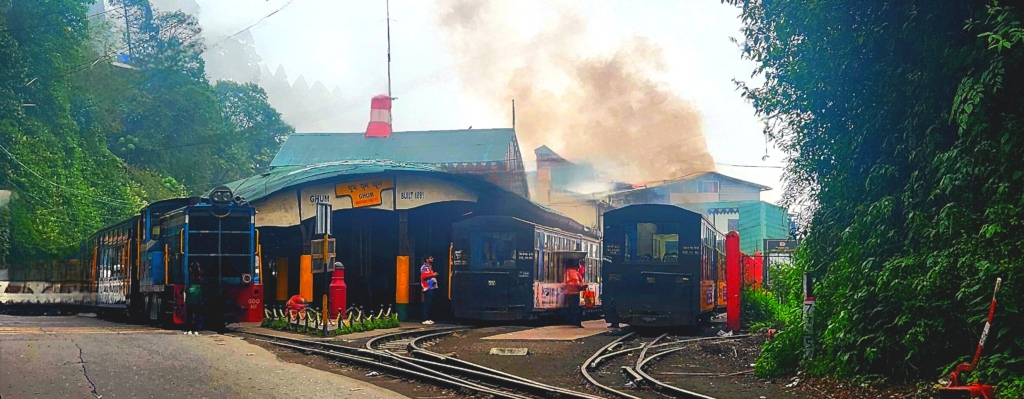
Luck was on our side as we found ourselves driving alongside the toy train, chugging along at a leisurely 10 km/hr. It was a surreal experience. MunMun attempted to capture the moment by recording the train while humming the iconic Bollywood song, “mere sapno ki raani”. However, luck wasn’t entirely with us, as MunMun realized she had forgotten to hit the record button.


As we sang along to “sapno ki rani”, we struck up a conversation with Chetan, curious to learn more about him. He shared his story of eloping with his girlfriend and marrying according to local traditions. Now, he was proud father to his one-year-old son, Nangzong, whose name he had proudly etched on wind-shield of his car. Chetan’s vehicle also sported a meaningful plaque that read, “Tourists Come as a Guest – Leave as a Friend“, a sentiment that struck a chord with me. Could genuine friendship really develop over just a three-hour road trip? Beyond that, he revealed himself as a devoted Manchester United football club fan.
The operational railway line we admired still retained most of its original features, albeit with upgraded diesel engines powering the locomotives. Initially, the toy train dramatically reduced the arduous 10-day journey to Darjeeling to just over two days, but today it takes about eight hours, covering a total distance of about 88 kms. The rail track criss-cross the road at multiple points, approximately 150 such crossings in total. There are no barriers or manual/ automatic arrangement to manage these crossings. Contrary to popular belief that the toy train was primarily for the convenience of English settlers seeking refuge in Darjeeling during the summer, its construction was actually driven by commercial interests. A detailed proposal submitted to the Government of Bengal highlighted how the railway could significantly lower transport costs between Darjeeling and the plains. For instance, rice that sold for Rs. 98 per ton in Siliguri commanded Rs. 238 in Darjeeling, underscoring the economic rationale behind its development.
Since its inception in 1881, the engineers employed bold and ingenious solutions, including curves, loops, and steep grades, ingeniously criss-crossing the road to overcome the challenges posed by the terrain. The narrow gauge and short wheelbase of the locomotive enabled it to negotiate sharp turns without requiring extensive tunnelling or bridging. These engineering feats contributed to its classification as a World Heritage Site. Here’s a fascinating engineering tidbit: the railway ascends from approximately 100 meters (330 ft) at New Jalpaiguri to about 2,200 meters (7,200 ft) at Darjeeling. Achieving this elevation involved utilizing six zig-zag (or reverse) and three loop sections (originally five) to navigate the steep terrain. Legend has it that the zigzag design was inspired by ballroom dancing steps, suggested by the chief contractor’s wife.
Witnessing Tazo and MunMun’s excitement over the toy train, Chetan kindly suggested a detour to the Batasia Loop in Ghoom. The Ghoom railway station, nestled at an altitude of 2,258 meters (7,407 ft), is a distinguished part of the World Heritage Site. Batasia Loop itself is a picturesque park where the toy train gracefully loops around, stopping for tourists to disembark, enjoy the park, and take in the stunning hill views from a panoramic vantage point.
It was delightful to see Tazo and MunMun in such playful spirits, reliving their childhood as they attempted to balance and walk along the single rail track line. If they had more time, they might have perfected the art of the human monorail walk! As the train came to a halt, they eagerly hopped into the vista coach, capturing videos and photographs to immortalize these precious moments. We were thoroughly enjoying ourselves, and the misty weather only added to the charm of the experience.
The weather suddenly became extremely foggy, reducing visibility to just a few meters. I realized I wasn’t alone in sporting shorts in this unexpectedly chilly climate – two guy’s from Chandigarh shared my fashion choice. Despite the romantic atmosphere and the company of two lovely companions, MunMun and Tazo weren’t quite impressed with the sweetness of the cream rolls we had with our first cup of Darjeeling tea. They went in search of something more savoury and stumbled upon a vendor preparing jhaal-moori – a localized twist on Mumbai’s bhelpuri with an extra kick of mustard oil.
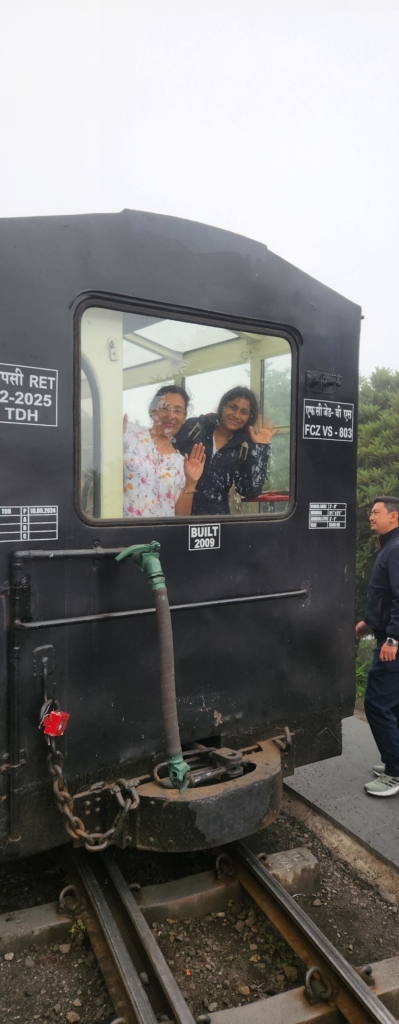


After an enjoyable hour at Ghum, we retraced our path towards our homestay in Dawaipani. As dusk settled and a light drizzle began, we navigated through thickly forested mountainous terrain. Without Chetan’s local knowledge, finding the way to Dawaipani village and our homestay would have been nearly impossible. His guidance proved invaluable as we made our way through the dimly lit, rain-drenched roads.
After Chetan dropped us off at the homestay, he kindly arranged for his friend Ashik to guide us around Dawaipani the next day. We expressed our gratitude for his hospitality and made plans with Ashik to explore the local tourist spots.
Upon reaching the homestay in Dawaipani, we were warmly greeted by Sandeep and his team, who managed the cozy establishment. The homestay was designed with two levels: the ground floor housed the kitchen and staff quarters, while the first floor accommodated 3-4 bedrooms. MunMun, accustomed to Marriott’s standards, was taken aback by the modest bathroom facilities.
I quickly claimed the double bed near the window, despite MunMun’s mild protest and lack of support from Tazo, who was understandably exhausted from her day-long journey and not inclined to engage in any disputes in this “communist land of protest”. The darkness prevented us from enjoying the breathtaking views of the Kanchenjunga range as depicted in signature photographs on homestay’s webpage, which we hoped to experience the following morning.
After refreshing ourselves, Sandeep and his team prepared a simple yet delicious dinner served in the kitchen, piping hot and freshly made. The homestay was bustling with tourists, and we had to clear the dining table quickly to accommodate other guests. Our booking was for only one night.
Following dinner, we moved to the open area under the night sky with our bottle of Chilean wine. Before we knew it, we had emptied the entire bottle, and the details of how we returned to our rooms on the first floor and when we eventually drifted off to sleep are somewhat hazy. Nevertheless, it was a perfect end to our journey from Mumbai to Dawaipani via Ghoom.
Day 2: Dawaipani – Lamahatta – Triveni Point – Gumbadara – Tinchuley
The day began breaking around 4 am in Eastern India, and I couldn’t bear to waste the opportunity to witness the unfolding of nature from the comfort of my bed. Drawing open the curtains, I was greeted by the gentle chirping of birds and dew-kissed window panes.

Tazo was quick to join me in excitement, eager to catch a glimpse of the Kanchenjunga range. MunMun, although still half-asleep, wasn’t about to miss out either. We stood on the balcony, anticipating breathtaking views of the mountains, only to find ourselves enveloped in thick fog. Disappointed yet undeterred, we accepted our fate with Kanchenjunga. Although witnessing the world’s third-highest peak with its golden tip glowing in the morning sun wasn’t the primary goal of our trip, it would have been a truly memorable sight. The theme of our vacation was to escape the Mumbai heat, explore new horizons with a touch of adventure, and immerse ourselves in the local culture. Unfortunately, our elusive encounter with Kanchenjunga persisted throughout our holiday, as dense fog followed us wherever we ventured. Clearly, the seasonal weather wasn’t ideal for a clear view from the eastern front. With the caretakers and other guests still asleep, and the weather pleasant, we decided to take a stroll and explore the neighbourhood.
Dawaipani
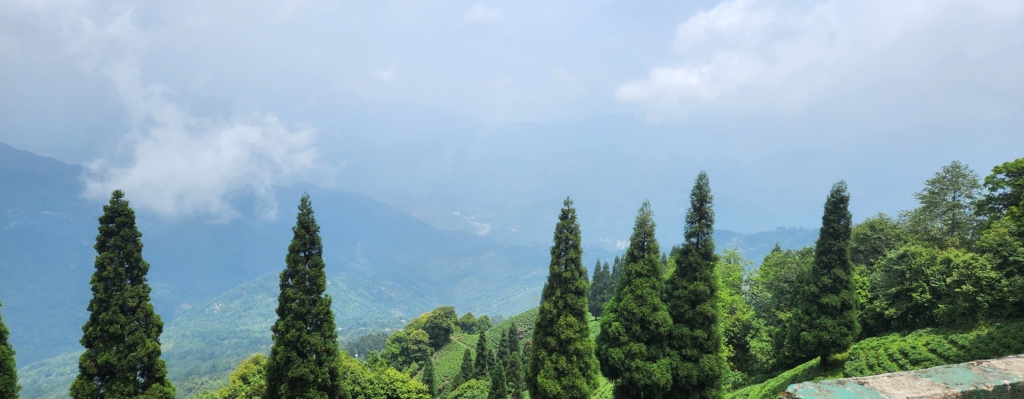
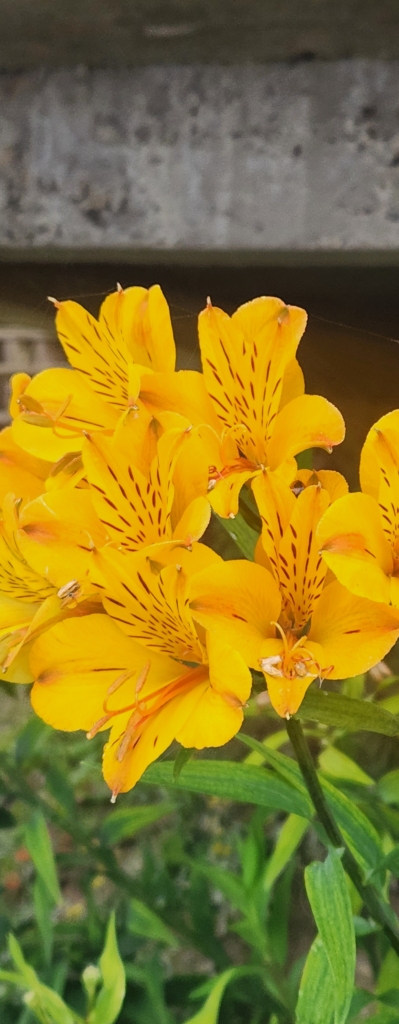
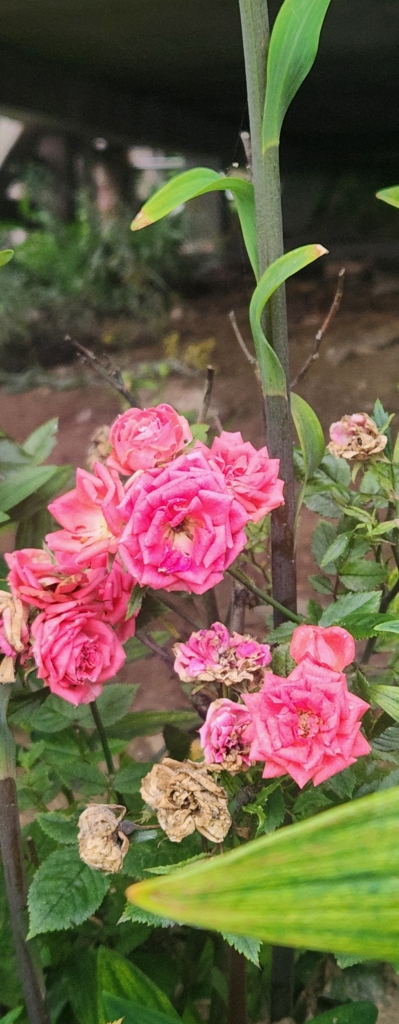
Dawaipani, a tranquil hamlet near Darjeeling, captivated us with its serene tea gardens, verdant forests, and mist-laden mountains. As we wandered, we noticed a few properties under construction for additional homestays – a sign of changing times in this beautiful place. Along our path, vibrant flowers bloomed, and exotic bird calls filled the air, a stark contrast to the urban noises we were accustomed to. MunMun, always playful, began mimicking the birds, receiving equally lively responses from the feathered inhabitants hidden in the bushes. I couldn’t help but wish we had a trained birdwatcher along us to identify these beautiful species. Not that I was complaining – I had two delightful companions, and thankfully, they weren’t hiding in the bushes.


Our homestay was nestled amidst mountains, requiring us to consider that every step downhill exploring the village would mean an uphill return. As we were preparing to head back, two friendly street dogs bounded towards us, eager for some playtime. MunMun, a dedicated dog enthusiast who owns a Dalmatian named “Angel” back home, immediately engaged with them. In contrast, Tazo, known for rescuing neighbourhood cats that seek refuge at her home to deliver kittens, confessed her preference for felines. Personally, I adore both dogs and cats – especially those with fluffy coats I can cuddle. I playfully named the black dog with mischievous eyes “Tiger,” and to my surprise, he obediently followed my commands with affection, contrary to his newly bestowed nickname.

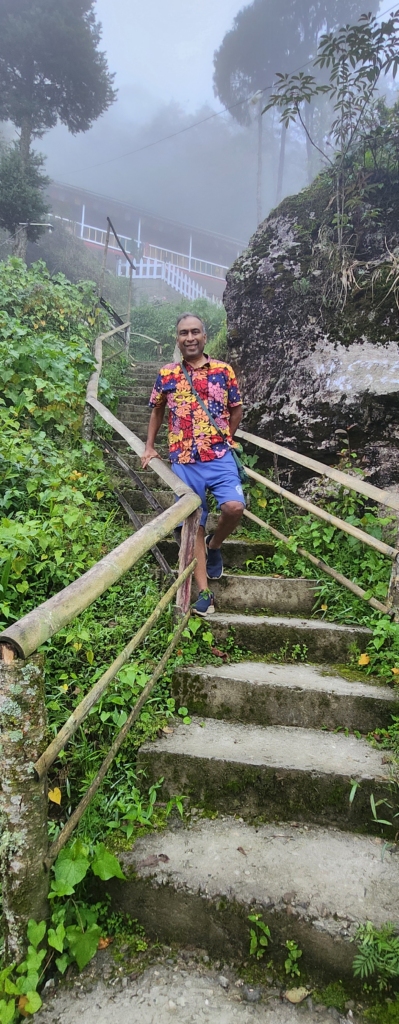
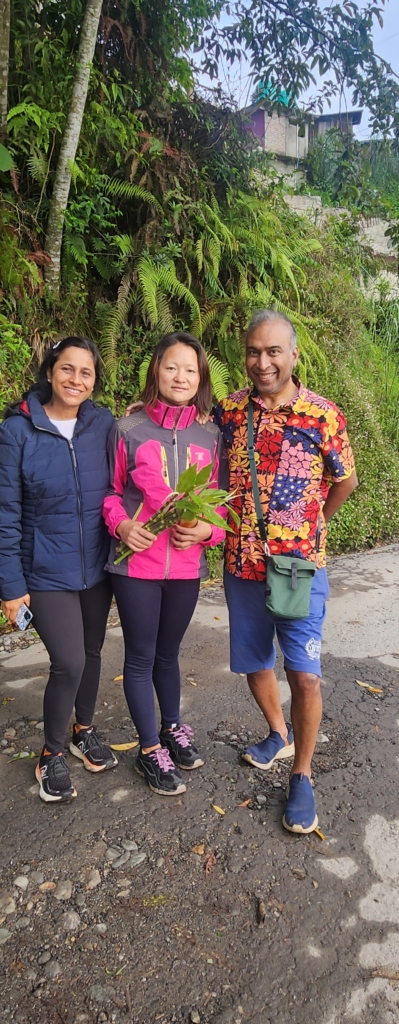
On the way back, we encountered Savitri, returning from her morning walk with a bunch of leafy stems she enthusiastically described as wild vegetables perfect for a delicious dish. On holiday to visit her parents, she shared childhood memories of growing up just a few villages away from Dawaipani. Now, post her marriage, she was staying couple of villages away from Dawaipani. According to her, the true Dawaipani village lay further down the hill, named for its springs renowned for their medicinal properties – a local secret contributing to the village’s timeless allure. With a playful wink, she hinted at the mystique surrounding these hidden springs, which we dubbed as “well-kept secrets with a disguised name”. We snapped some photos with Savitri to commemorate our encounter before bidding her farewell. Throughout this exchange, the dogs trotted alongside us, almost as if guiding us back to our homestay, ensuring we respected the sanctity of the medicinal springs.

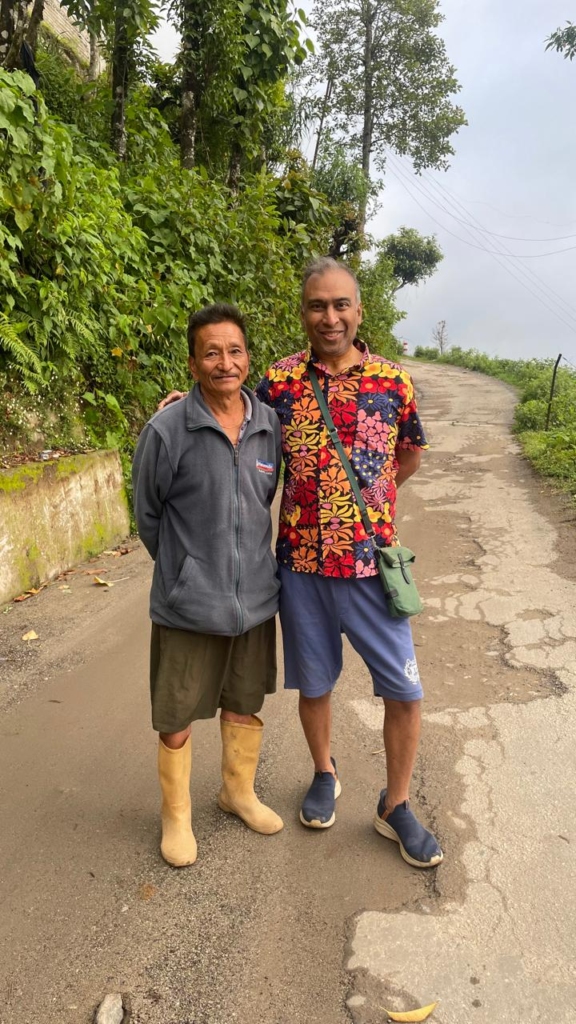
As we neared our lodging, we met Tezing, a youthful-looking man in his late 60s whose demeanour belied his age – a common trait among locals accustomed to the effects of mountain weather and skincare rituals. His striking deep blue eyes caught my attention, though MunMun later mentioned he had cataracts, which gave his eyes a unique hue. Tezing, dressed in gumboots and headed to work in the fields. Tiger and his companion, preferred Tezing’s company over ours, signalling our leisurely pace was no match for their energetic spirits.

As we ascended the steps towards our homestay, we encountered Sougata, the owner of another nearby lodging. He was out early with his digital camera, equipped with a long lens, capturing the vibrant avifauna in the area. He shared insights into the local flora and fauna, mentioning how leopards are colloquially referred to as “cheethas” and tigers as “sher” in the region. MunMun took his words quite literally, sparking a light-hearted moment. Meeting Sougata seemed serendipitous; he graciously guided us on activities in and around Dawaipani. With our plans to visit Dzango and Lachung uncertain, he recommended exploring East Sikkim via the old Silk Route. We carefully noted down the suggested destinations, potential routes, and places to stay overnight. Such encounters truly feel like a stroke of luck, and we were genuinely grateful for his thoughtful suggestions. As the clock approached 7 am, time seemed to linger in Dawaipani.
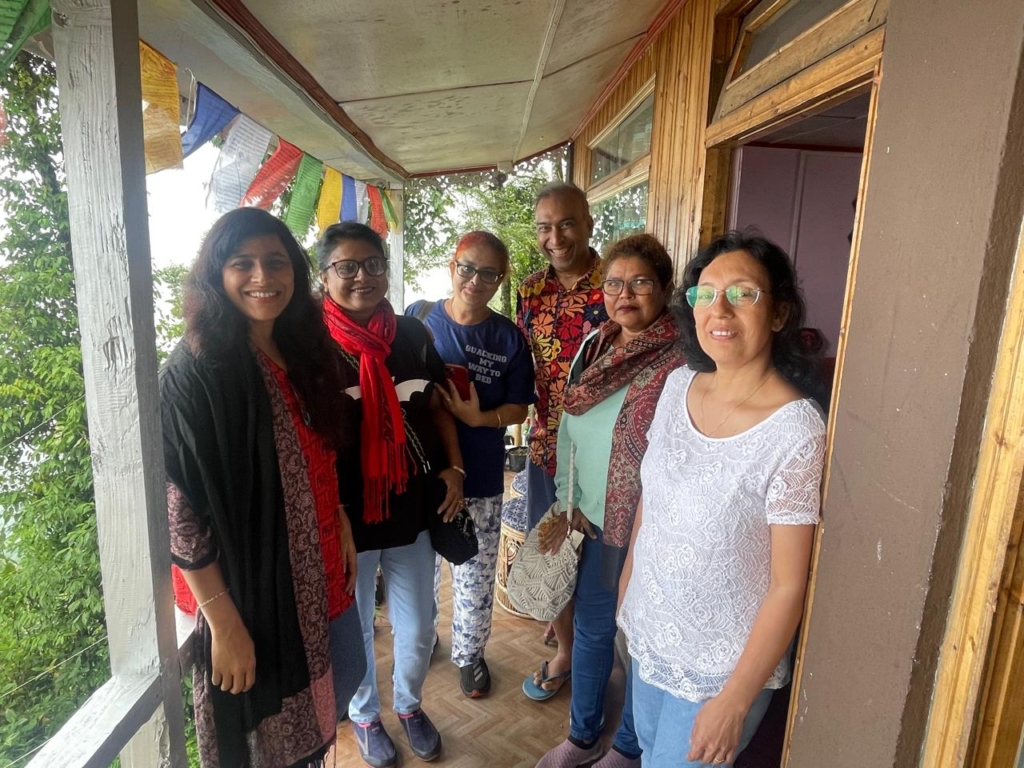
Back at the homestay, life was slowly stirring awake. Guests began emerging onto their balconies, while staff ventured out from their quarters. Inquiring about breakfast, we learned it would be served by 9 am. To make the most of our time, we readied ourselves promptly, anticipating a swift departure after our breakfast. As we prepared, a melodious voice drifted from the adjacent room where a group of 3-4 women were staying. One of them was singing a soulful Bengali devotional song, a beautiful Rabindra Sangeet. Entranced by the sweetness of her voice, we couldn’t resist asking if we could join them and listen her briefly. They graciously welcomed us, and soon MunMun and others joined in with Hindi songs, creating a delightful and memorable morning interlude. Following this musical treat, we enjoyed breakfast together and were soon prepared to move on to our next destination. We thanked Sandeep and his team for making our stay comfortable and memorable.

Ashik arrived punctually and we relocated to a neighbouring homestay just a hundred meters away. After settling into our new accommodations with Susheela’s warm assistance, we were ready to explore the region. MunMun found the new homestay more to her liking, while I claimed the double bed by the window once again. Tazo remained neutral, likely preoccupied with her pending work responsibilities.

Lamahatta
Our itinerary for the day was in the capable hands of Ashik, our chauffeur and guide, both rolled in one. Driving through the picturesque hills, we arrived at the charming village of Lamahatta. The village’s highlight is its eco-park, surrounded by tall pine trees and offering a backdrop perfect for photography enthusiasts. For those willing to tackle a moderately challenging trek, there’s a small lake atop the mountain, considered sacred by the locals. While Tazo and MunMun ventured uphill in search of the lake, I patiently waited below, observing other tourists struggling to navigate the park’s terrain – some in high heels, others in sarees – unprepared for the park’s natural challenges.

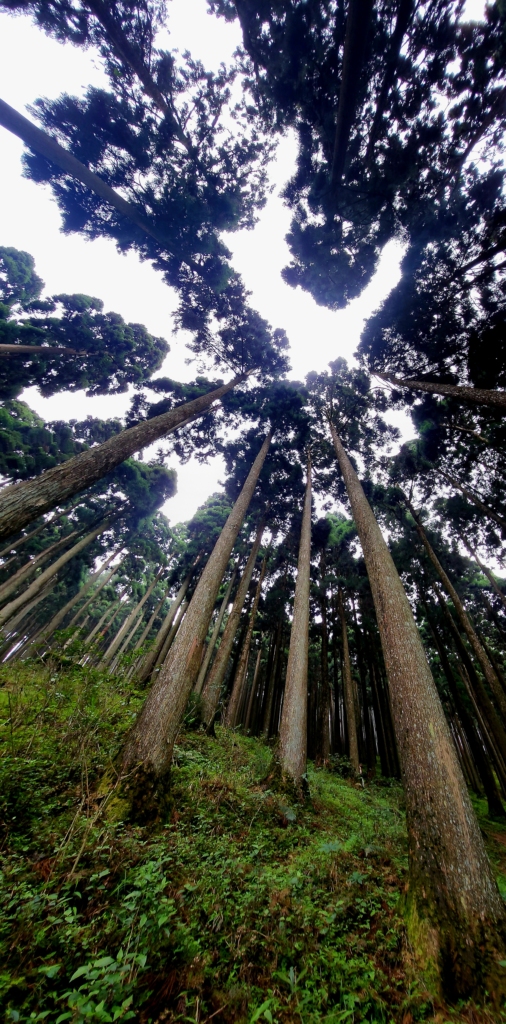

After exploring the park, we settled into a cozy family-run café on the first floor, overlooking the forested park. The mother and daughter duo were bustling about, preparing lunch for their patrons. We placed our specific order for robust ginger tea, which they brewed to perfection and served promptly.
Triveni Point / Lover’s Meet Point
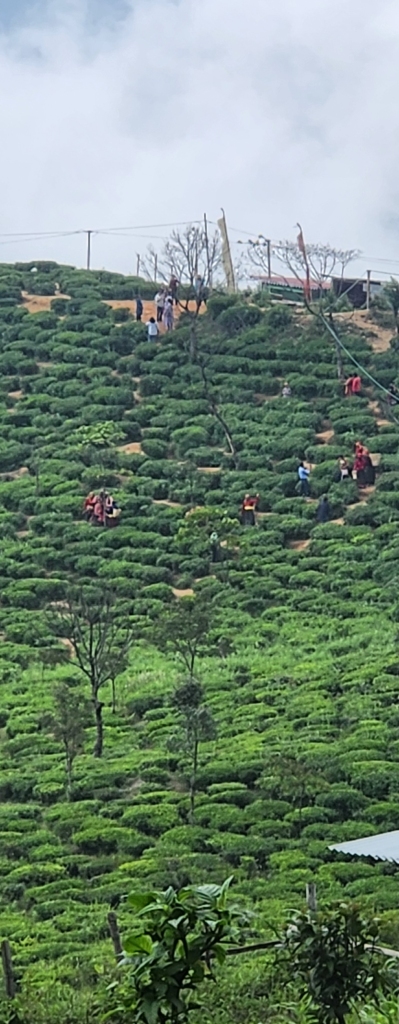
Next on the agenda was a visit to the local tea estate, followed by a stop at Lover’s Meet Point, also known as Triveni Point. At the tea estate, we observed tea workers, all females, meticulously tending to the plants, diligently removing weeds. It was our first glimpse of seeds on the tea plants, adding to the picturesque setting. We engaged briefly with the locals, predominantly women dressed in traditional attire, with buckets perched gracefully atop their heads as they focused on weed removal from the tea plantation. Conversing with them, we gained insights into tea leaf selection, the plucking process, and the nuances of tea plant quality. Our interaction deepened our appreciation for their challenging daily lives in the hills and also their simple yet fulfilling existence. Enriched with new found tea knowledge, we bid farewell and headed towards our next destination, the memory of our encounter with locales lingering in my mind.


Lover’s Meet Point awaited us next – a modest visitor’s gallery perched on a cliff offering stunning views of the mighty Teesta River as it merged with the River Rangit. We lingered there, absorbing the natural beauty unfolding before us. The area bustled with tourists and food stalls, tempting us with their offerings. Feeling parched and hungry, we treated ourselves to refreshing coconut water, crisp cucumbers, and tangy raw mangoes. The coconut water, sweetest I’ve ever tasted at such an altitude, left me pondering about its origin.
Gumbadara
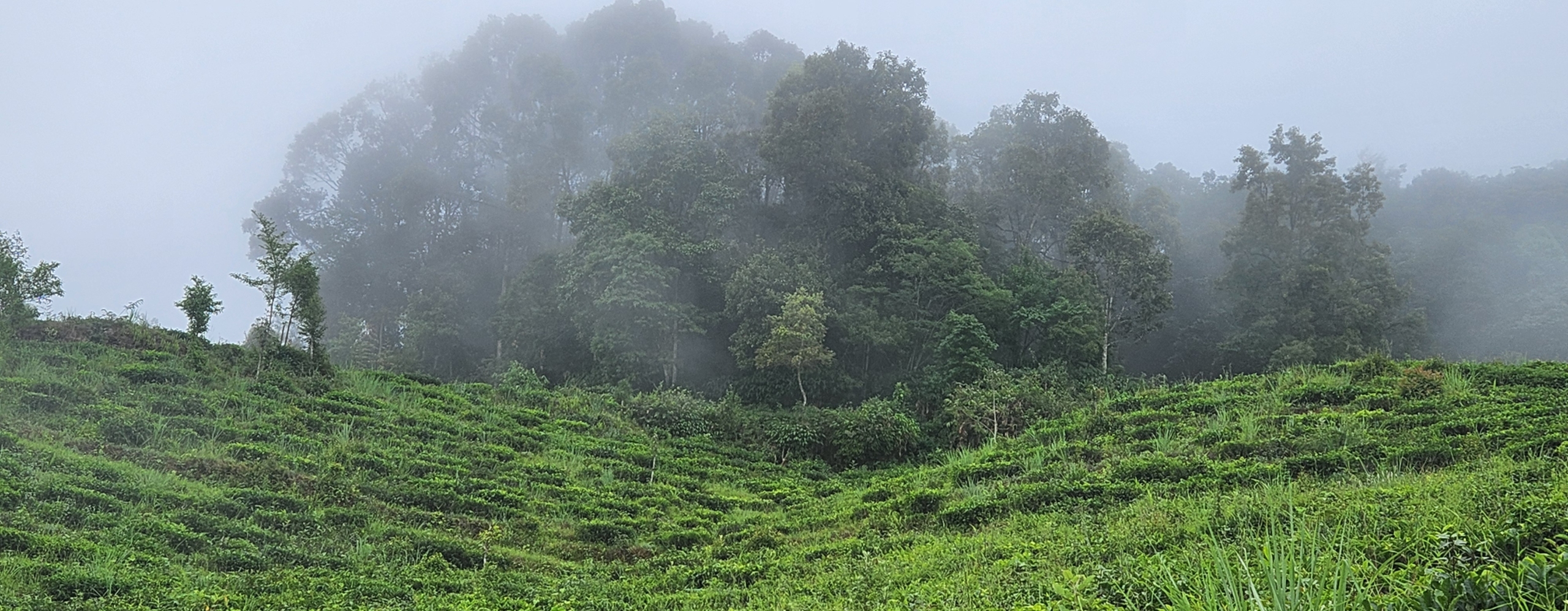
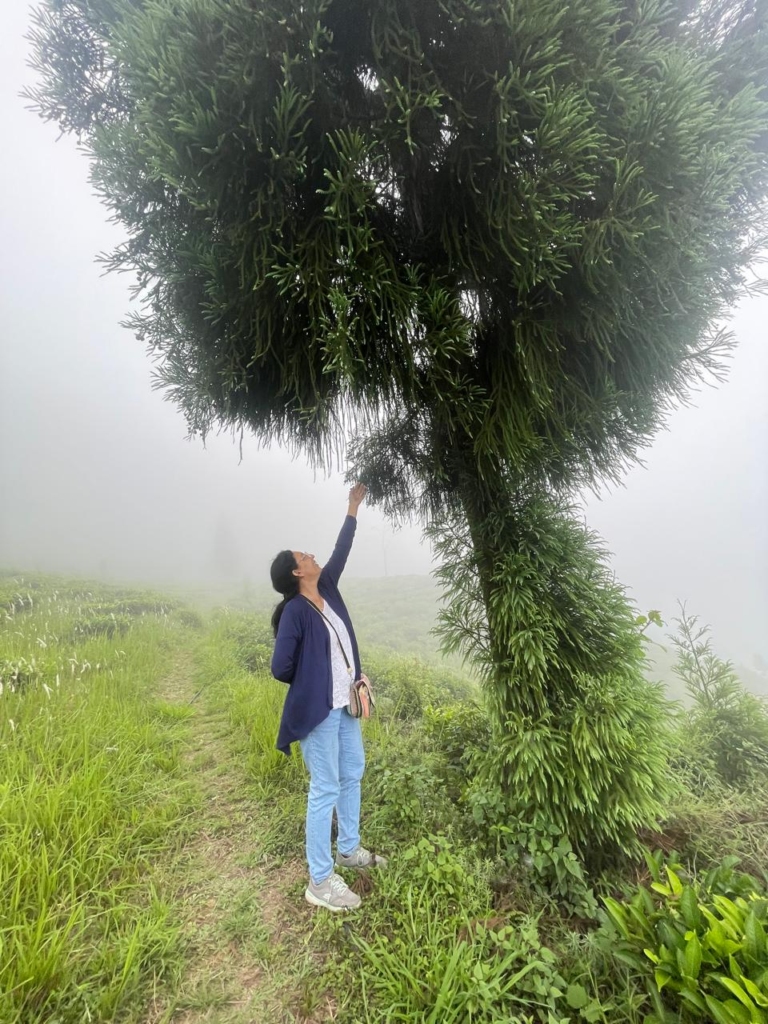
Next, our journey to Gumbadara Tea Estate unfolded amidst a picturesque landscape, with sprawling tea plantations cascading down the mountain slopes and the majestic Himalayan range looming in the backdrop. The misty atmosphere transposed each of us “3-idiots” into our own world of serenity, reflecting our state of mind. Situated amidst tea gardens, the name “Gumbadara” derives from “Gumba,” meaning monastery, and “Dara,” meaning hilltop, hinting at a nearby monastery. Nestled at an elevation of 6,500 feet, the foggy conditions prompted us to skip the Gumba and instead venture along a secluded trail winding through the tea estate.


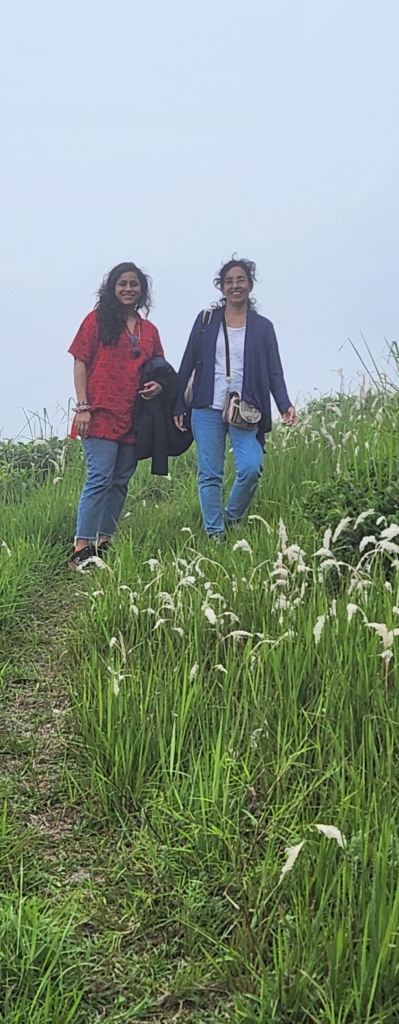
It was a tranquil walk as we savored the solitude, accompanied only by a young family who decided to follow our lead. The tea estate, cloaked in mist, exuded serenity, with birds chirping along our path. Though sparse, the trees dotted our route, leading up to a small forest atop the mountain. The lush green surroundings and the cool, mist-laden air felt rejuvenating, almost therapeutic. I couldn’t help but yearn for a moment of leisure in the heart of the tea garden, sipping on a steaming cup of tea – a dreamlike vision of paradise.


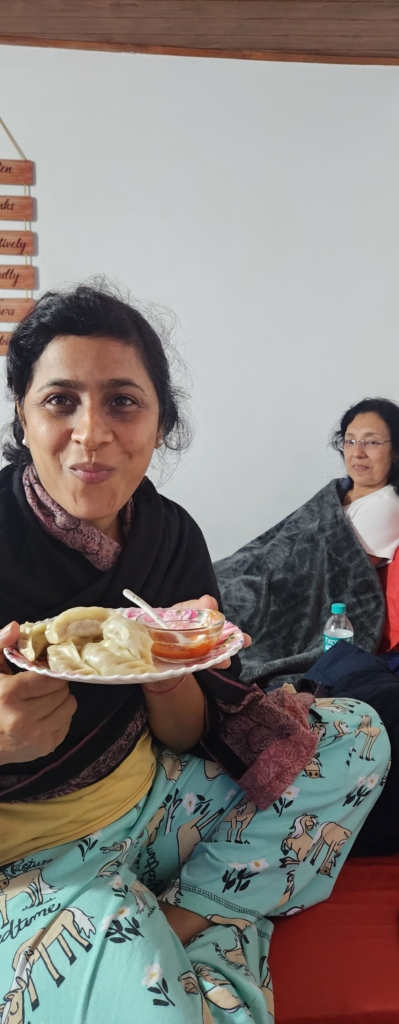
Returning to our senses and growing hunger, MunMun expressed a craving for “momo’s”, a local delicacy she was eager to indulge in. Tazo, on the other hand, had her fill of momo’s during her trip to Bhutan. Upon Ashik’s suggestion, we headed to a nearby restaurant where MunMun savoured her chicken momo’s, finding them delectable and couldn’t resist trying their Maggi preparation as well. The dishes, though simple, bore the mark of the cook’s skill. Even their cup of tea was impeccable. Whether it was our voracious appetite or the restaurant’s ambiance, sourced ingredients, or the chef’s culinary finesse, everything tasted exceptional. We struck up a conversation with the restaurant’s owner and cook, learning more about their surroundings. She mentioned that on clear days, they could enjoy a breathtaking view of Kanchenjunga right from where we were seated. She recommended October and November as the best months to visit for optimal views of the peak. Intrigued, we promised to return someday. Sensing MunMun’s disappointment at missing the peak, the owner kindly took her contact details and promised to share a video call view of Kanchenjunga in October, bringing smiles to everyone’s faces.
Leaving the restaurant, we decided to tip the staff for their exceptional service. The gesture took the young lady staff by surprise, with the server initially hesitant to accept it until the owner intervened and graciously accepted the token of appreciation.
Reflecting on the incident, it struck me how steadfast the lady staff was in not accepting extra money she hadn’t earned. It made me contemplate whether this was an exception or a reflection of village life’s values. The temptation to earn more money exists universally, evident in urban areas where people readily accept gratuities to afford small luxuries. In remote villages like this one, perhaps there’s less pressure for additional income or the moral values still dominate the life. I’m uncertain of the exact reason, but her integrity left a lasting impression, prompting me to reflect on my own behaviour. Generally, the people here struck me as humble, cheerful, and eager to engage with strangers.
Tinchulye
Ashik urged us to hasten to our next destination, Orchid House in Tinchulye, mentioning it closed promptly at 4 pm. Despite the time constraint, we relished the drive, taking in the scenic beauty. Tinchulye, a charming village bustling with tourists, boasted numerous resorts and homestays. Unfortunately, we arrived at the Orchid House a minute late, missing entry by a whisker.

Undeterred, we decided to explore the village instead. The persistent fog added a mystical allure as we drove back through the forest to Dawaipani. I highly recommend experiencing this forested route if you visit, even a short walk through it – it’s enchanting. Staying a couple of nights in Tinchulye would be worthwhile to explore its famed orange orchards and more, although in the right season.
Passing through Dawaipani’s village market on our return, we picked up some cream rolls, samosas, and even a lottery ticket with a grand prize of Rs. 1 crore. Anticipation heightened as the results were due soon – in an hour. Back at our homestay, Susheela awaited us with steaming chicken momo’s, treating us to a feast alongside wine, samosas, and cream rolls. Tazo and MunMun devoured the momo’s swiftly, debating which was better while MunMun praised the lip-smacking chutney served with them. As rain began to fall, we stayed indoors, eagerly awaiting the lottery results – though predictably, we didn’t win a single rupee.


Rohit, our chauffeur for the remainder of the journey, confirmed his arrival in Dawaipani the next morning at 9 am. After dinner, we decided to turn in early, looking forward to the adventures that awaited us the following day.
Day 3 & 4 – Zuluk (East Sikkim): Tracing the Old Silk Route (Read More)
Day 5 & 6 – Dzongu: Hideout nestled in lap of Mt. Kanchenjunga (Read More)
Day 7 -9: Darjeeling: Romancing with “Queen of Hills” & Shopping (Read More)
Gallery


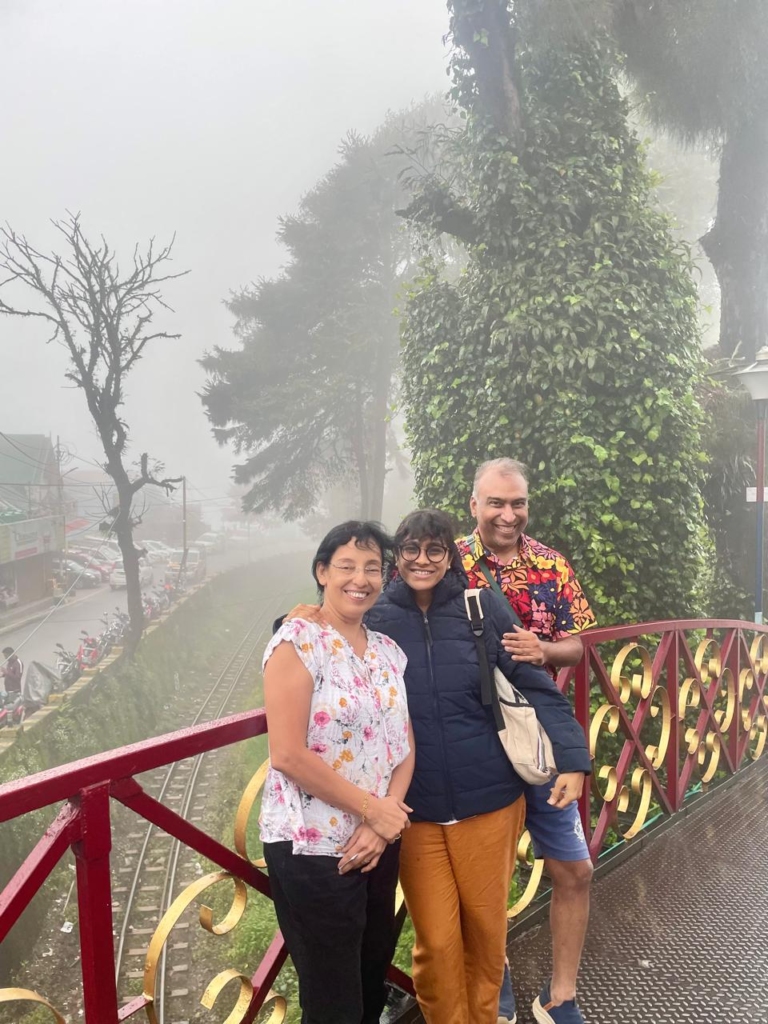






Sukumar Jain, a Mumbai-based finance professional with global experience, is also a passionate traveler, wildlife enthusiast, and an aficionado of Indian culture. Alongside his career, which includes diverse roles in international banking and finance, he's working on a wildlife coffee table book and enjoys sculpture and pottery. His interests span reading non-fiction to engaging in social and global networking.