
Background: Romancing the Mystic Hills of Darjeeling & Sikkim (Read More)
Day 1 & 2 – Dawaipani: Flirting with Darjeeling “Princesses” (Read More)
Day 3 & 4 – Zuluk: Tracing the Old Silk Route (Read More)
Day 5 & 6 – Dzongu: Hideout nestled in lap of Mt. Kanchenjunga
(Read More)
Day 7: Dzongu – Rangpo – Chimney
150 Kms. / 5.40 Hrs.
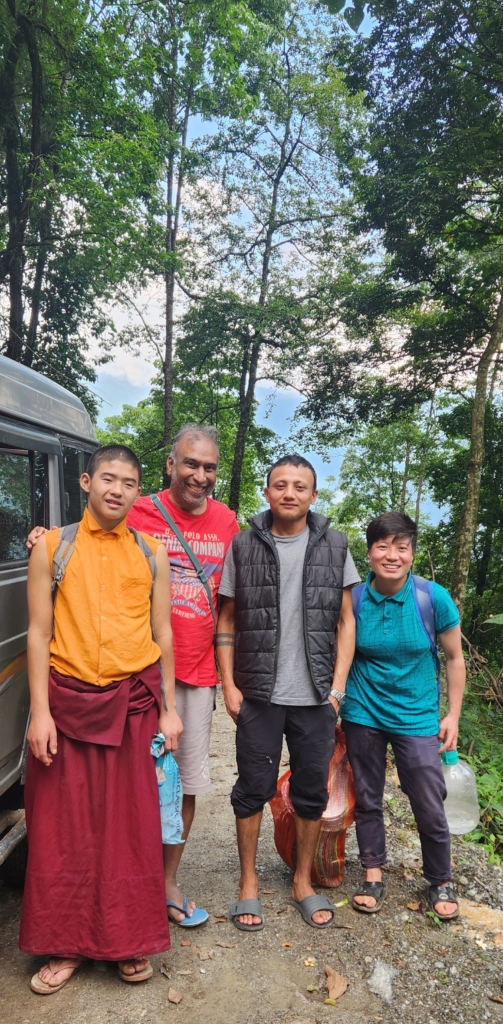
Sanjeev and Keepu were up bright and early the next morning, diligently preparing our breakfast. As they walked us to the car, Keepu mentioned she was working part-time at the homestay while awaiting confirmation of her posting from clearing the state civil service exams. We congratulated her and wished her well in her future endeavours.
Curious about her name, Keepu shared that it meant “love and peace” in the local language.
Sanjeev, having recently turned forty and still single, revealed his plans to marry in the next couple of years.
He joked about hoping there would still be single girls left in the village by then.
We all chuckled and wished him luck. We expressed our heartfelt thanks to the entire staff for their warm hospitality and courteous service.
It’s incredible how we forge connections with strangers over such a short span, sharing stories that become cherished memories for years to come. The entire homestay team went above and beyond to make our stay comfortable, pleasant, and most importantly, unforgettable.
Driving along our new route, we encountered several army trucks. Rohit respectfully gave way to them whenever the road narrowed due to ongoing widening works. Rohit reminisced about his early career with a stint in the army, recounting amusing anecdotes from those regimented days. From his stories, I gathered he hadn’t been directly recruited but employed as a contract resource, likely subject to similar army protocols. After a couple of challenging years, he left due to the physical demands.
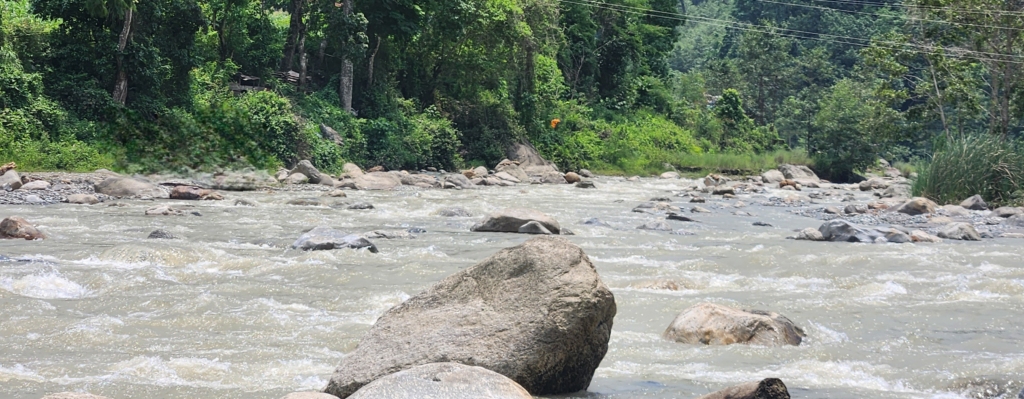
The Teesta River accompanied us throughout our journey. At a specific point, Rohit pointed out his village atop a mountain across the river. He shared details of his family background and dream project: his village’s proximity to Yangang, home to a newly constructed 7 km round-trip cable-car. Excitedly, he mentioned the government’s plans for a glass walking bridge at the end of the cable-car, envisioning the area becoming a tourist hotspot in the coming years. His family owned significant land nearby, and he was working on developing it into a homestay and restaurant. He hoped to transition from driving within two to three years once the project was up and running smoothly. When I jokingly offered to apply for the caretaker position, he promptly rejected me, citing me as overqualified, which drew laughter from us all.
As we relaxed into each other’s company, Rohit remarked on how kind Tazo and MunMun were, unlike the demanding tourists he often encountered. He humorously speculated on their contrasting personalities and how they would fare as partners in a relationship. Our journey was filled with laughter and quirky discussions throughout.
Passing through Singtam, Rohit mentioned it was a pivotal town, serving as a gateway to Sikkim for all goods and services transport. We were running at least an hour behind schedule, and Sonam had already reached Rangpo to pick us and awaited us across the Rangpo Bridge — Atal Setu Bridge, Sikkim’s longest bridge. Hastily transferring our luggage, we bid farewell to Rohit, who was now running at least two hours late for his next assignment. We wished him the best in his future endeavours, thoroughly enjoying his company and service. As we parted ways, Rohit expressed how much he’d enjoyed our company, feeling like a tourist himself in his own state after a long time.
We stopped further ahead for a tea break, where we learned that Sonam was a newly wed young man. Over tea, he shared his fascinating love story, which had culminated in marriage a year prior. Sonam had met his now-wife on Facebook. His wife belonged from a distant village near the West Bengal-Bhutan border. They both belonged to the same community, crucial for their marriage. Sonam came from a humble background, and arranging 50 kg of pure ghee as dowry had been his main challenge for the wedding, following their community’s customs. Each region in India brims with diverse traditions, cultures, and practices, making it captivating to hear people’s unique life stories and journey struggles. Unlike Rohit, Sonam was exceedingly humble and soft-spoken, showcasing two contrasting yet equally commendable personalities.
Most of our road journey to Chimney retraced the route we had taken earlier. Sonam resided in Jorbangla, which came along the way. In hindsight, we could have stopped to meet Sonam’s wife. As we crossed, Ghum, one station stop before Darjeeling town on the toy train route, I asked Sonam if he could take us to Darjeeling for a half-day shopping trip the following day. With our stop-over plans at Gangtok cancelled, Darjeeling was next best bet for local shopping for the girl’s, especially for tea leaves, which topped MunMun and Tazo’s shopping list.
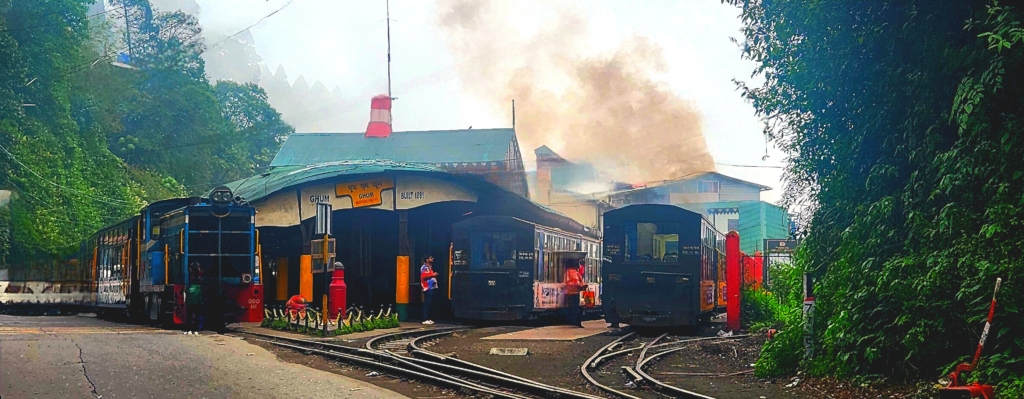
Darjeeling is known for its popularity among commercial tourists and honeymooners. Road leading to Darjeeling, particularly from Ghoom, are notoriously narrow and prone to chaotic traffic jams that can bring vehicular movement to a standstill for hours. Considering these challenges, we had opted not to include Darjeeling in our initial travel plans – so near, yet so far. It seemed like a prudent decision, though some might argue it was a missed opportunity to visit such a beautiful destination. Sonam agreed to oblige us. To evade notorious traffic, we agreed to depart early the next morning.
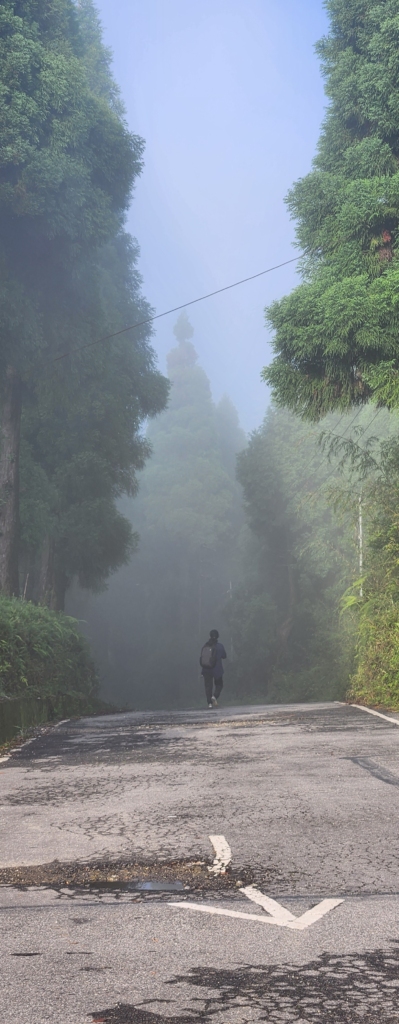
Chimney, nestled in the hills like a retreat designed by nature itself, offers a tranquil escape from the hustle and bustle of urban life. The road leading to the Chimney village, a detour from Hill Cart Road via Bagora, winds through serene and secluded pine forests. The solitude here is so profound that even the soft rustle of a squirrel in the distance can startle you. Upon reaching the mountain’s crest overlooking the valley, we were greeted by Nima, the owner of the homestay where we would spend the night. The atmosphere was so serene that it felt as if time had halted indefinitely. For anyone seeking to unwind, let go of turbulent memories, or simply breathe in the pure mountain air, Chimney is an ideal destination, especially under the care of Nima and his family.

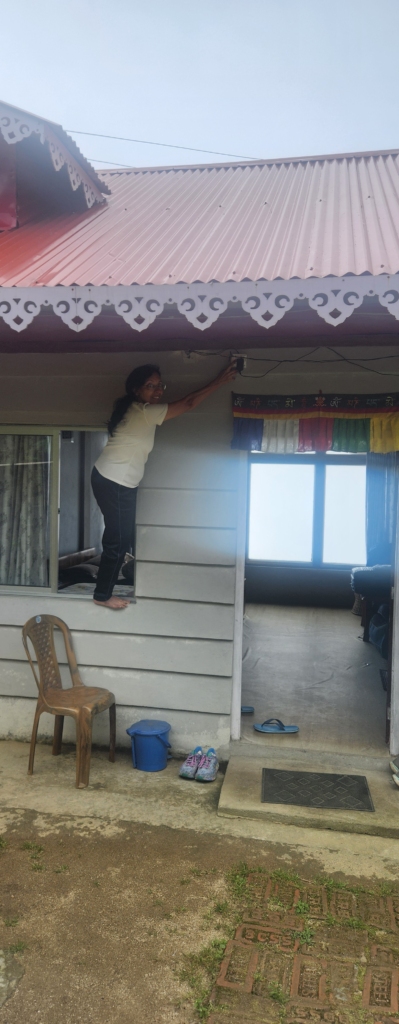
Nima possesses an enigmatic and infectious smile that immediately dissipates any stress, replacing it with joy and contentment. Jamuna, Nima’s wife, equally impressed us with her warmth and dedication. She single-handedly manages the kitchen at the homestay, while Nima oversees everything else. MunMun and Tazo strategically claimed the beds by the windows, although the lack of wifi prompted Tazo to resort to an age-old trick: toggling the main electrical switch. The plug was inconveniently placed high above the door, but before Nima could fetch a chair, Tazo had already devised a plan involving climbing through the window to reach it. This incident perfectly captures Tazo’s resourcefulness and can-do spirit.

We settled down for a light lunch prepared by Jamuna in their cozy kitchen. We also asked Jamuna if it was possible to include some local delicacies like curved fern in our dinner. Nima kindly offered to arrange Tongba for a pre-dinner drink session. He suggested several activities for us for the following day, including exploring the nearby woods, visiting a Heritage Park with an old chimney, and checking out other local points of interest accessible by a short drive.

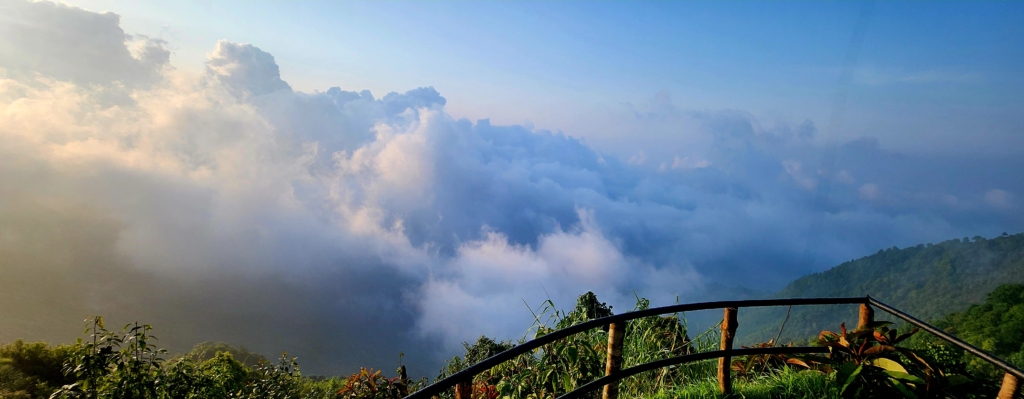
Post-lunch as we relaxed amidst the open expanse of nature, we sipped our tea while admiring the boundless valley below, where birds darted through the low-hanging clouds. Although we had given up hope of spotting Kanchenjunga due to overcast skies, we found solace in the simple joy of tea-drinking, a delightful indulgence supported by the favourable weather.
Chimney village itself is sparsely populated, home to no more than ten families. Intrigued, we decided to take a leisurely stroll around the area, exploring off-beat trails that led us to unexpected discoveries. One such find was a walled area where we heard children’s laughter and cheers as they played sports. Peering through the half-open gate, we saw about twenty children dressed in Buddhist robes playing football. We later met their music teacher, a monk, who explained that while a few local students attended, the majority hailed from Uttar Pradesh, Maharashtra, and Karnataka – a surprising revelation in such a remote setting.
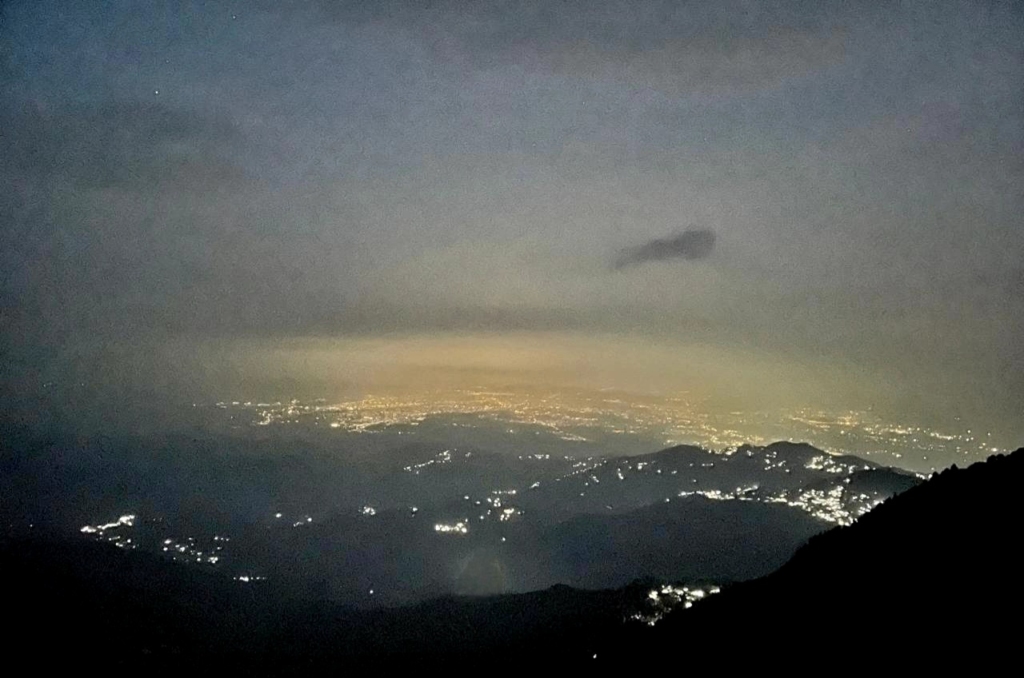
As darkness descended, we decided to return to the homestay, mindful of Nima’s earlier warning about a recent leopard sighting in the vicinity. We didn’t want to take any chances with a leopard possibly lurking nearby. Chimney had already woven its quiet charm around us, promising an enriching stay filled with unexpected encounters and serene moments in nature’s lap.
Nima graciously invited us into the kitchen where Tongba awaited us eagerly. He shared a brief history of this traditional millet-based alcoholic beverage, explaining that it was crafted from a millet variety called “kodo,” similar to the “ragi” millets found in the plains. The local variant of yeast is used to ferment cooked millet over a span of 3-4 days. Interestingly, “Tongba” actually refers to the bamboo vessel itself in which the drink is served – a long, vase-like bamboo container with a thick bamboo straw. Nima ensured we experienced Tongba in its most authentic form. The fermented millets settled at the vessel’s bottom, and Nima poured hot water over them, releasing both the flavour and intoxication into the milky-white concoction. He explained that the vessel could be refilled with water from the same millet stock up to three times until the alcohol content was exhausted, cautioning us not to disturb the settled millets at the bottom.
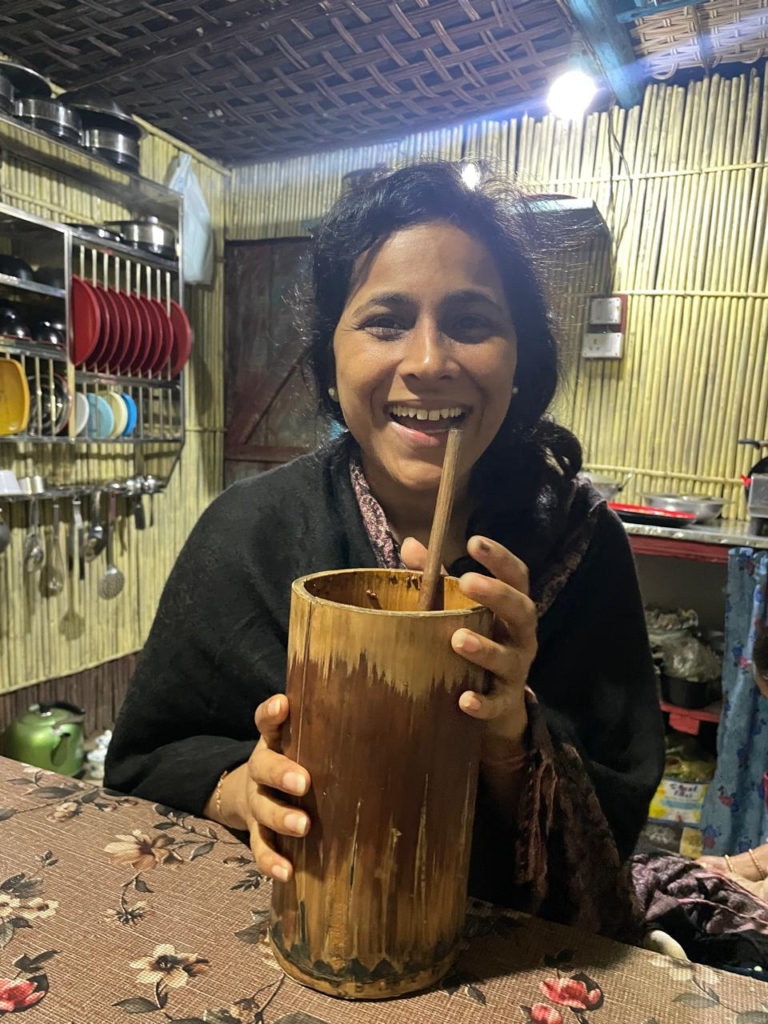
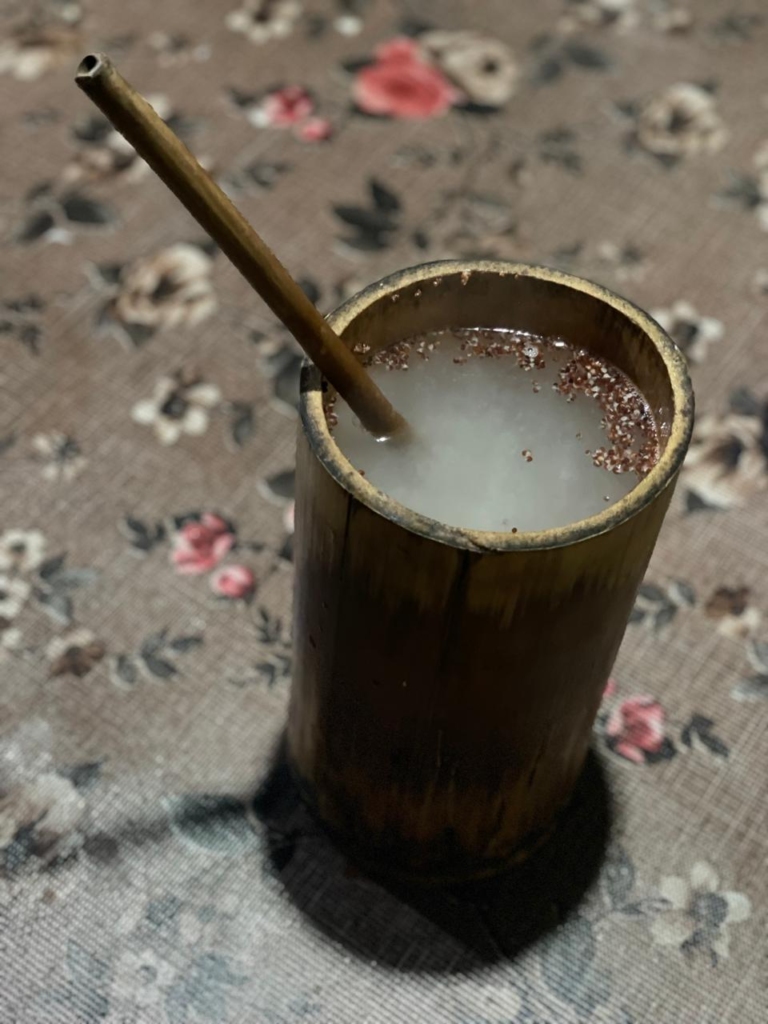

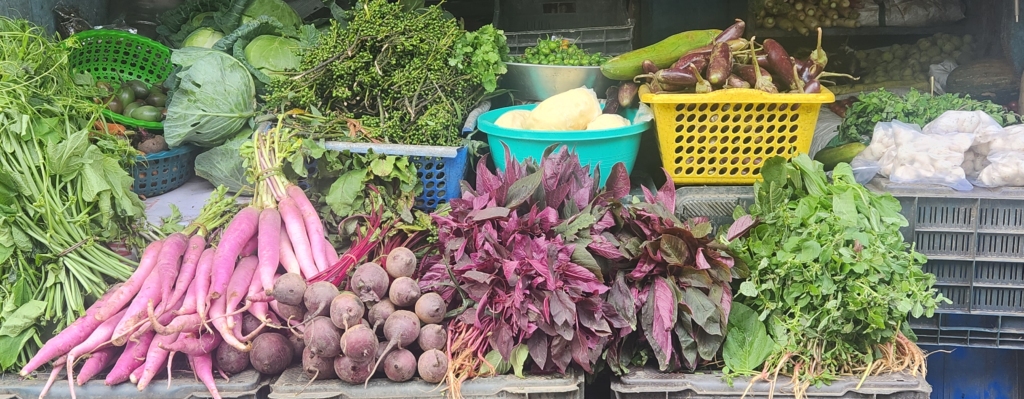
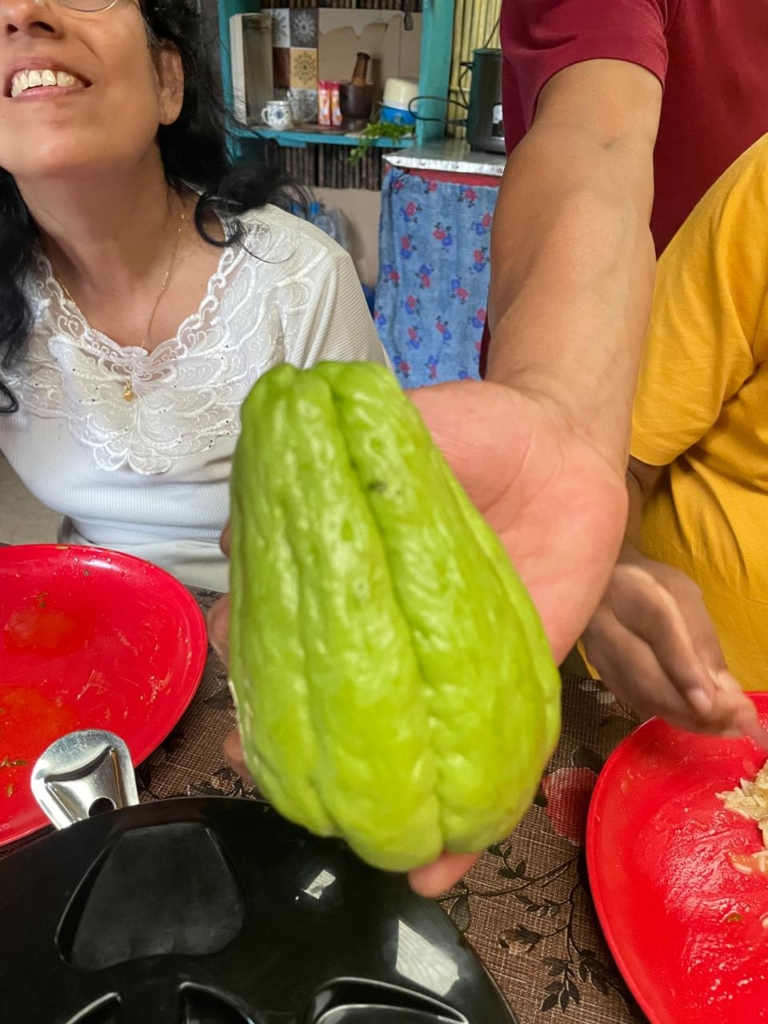
As we savored Tongba, Jamuna busily prepared our dinner, including a local vegetable known as “Ishkush,” resembling an elongated guava. Knowing that the vegetable market was at least half an hour’s walk from our homestay, we appreciated her effort to procure this local delicacy for us. We raised our glasses to Ishkush and Nima’s family well-being, enjoying the unique flavour of Tongba and the warm hospitality of our hosts.
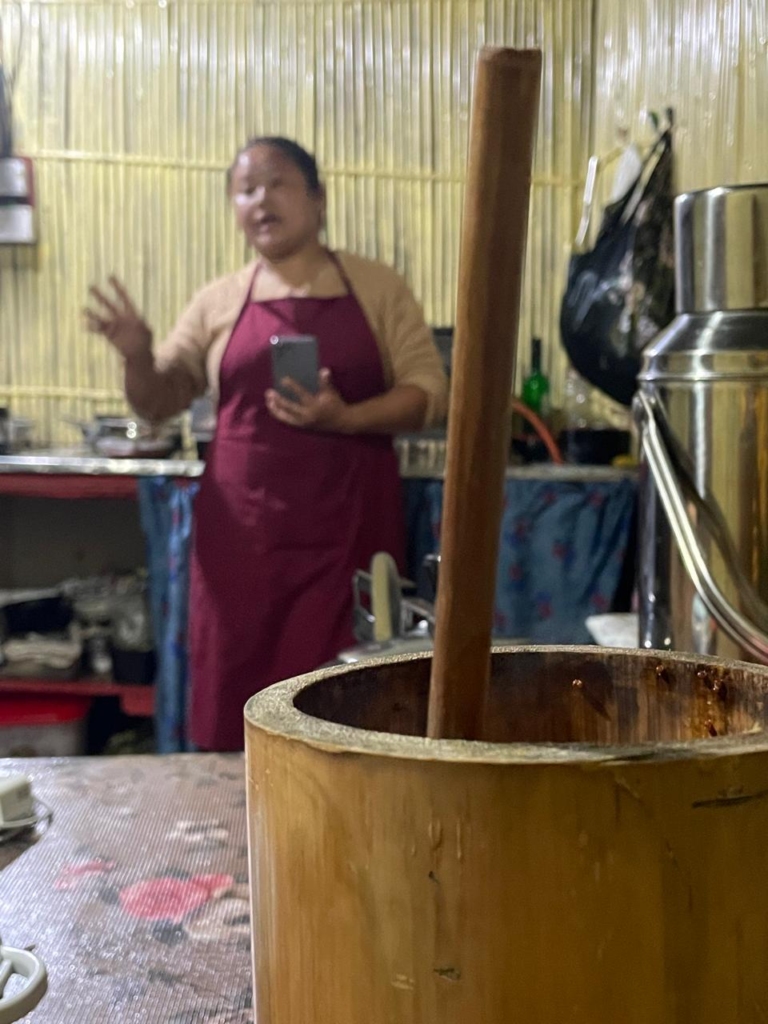
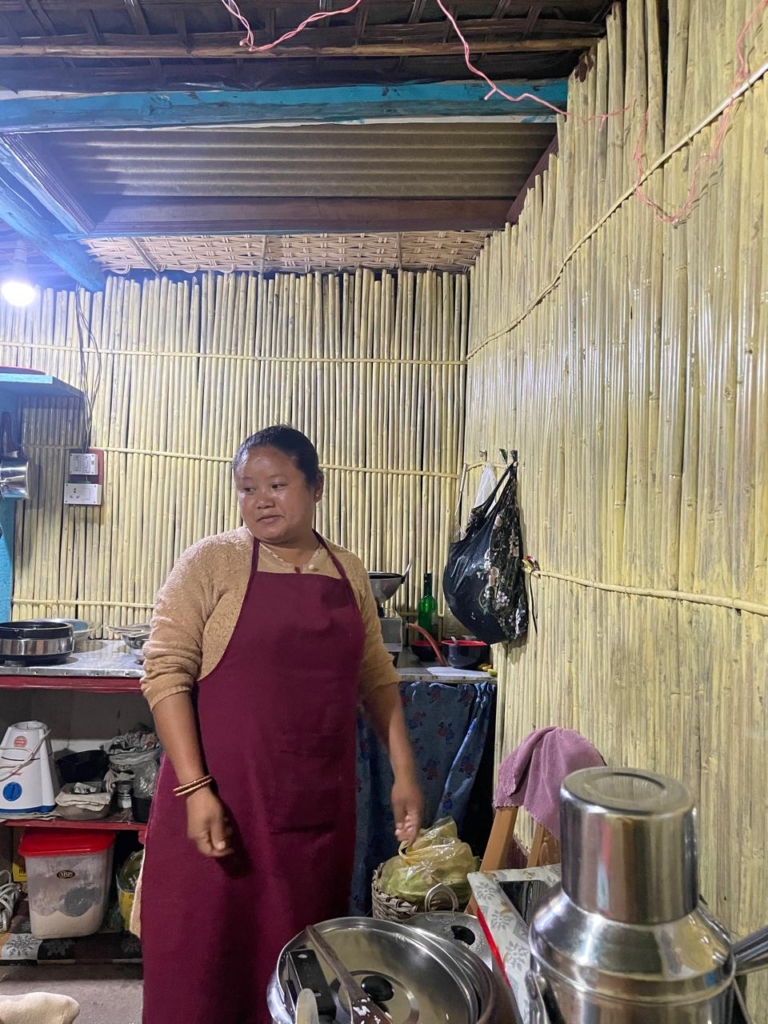
Beyond Tongba’s enchanting taste, what truly resonated was its unique serving tradition, underscoring how local food and drink can connect people deeply to a place and its culture. As our conversation became more philosophical with each refill of Tongba, we delved into life in Chimney and the challenges of living in a hilly area. Jamuna mentioned that access to good medical facilities was a primary concern, despite an otherwise contented life. Amidst MunMun’s tipsy attempts to assist Jamuna with rolling chapatis and frying papads, surprisingly successful, we all shared laughter and warmth. I cherish that memorable evening, filled with enlightening, humorous, and surreal conversations with Nima and his family over Tongba.
As Tongba continued to flow, MunMun’s mood turned musical, prompting Nima to fetch his daughter Eden’s guitar to enhance the evening’s atmosphere. Eden, an eighth-grader, and her cousin Uden, who had recently graduated and was preparing for state civil exams, joined us. They shared stories of their school and college life respectively, while I shared my last stash of chocolates with Eden and Uden. As we bonded over sweets, Eden said her favourite desert was red velvet cake. Eden, was part of the school choir and she sang beautifully. Both of them promised to show us around their village the following evening.
Sonam was scheduled to pick us up at 6 am the next day for a shopping expedition to Darjeeling. Dinner was served punctually, and Ishkush turned out to taste somewhat like pumpkin. After dinner, we retired early for another night of restful sleep.
Day 8: Shopping @ Darjeeling & Exploring Chimney
25 Kms. / 1.30 Hrs.
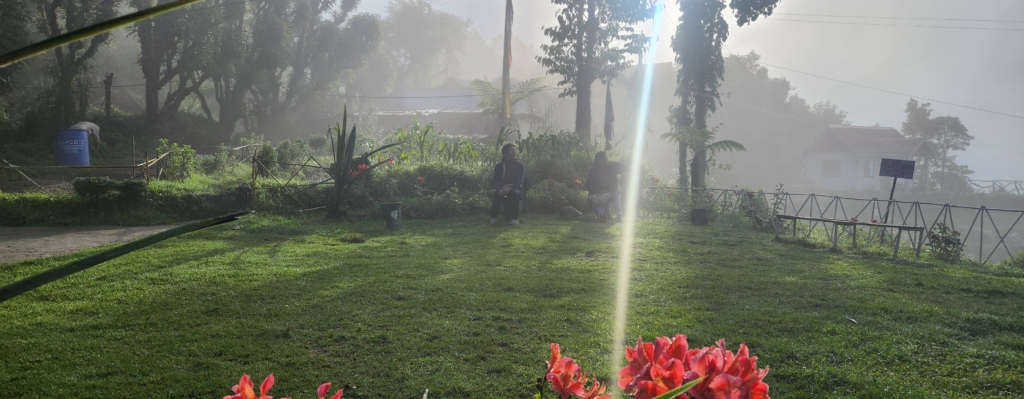
We were up early and ready for our shopping excursion to Darjeeling. For once, MunMun and Tazo were already awake, no prodding necessary – the prospect of shopping had worked its magic, such is the allure of shopping. MunMun, recovering from a slight Tongba-induced hangover from the previous evening, perked up after a steaming cup of black tea, graciously provided by Jamuna before our departure, even though we had declined breakfast proposal the evening before. We were in awe with their hospitality.

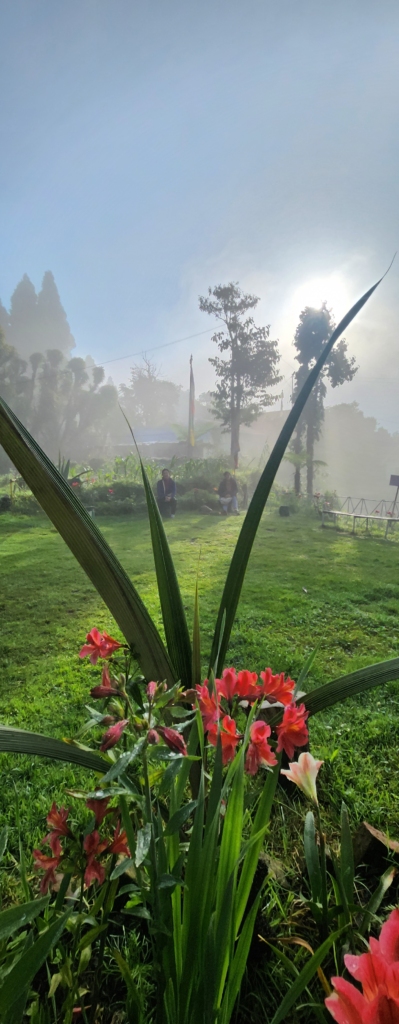

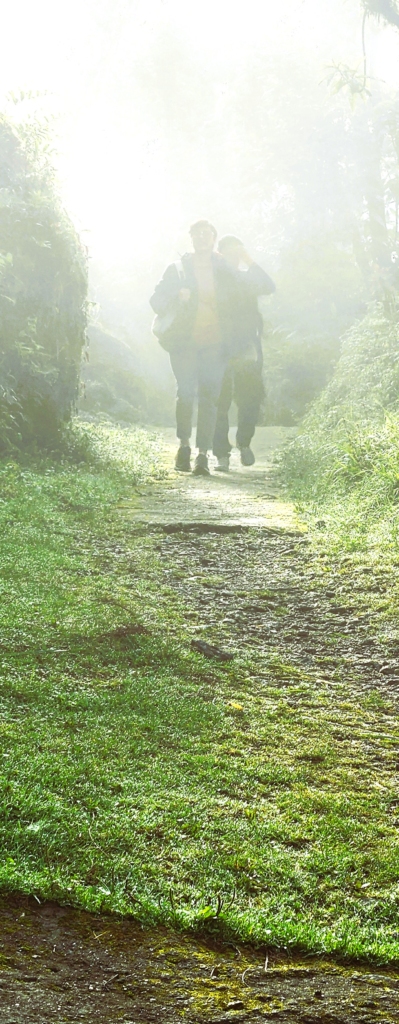
Sonam, running behind schedule, gave us the opportunity to take a walk into the woods and explore the surroundings where squirrels and birds were already busy with their morning rituals under a bright and pleasant sky.

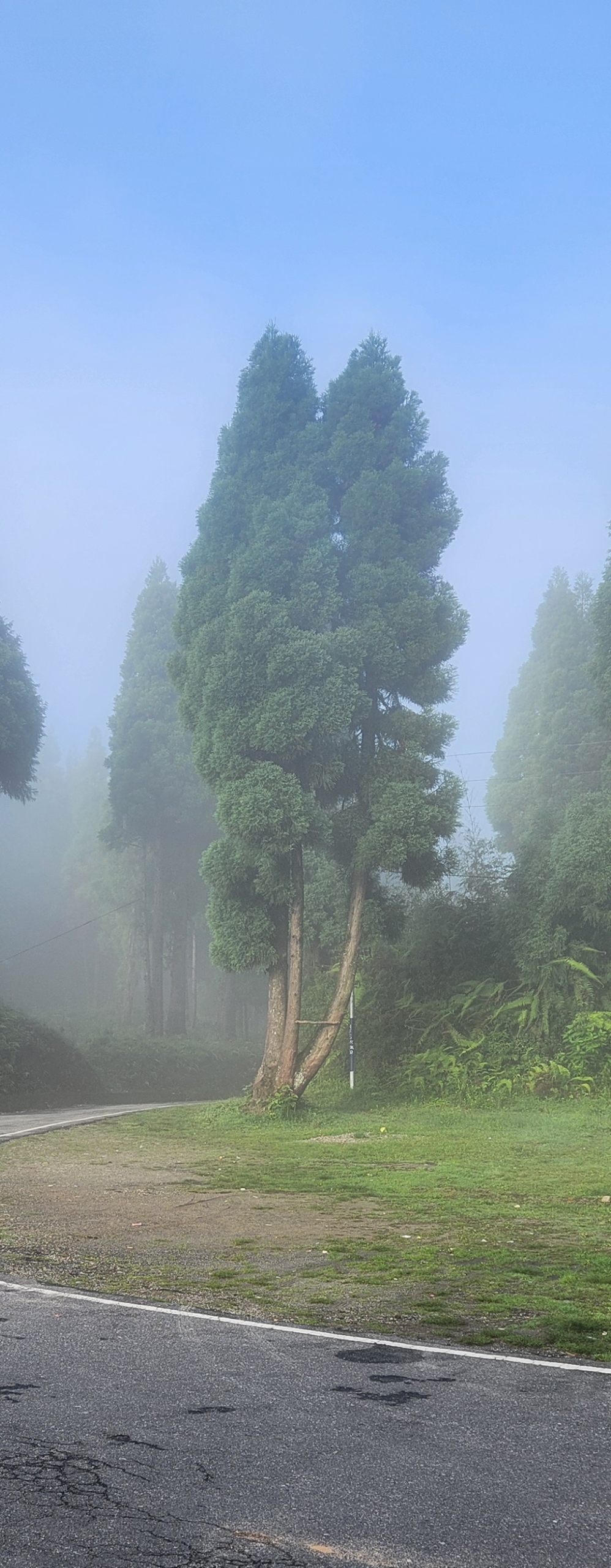

En route to Darjeeling, we made quick plans and shortlisted two cafes, Glenary and Tom & Jerry, for breakfast and to await the opening of the bazaar. Sonam shared that the name “Darjeeling” had evolved from the Limbu language, meaning “the place where the stones talk to each other”. Along the way, we passed the impressive Dali Monastery, adorned with its spirited, colourful exterior walls.


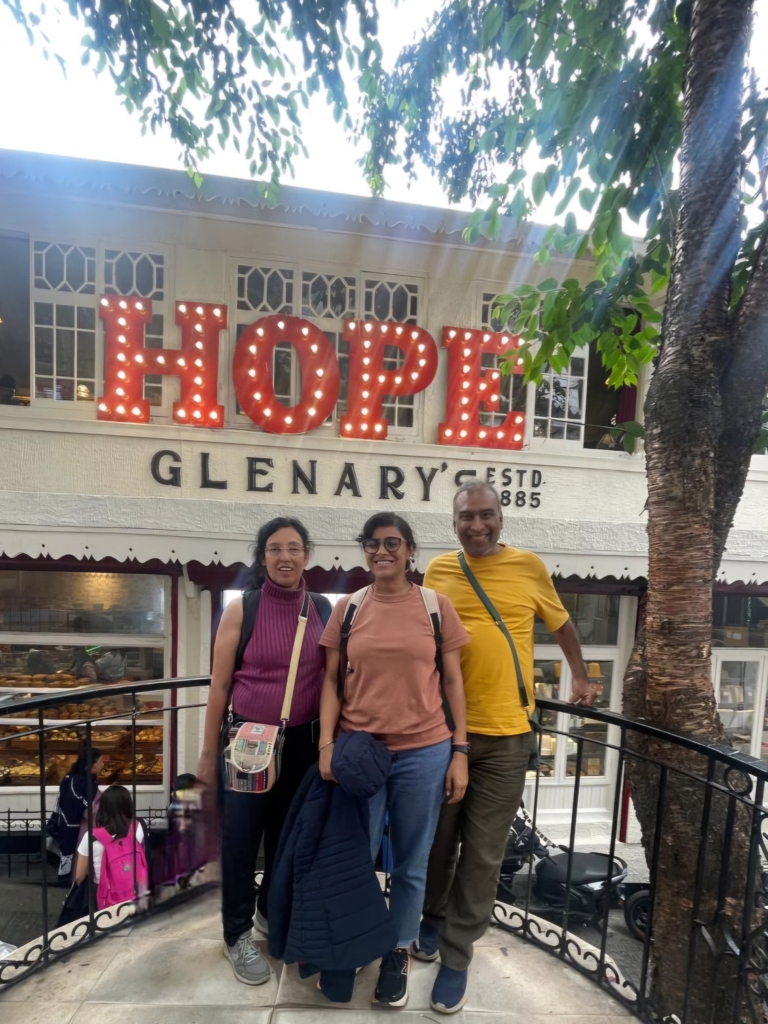
Arriving in Darjeeling promptly at 8 am, we located Glenary’s at the beginning of the main street – Mall Road / Nehru Road.
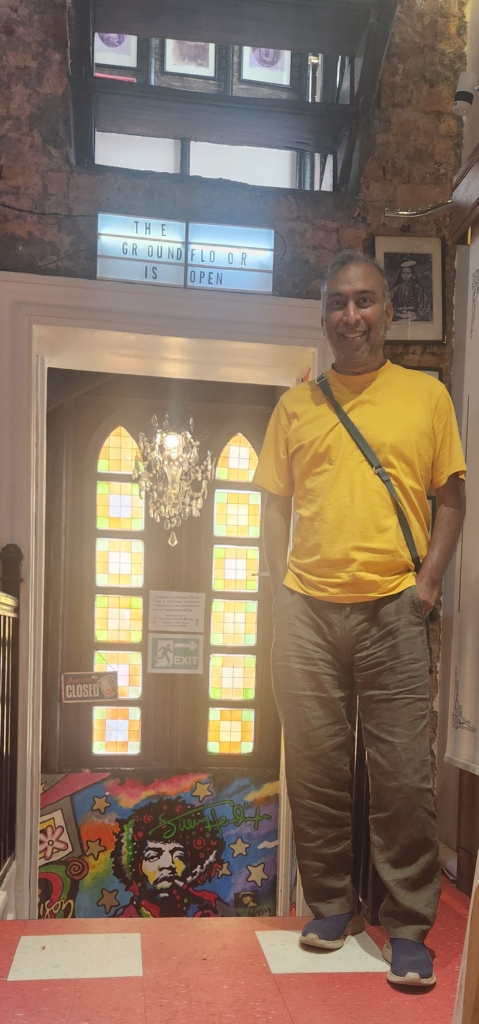
Glenary’s, established in 1885, is one of the oldest confectioners in Darjeeling, having evolved over the years into a multifaceted establishment featuring a bakery, café, restaurant, and a pub/lounge with live music.
As I recounted our visit to Glenary’s back home, my father fondly recalled it, mentioning that my grandfather always brought bakery items from Glenary’s whenever he visited Darjeeling.
Arriving early, we discovered that the bakery section was closed until 11 am. Instead, we decided to enjoy the cafe section. Although there was an option to sit on the balcony and enjoy the natural beauty around, the surrounding buildings had encroached on the once picturesque setting. We opted instead for a cozy spot inside the cafe.
A miniature railway track ran along the cafe’s ceiling, complete with a locomotive, a nostalgic nod to the famous Darjeeling toy train, though it wasn’t operational that morning.
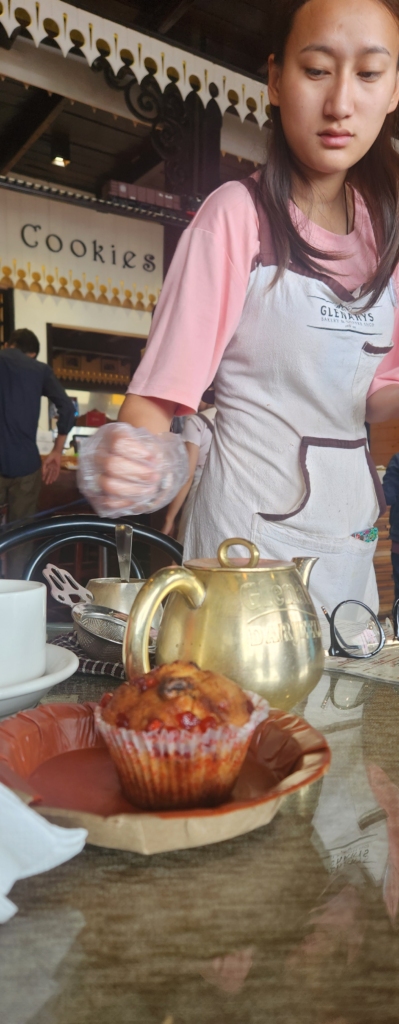
We ordered tea and sandwiches. Tea was served elegantly in a complete tea set – cup-n-saucer, pot, strainer, milk jug, and sugar bowl. The tea pot even came with a small cloth cushion to handle the hot handle – an attention to detail we appreciated.
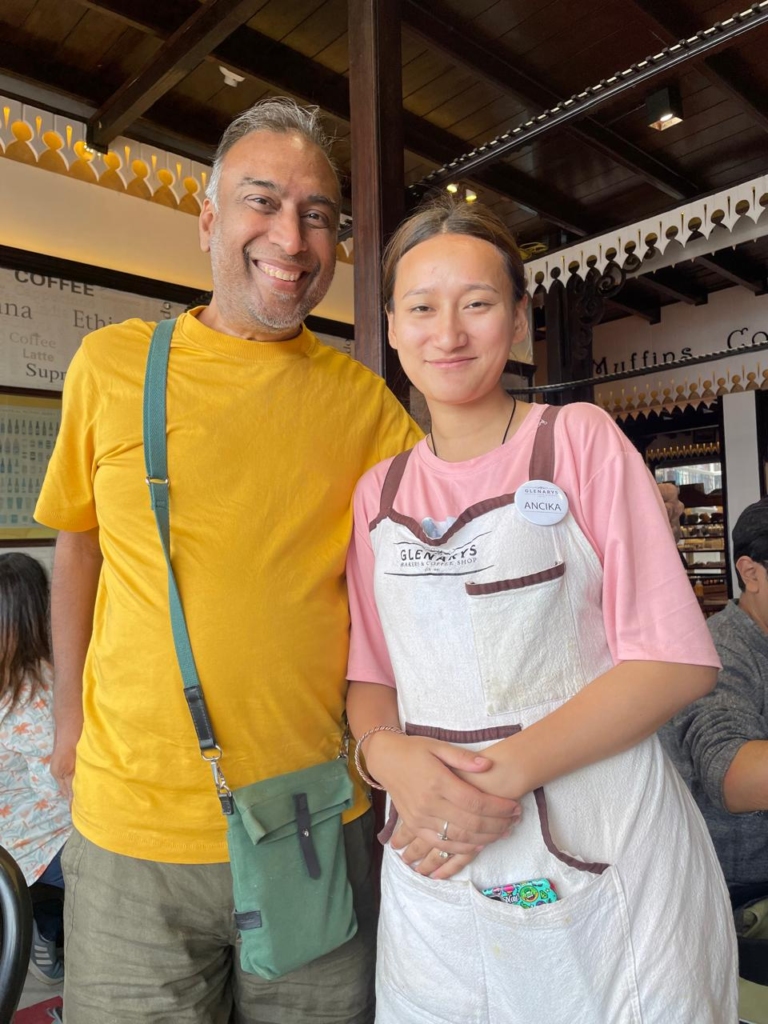
Ancika, a charming young server, assisted us courteously, guiding us through the menu and promptly delivering our orders with grace and elegance, complementing the tea set perfectly.

Around 10 am, fueled by our breakfast and eager to explore, we set out to wander the market. Ancika kindly provided us with the names of shops known for the best buys, setting us up for an enjoyable morning of shopping in Darjeeling.

The market was slowly coming to life. The main street bustled with tourists hurrying by with their luggage after checking out of their respective hotels.
I led MunMun and Tazo to Kalimpong Art Gallery, a store selling trinkets from Kalimpong, where we purchased magnets and oil paintings on black cloth, a signature art of Kalimpong.
After our initial bout of shopping, we continued up the street and reached Chau Rasta junction, arguably the most interesting part of Darjeeling market. There is a small fountain at the corner and few restaurants, which offered the perfect spots to sit out and watch the world pass by.
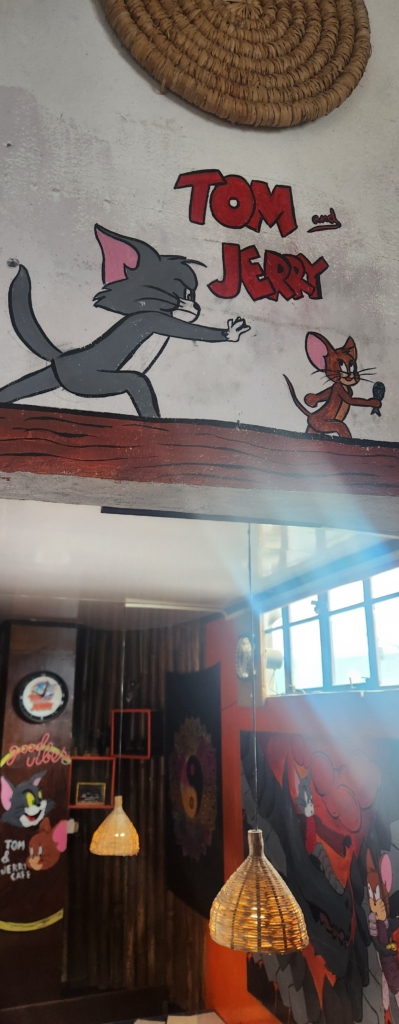
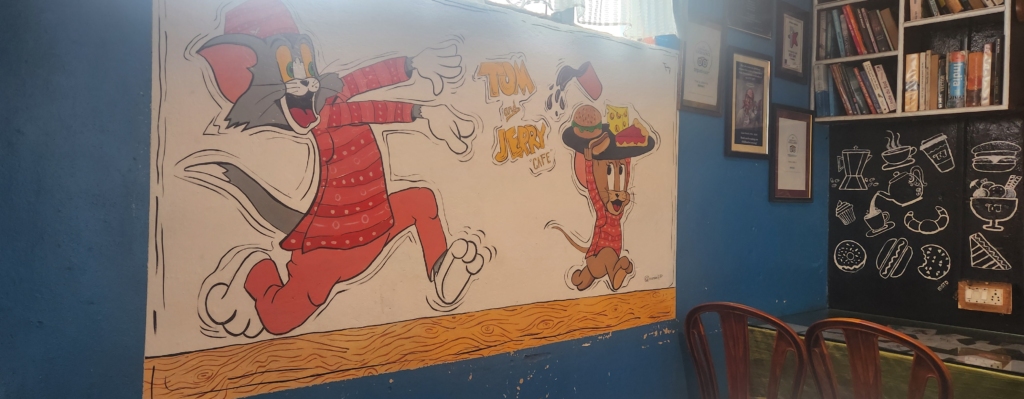
Deciding to let MunMun and Tazo indulge their passion for shopping, I found myself at Tom & Jerry. The café, though small with just 5-6 tables, boasted a vivacious interior adorned with walls painted of Tom & Jerry. Despite its size, it offered a comprehensive menu.
I ordered a glass of juice and patiently awaited the girls to finish their shopping. Since they were taking more time than I could sit in the cafe, I wandered around the local market area. Except for Chau Rasta, all the by-lanes of Darjeeling town were narrow, some shops even converted into horse stables. Local restaurants buzzed with breakfast activity for late risers.
As I explored one shop after another, I couldn’t resist indulging in some shopping myself. Among my favourite stops were a Das Studio and a state government-promoted signature store – Biswa Bangla, featuring state-centric garments, packaged food items, and handicrafts. I purchased a traditional red and white-coloured saree and a few other items. Perhaps I ended up shopping more than the girls. Although I didn’t buy anything from the studio, it remained my favourite shop in town with its impressive collection of photograph prints showcasing some of the world’s tallest peaks.
Since our visit to Darjeeling was brief, I can’t provide a detailed review. Like any commercial hill station, the town was bustling with street shopping and crowds. Personally, these days, I prefer quieter destinations like Dawaipani, Tinchuley, or Chimney, nestled in nature for vacations. Still, visit to Darjeeling town was a nice change to experience the lively chaos after spending days in the midst of serene nature.
Finally, the girls completed their shopping, and we agreed to meet again at Glenary. We chose the same table to ensure Ancika’s exceptional service. She graciously helped us navigate the menu once more and obliged us with some selfies. Ancika, worked at Glenary’s to support her distance studies in sociology. We thanked Ancika for her service, and wished her success in her studies. The bakery section, replenished with fresh bakes straight from the oven, enticed us to over-order. The bakery’s red velvet cake was irresistible, so we packed a couple of slices for the two lovely girls back at the homestay.
MunMun still had two things on her to-do list: to try “Thupka” and to visit the Kalimpong Art Gallery for some last-minute shopping. There was a small trade-off – I agreed to her request to revisit the store but convinced her to skip “Thupka”. Once the girls were satisfied with their shopping spree, we bid farewell to Darjeeling town.
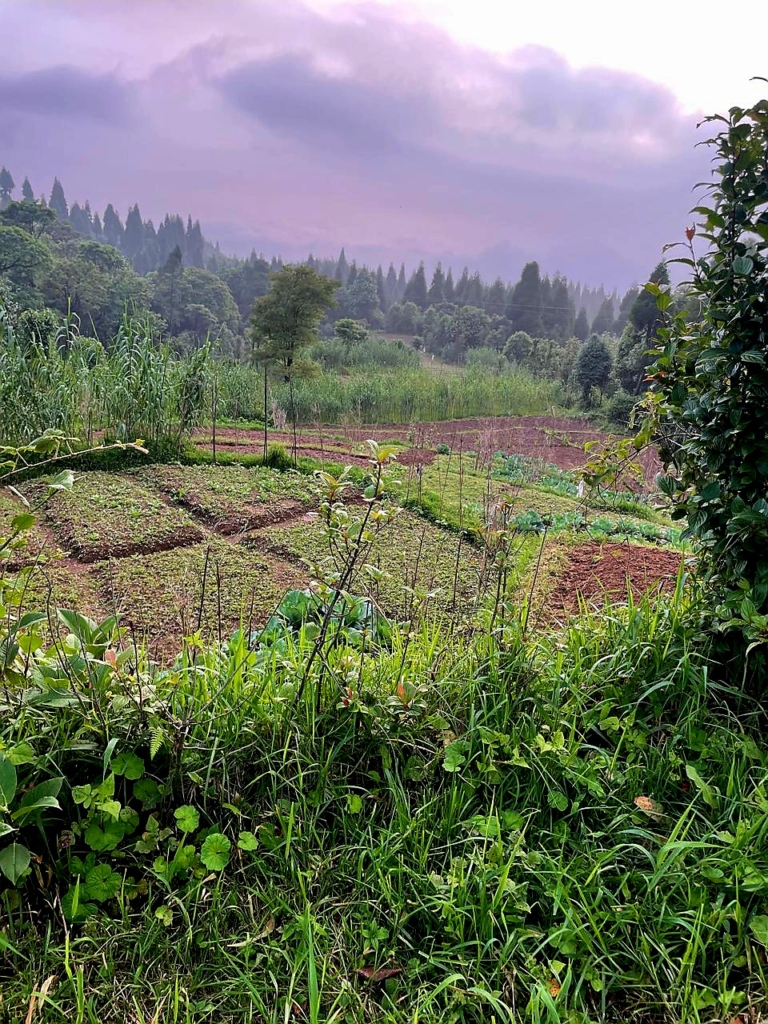
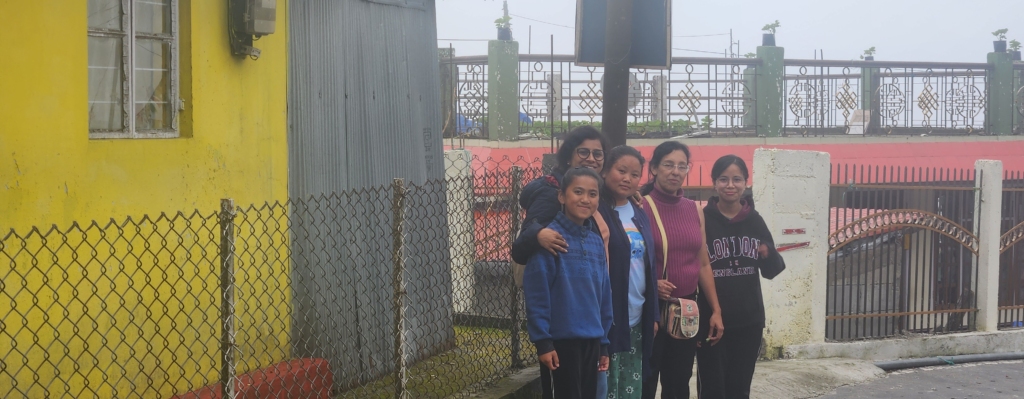
Back at the homestay, Eden and Uden eagerly awaited to take us to the Chimney Heritage Park. Jamuna joined us, and we opted for a shorter route through the forest and local fields, a highlight of our trip.
Jamuna was at her best, sharing her deep knowledge of the local flora along the way. She plucked leaves and stems, suggesting their various medicinal benefits – from throat soothing to gut cleansing and even herbs to treat urinary tract infections. These were all small bushes growing wild alongside the trail. She offered us a small, tender stem of a bush that tasted sweet-sour, reminiscent of rhubarb. As we passed through neighbouring fields, locals greeted us with curiosity.
Jamuna introduced us as her guests from Mumbai, earning us warm invitations to visit their homes, which we would have loved to accept had time allowed.
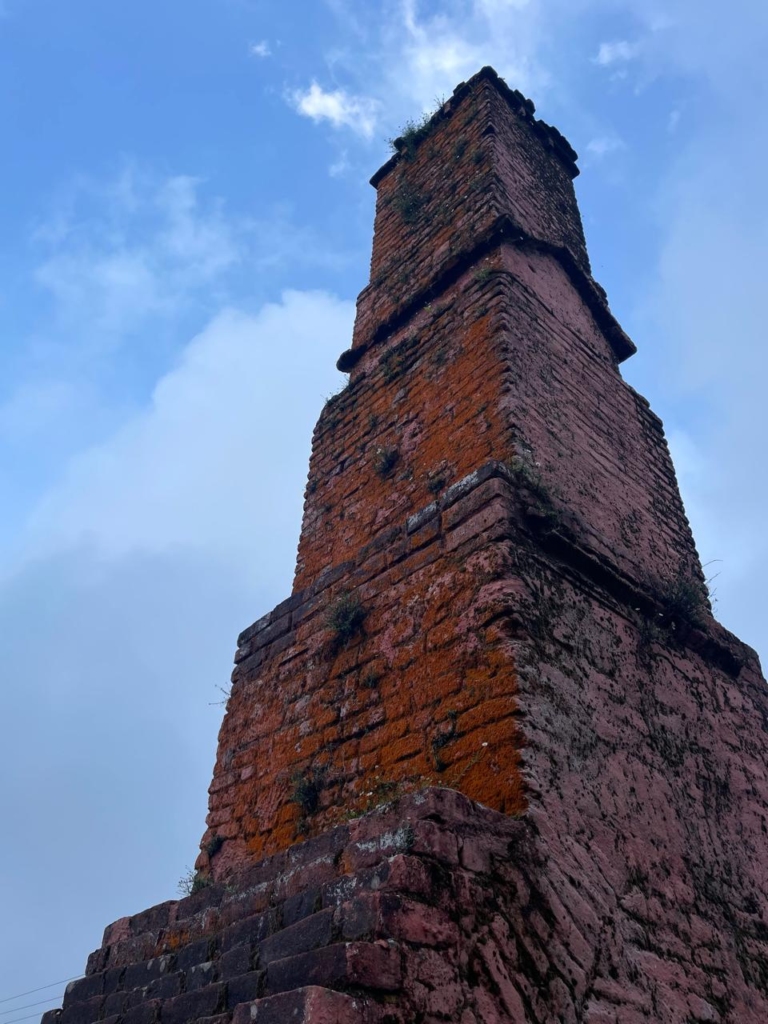
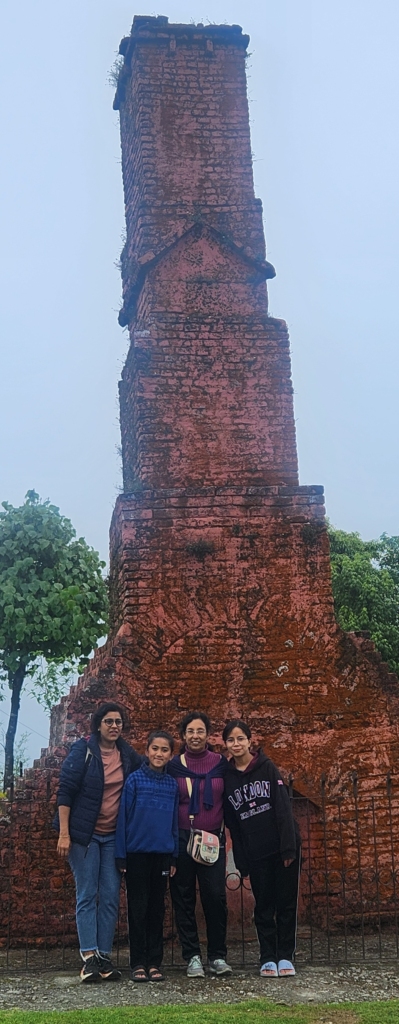
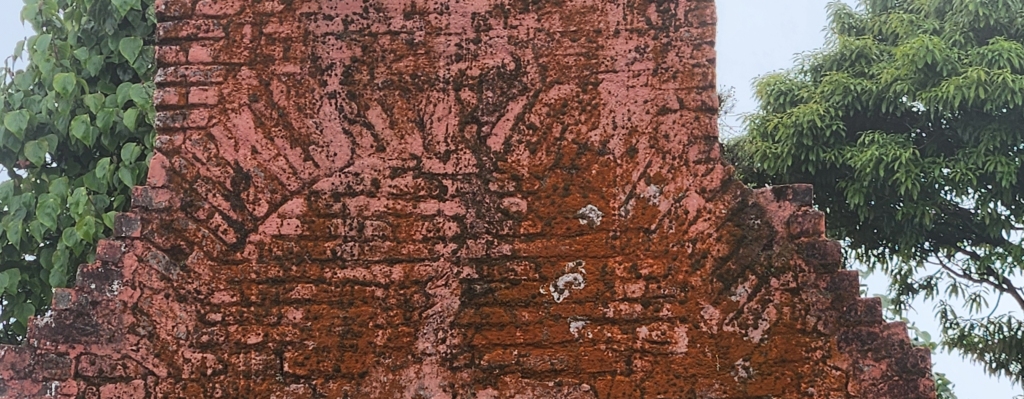
Literally running, we reached the Heritage Park just as it was about to close for the day. The park’s main attraction, a 24-foot high chimney, stood tall – a relic of a larger residential complex built during the British era. Today, only the chimney remains, partly tilted due to a recent earthquake. When we suggested nicknaming it the “Leaning Tower of Chimney”, the kids enthusiastically agreed with thumbs up. This chimney, more than a century old, was a fitting end to our exploration of Darjeeling’s history and charm.


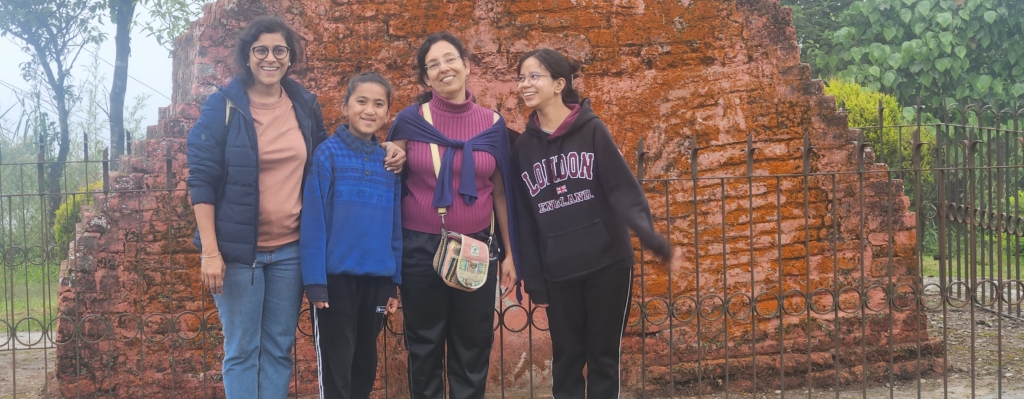
We strolled through the Heritage Park, immersed in its lush vegetation and numerous viewpoints offering spectacular vistas of the confluence of two major rivers, Teesta and Mahananda. Despite the fog obscuring a clear view of Kanchenjunga that day, the park attendant mentioned that on clearer days, one could even spot Sandakphu (Read More about Red Panda). The kids excitedly shared tales of a haunted spot nearby, but our limited time and impending flight the next day forced us to skip exploring further.
The kids suggested an alternative scenic road route back to the homestay, promising it was just five turns around the mountain. The journey became an adventure as we wound through isolated roads flanked by dense forests. Along the way, the kids recommended a visit to a local strawberry farm, though we arrived just after closing time. Nonetheless, we enjoyed the picturesque nursery, and MunMun couldn’t resist plucking a couple of ripe strawberries lining the path. Despite our familiarity with strawberries, the joy of picking them fresh from the farm was unparalleled.

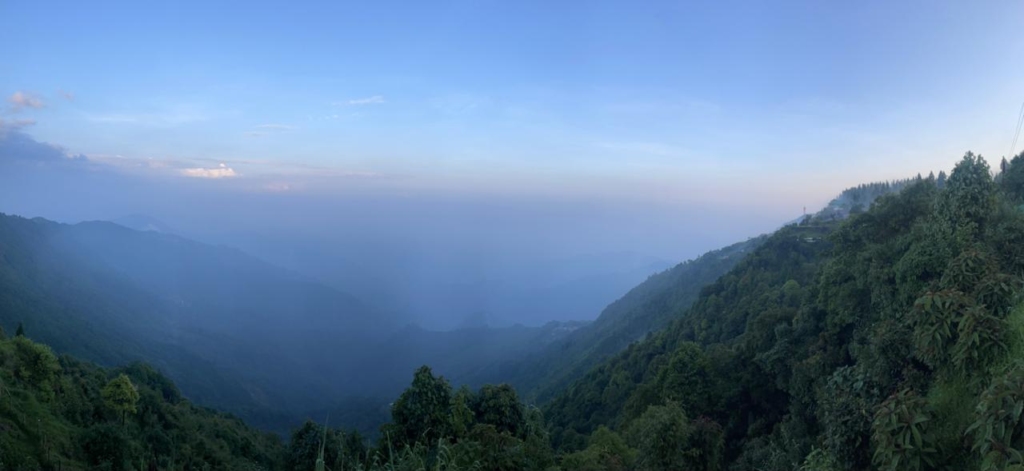
Contrary to the kids’ estimation of five turns, we must have navigated at least twenty bends before reaching the homestay. A valuable lesson was reinforced – never entirely trust mountain local estimates of distance and time. Despite the extended walk, none of us complained. While passing through a forest patch, Eden pointed out a group of spotted deer under a tree – a magical and surreal sight. I’ve encountered deer in wildlife sanctuaries before, but seeing them here in their natural habitat was a uniquely enchanting experience. They noticed us too, disappearing swiftly into the forest before we could capture them on camera.
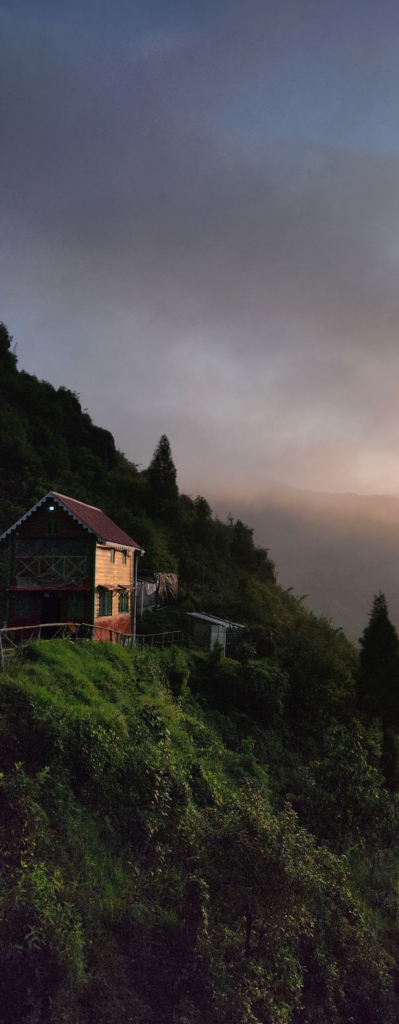
Back at the homestay, Jamuna greeted us with refreshing tea. We expressed our heartfelt gratitude to Nima and his entire family for their exceptional hospitality, which made our stay unforgettable.
Nima assisted us in transitioning to our final homestay of the trip. Kunal, the owner of the neighbouring property was eagerly awaiting us.
The homestay was nestled at the end of a mountain trail, commanding a breathtaking view of the valley. The property featured a spacious garden in front of the villa, culminating in a small viewing deck that made us feel secluded in a corner of the world. Kunal, along with his business partner, manages a network of homestays across the Darjeeling district.
They had secured this particular property on a long lease from a local villager. Introducing us to his wife Jyoti, we couldn’t help but ask if she was his business partner. With a chuckle, Jyoti replied that post-marriage, one inevitably becomes partners in every aspect of life, whether or not one loves it – a sentiment that resonated with us all.
Due to an unexpected staff shortage, Kunal and Jyoti were personally managing operations during our stay. Although we didn’t have ample time to chat with them, they ensured our comfort and shared interesting anecdotes, like the regular evening visits of a porcupine couple to the kitchen backyard, which didn’t occur that evening.


Enchanted by the homestay’s location, I wished we had a few extra days to savour Kunal’s hospitality and explore the surrounding area. Dinner, though simple, was delicious, prepared with care by Kunal and Jyoti. The toilet, enclosed within a tin structure inside the villa, was surprisingly embraced by MunMun as a luxury in this region. With our shopping safely repacked, we called it an early night, leaving the windows open to relish the cool mountain breeze. Samir was scheduled to pick us up at 9 am sharp the next day for our airport transfer – a bittersweet farewell from the serene hills of Chimney and the warm hospitality of its people.

Day 9: Chimney – Bagdogra – Hyderabad – Mumbai
50 Kms. / 1.30 Hrs.
As our holiday drew to a close on the final day, we all rose early to soak in the serene morning in Kunal and Jyoti’s garden, observing the local birds in their natural habitat. MunMun and Tazo eagerly took on the task of feeding the birds, though it was evident that the birds preferred hunting their own prey to the bland offerings of cooked rice. We witnessed an impressive display of nature as a bird swooped down from a tree, effortlessly capturing a flying insect mid-air – a testament to its swiftness and agility, considering the insect was a fraction of its size.
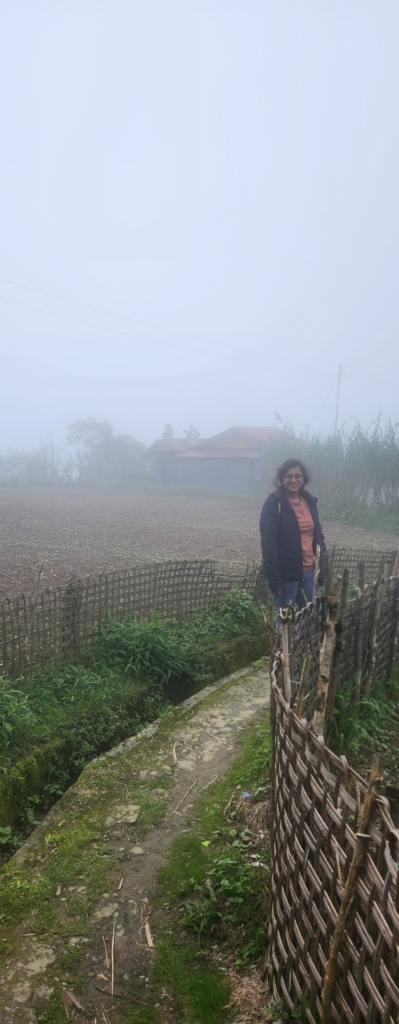

While we longed for a steaming cup of tea, Kunal and Jyoti were still asleep when we called out to them, prompting Lapha, a staff member at the homestay, to fetch a gas cylinder for our morning brew. Eventually, our tea arrived, accompanied by a hearty breakfast. Samir arrived punctually, signaling it was time to bid farewell to the misty mountains. We exchanged warm goodbyes with Kunal and Jyoti, grateful for their hospitality.
En route through Kurseong, we encountered groups of college students strolling down the street, dressed impeccably in suits and sarees, presumably celebrating their graduation day from the reputed convent schools in the town, as Samir informed us.

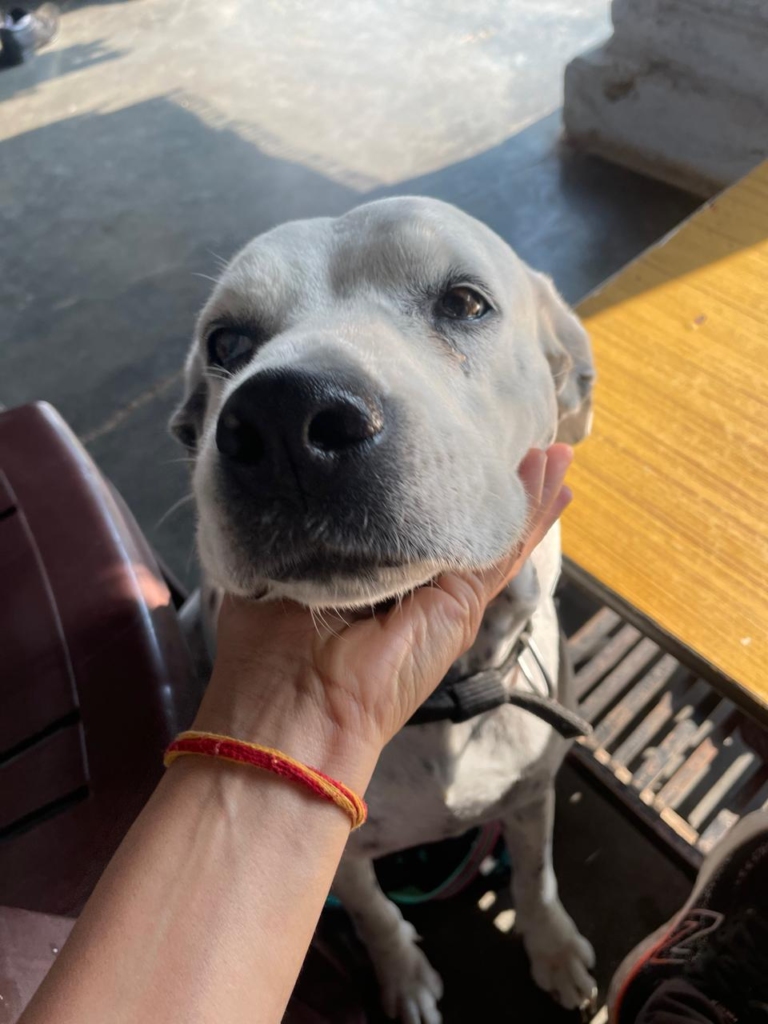
During our drive, we spotted local Bhutia dogs roaming the streets, prompting MunMun to reminisce fondly about her pet Dalmatian, “Angel”, recounting Angel’s endearing quirks and behaviours whenever she returned home during holidays.
Coincidentally, just as we discussed the possibility of MunMun adopting another dog to keep Angel company in her old age, MunMun’s brother messaged her, seeking her preference between a Labrador and a German Shepherd.
We all agreed on the German Shepherd, though offering advice is far easier when one isn’t responsible for caring for the pet.
Upon our return to Mumbai, MunMun received a poignant call from her mother, revealing that Angel had peacefully passed away during our travels – an unspoken connection and a powerful signal of the bond MunMun shared with her beloved pet.
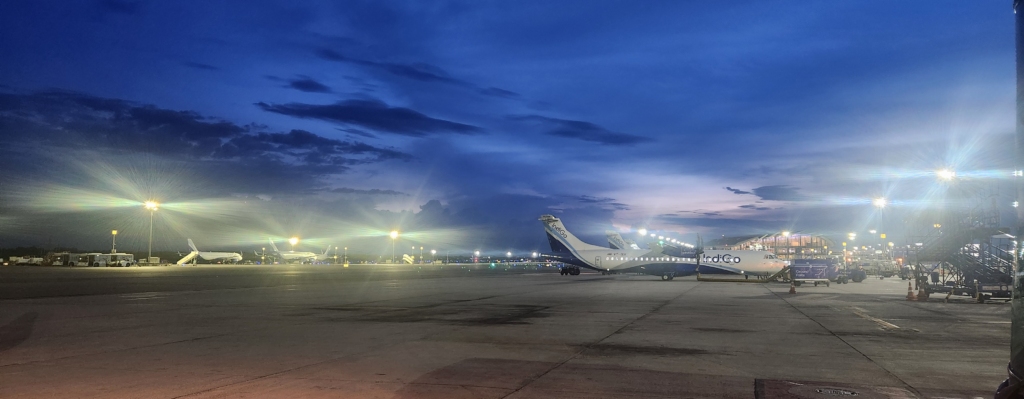
At Bagdogra airport, we stumbled upon the Biswa Bangla outlet, where MunMun and I indulged in another round of shopping. We were so absorbed in our purchases and Tazo was engrossed in her laptop that we lost track of time. By sheer luck, we heard MunMun’s name being called for boarding. It was a close call, as we ended up being the last passengers to board the plane.
Our flight back to Mumbai via Hyderabad was a cost-saving choice. However, the layover at Hyderabad airport turned into yet another shopping spree, causing us to question the wisdom of saving on flight tickets. Upon finally arriving back in Mumbai, amid the polluted haze of our urban jungle, we found comfort in the memories of the pristine natural beauty and warm hospitality we had experienced. Despite some last-minute permit issues, the trip had been filled with activities and fun, leaving us with a sense of fulfillment.
In summary, our journey was marked by the profound connections forged with both people and nature, leaving an indelible imprint of love on our hearts that is sure to endure.
Gallery










Sukumar Jain, a Mumbai-based finance professional with global experience, is also a passionate traveler, wildlife enthusiast, and an aficionado of Indian culture. Alongside his career, which includes diverse roles in international banking and finance, he's working on a wildlife coffee table book and enjoys sculpture and pottery. His interests span reading non-fiction to engaging in social and global networking.