
Timeless Cambodia: Uncovering the Beauty of Ancient Ruins – Coming Soon!
Day 1: Siem Reap Outskirts & Homestay
The two-hour flight from Hanoi to Siem Reap was delayed by a couple of hours, and my plan to catch the sunset at Phnom Bakheng in Angkor Archaeological Park shifted to a rather unromantic sunset over Hanoi Airport Terminal. It was around 8 pm, local time, when we finally touched down in Siem Reap. Walking out of the terminal, there’s a faint but unmistakable aura reminiscent of the communist past, a curious parallel to Hanoi’s airport. Likely, ours was the final flight of the day; the terminal felt hushed, nearly deserted, with only a few lingering shadows.

I quickly swapped my USD for Cambodian Riel at the currency counter, but my hopes of grabbing a SIM card were dashed; the shops had already closed for the day. Take note if you’re arriving late – it’s best to have a back-up plan for Wi-Fi if data connectivity is crucial on landing.
The city lies about a 40-minute drive from Siem Reap’s new airport. Sieng, with his ever-present, enthusiastic smile, was waiting eagerly as I stepped out. Dressed in his traditional short pants, he was a lively sight, eager to get me acquainted with his city.

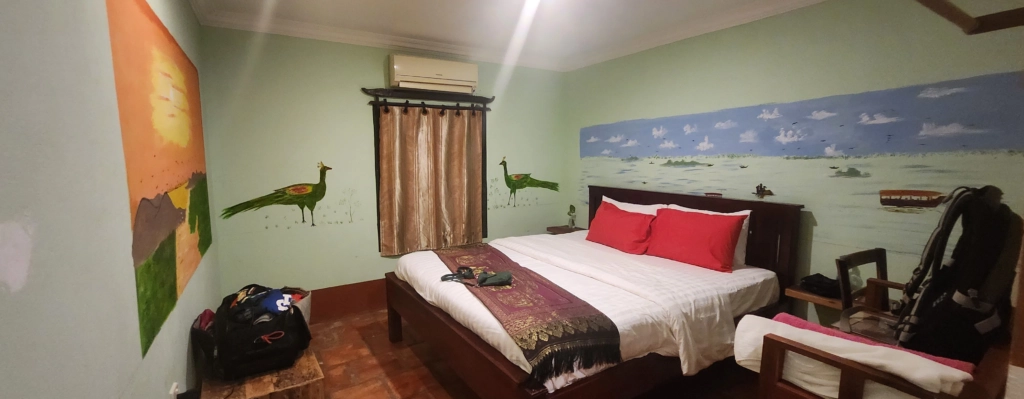
We made a stop at a street food market for a late evening dinner. The energy was contagious, with locals queuing up and the aroma in the air bringing back memories of those lip-smacking food joints back in India. After dinner, Sieng drove me to the homestay I was booked for the night, a cozy spot tucked away on the outskirts of the city. By the time we arrived, Kourn, the host, was already half-asleep. With a few quick directions to my room, he disappeared into the quiet night.
Day 2 (Part 1): Angkor Archaeological Park
Angkor Wat
Sieng was already waiting when I emerged just before dawn – likely around 5 a.m., ready to witness the sunrise over Angkor Wat. The temple complex sits just 7 km. from Siem Reap’s center, and since Kourn’s homestay was on the city’s edge, we were only a short drive away. The predawn darkness wrapped around us, and the quiet, empty roads had an almost magical stillness, broken only by the occasional hum of a passing motorbike.
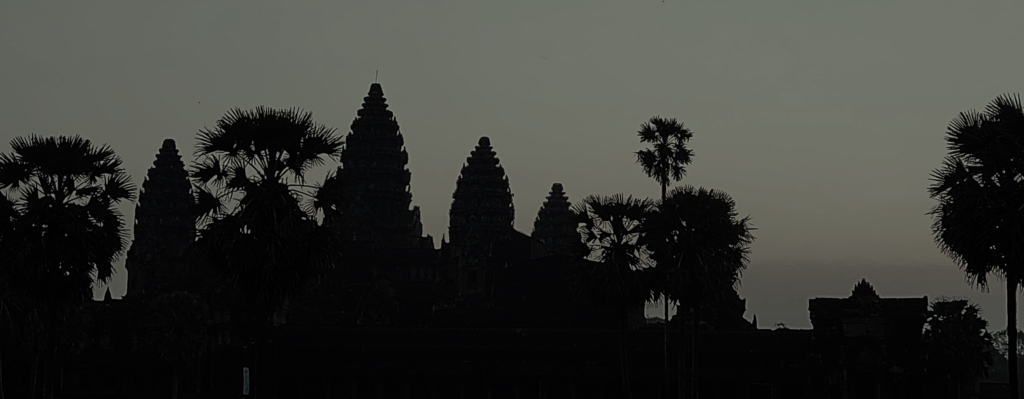
Chirpy and enthusiastic, Sieng was quick to adopt his role as a guide. His early morning chatter on the local culture and legends was endearing, though I was still only half-awake. At a check-post where my Angkor pass was verified, Sieng shared a nugget of language trivia. “Angkor”, he explained, means “city” or “capital city” in Khmer, and “Wat” translates to “temple grounds”, so “Angkor Wat” essentially means “Temple City”. With a smile, he added that the word “Prasat”, meaning “temple”, is sometimes used interchangeably in Khmer, though pairing it with “Wat” can sound redundant.

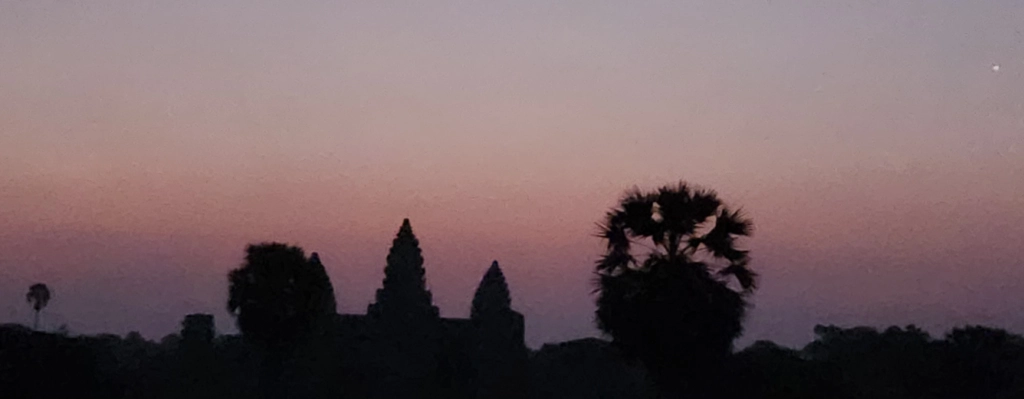
We entered through the west (main) entrance, and Sieng launched into a quick architectural overview with the enthusiasm of someone genuinely passionate about his culture. He described Angkor Wat as a vast rectangular complex surrounded by a serene, wide moat. As we crossed over the moat on the sandstone causeway, he pointed out its impressive width—200 meters—and explained how it encircles a perimeter of around 5 km. The grandeur of the scene began to wake me up fully. “Built in the 12th century by King Suryavarman II”, Sieng explained, “it is the largest religious monument in the world”. The core temple building itself covers about 21 acres, though the entire site spans roughly 400 acres and is dedicated to Vishnu, the Hindu god of preservation.
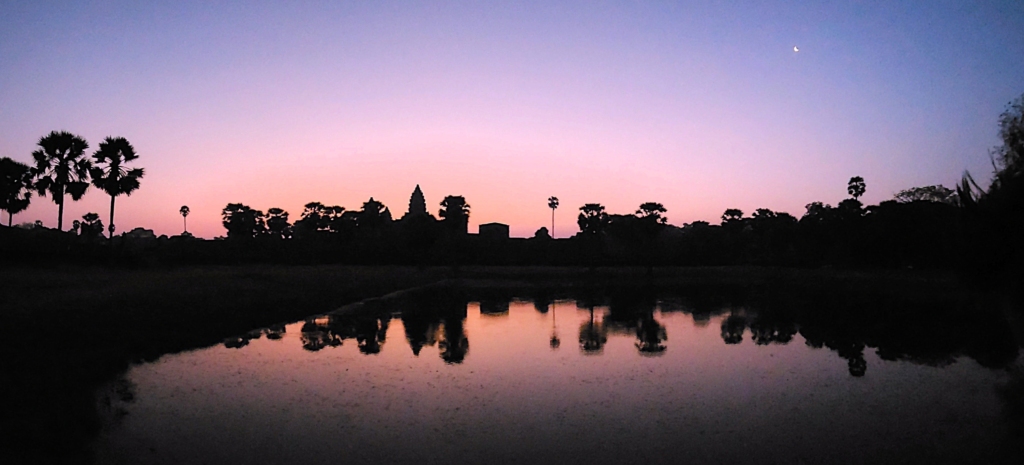
In a moment of delightful trivia, Sieng pointed out that Angkor Wat’s silhouette is featured on Cambodia’s national flag—likely the only flag in the world to showcase an entire national monument. It was the kind of fact that sneaks up on you, adding another dimension to the landscape as I gazed at the iconic outline before me.
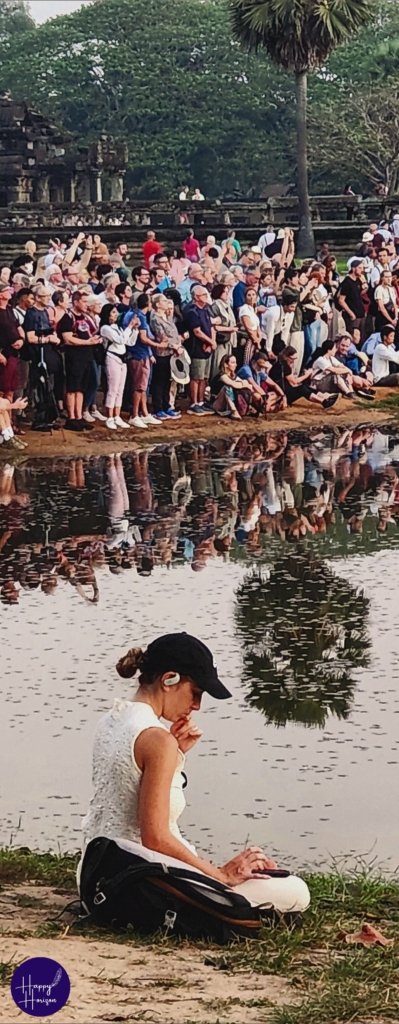
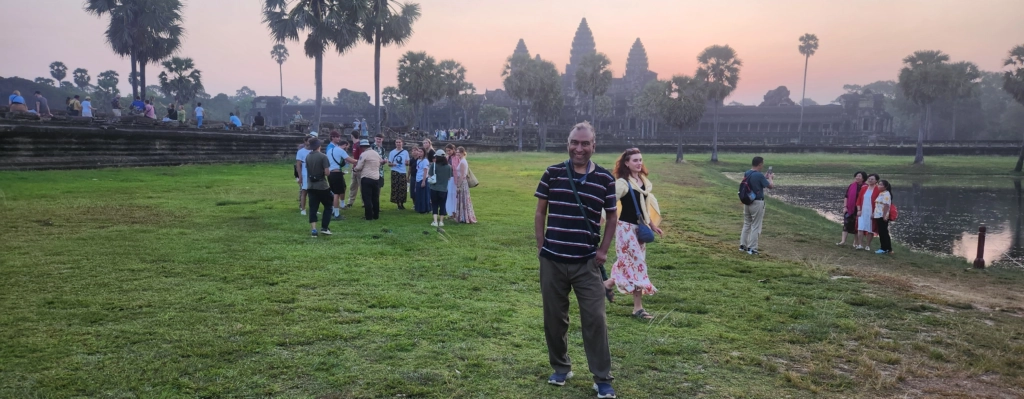
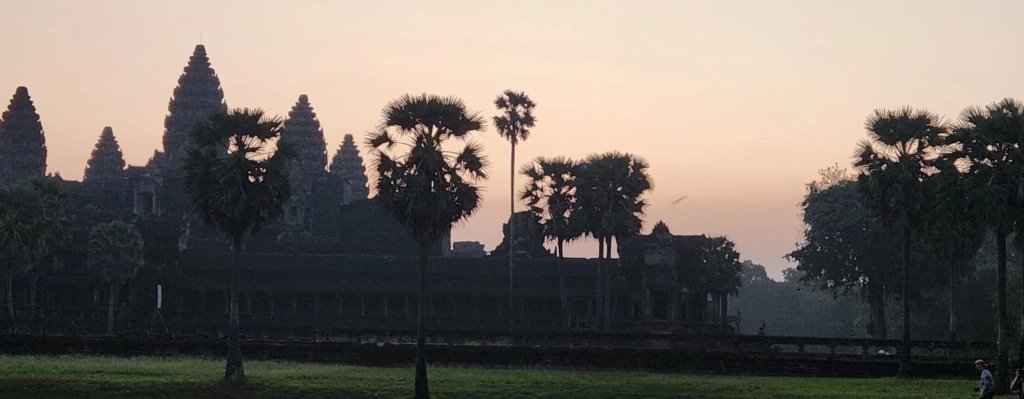
Carefully, we made our way down to the temple ground, stepping cautiously in the lingering darkness. To my surprise, the area was already alive with tourists, their voices a soft murmur as everyone claimed their prime spots for that magical first glimpse of sunrise over Angkor Wat and reflection of the temple in the lake. As dawn gradually unfurled, the silhouette of the temple stretched out before me, a vision both surreal and spellbinding. Though the clouds subdued the sunrise, the sheer scale and symmetry of Angkor Wat made up for it. Its intricately crafted structure left me in awe, a moment that felt timeless.

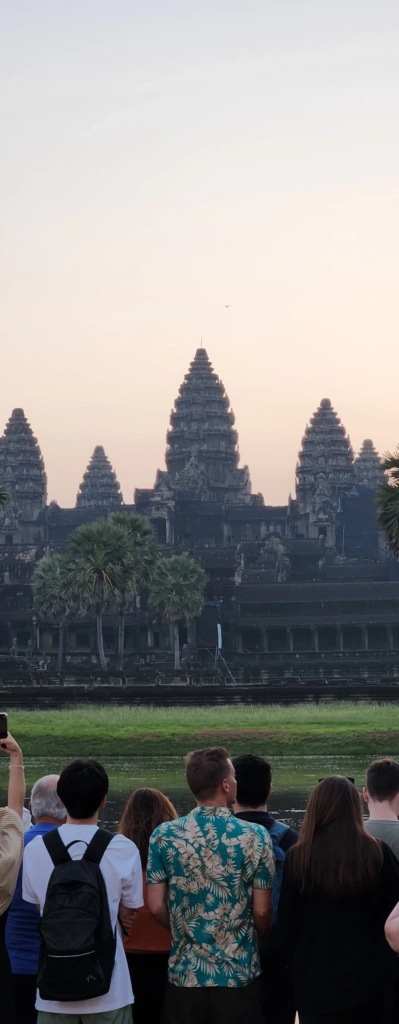
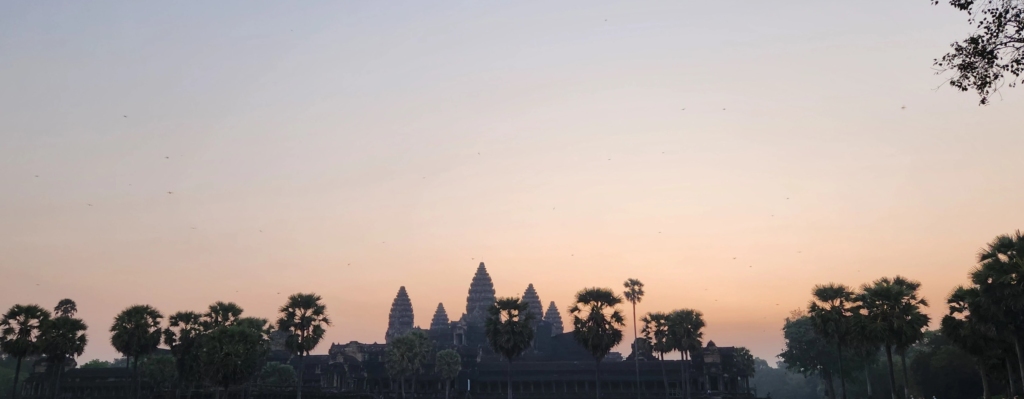
As I stood there, I couldn’t help but reflect on some of the monumental sites built through the ages—the Temple of Hatshepsut, Luxor, the Pyramids of Giza, Persepolis, and the Parthenon. These wonders were constructed at least 3,000 years before Angkor Wat. Of them, I’d only visited the Parthenon, back in 2002—a memory that still lingered vividly. But Angkor Wat? Its sheer size was staggering, and its detail almost incomprehensible without a guide or prior knowledge. Standing in midst of travellers from across the world, my purpose here wasn’t just to see but to understand—to piece together the history and design that make Angkor Wat so mesmerizing.
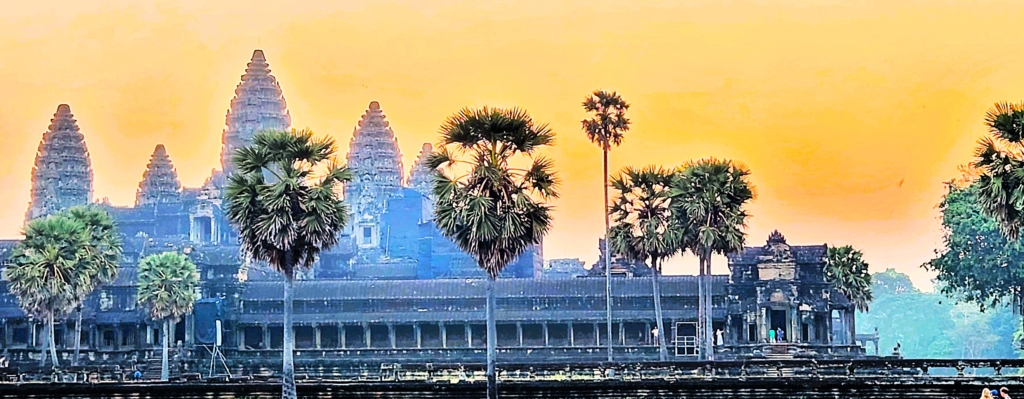
My purpose in writing this is to offer a concise layout of Angkor Wat, helping future travellers appreciate the era and context in which it was constructed. Angkor’s complexity can both captivate and overwhelm, but with a bit of context, it becomes even more mesmerizing. Click here if you wish to skip ahead and read a little more about Angkor architecture.
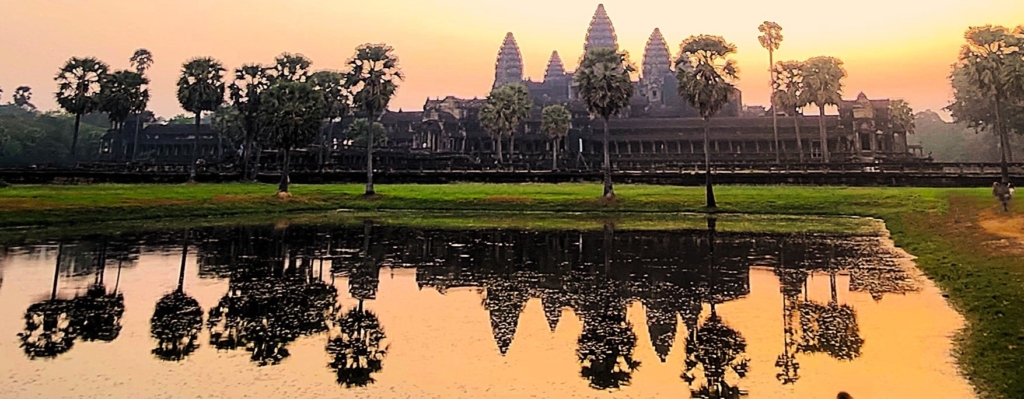
As we walked towards the temple building, the heat was palpable, far removed from the cool breezes of Ha Long Bay or Hanoi. Inside, however, the shade brought welcome relief, and the structure began to reveal itself as a journey upward through three levels of galleries, each one ascending above the last, drawing us upward in stages.

Level 1: The Outer Gallery
Our entry led us to the outer gallery, which encircles the entire temple. The walls were lined with intricate bas-reliefs, carved in shallow “bas” relief on pink sandstone, their details so delicate they seemed almost alive. The northern section of the western gallery told stories from the Ramayana, while the southern part illustrated the Mahabharata.
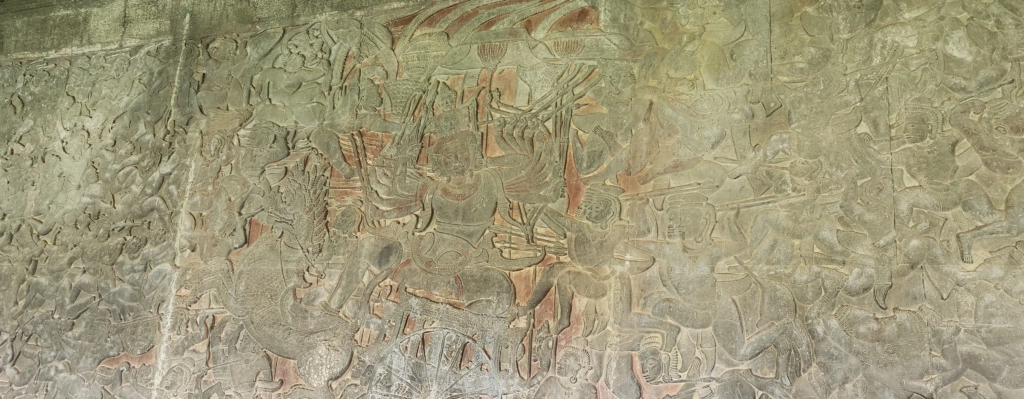
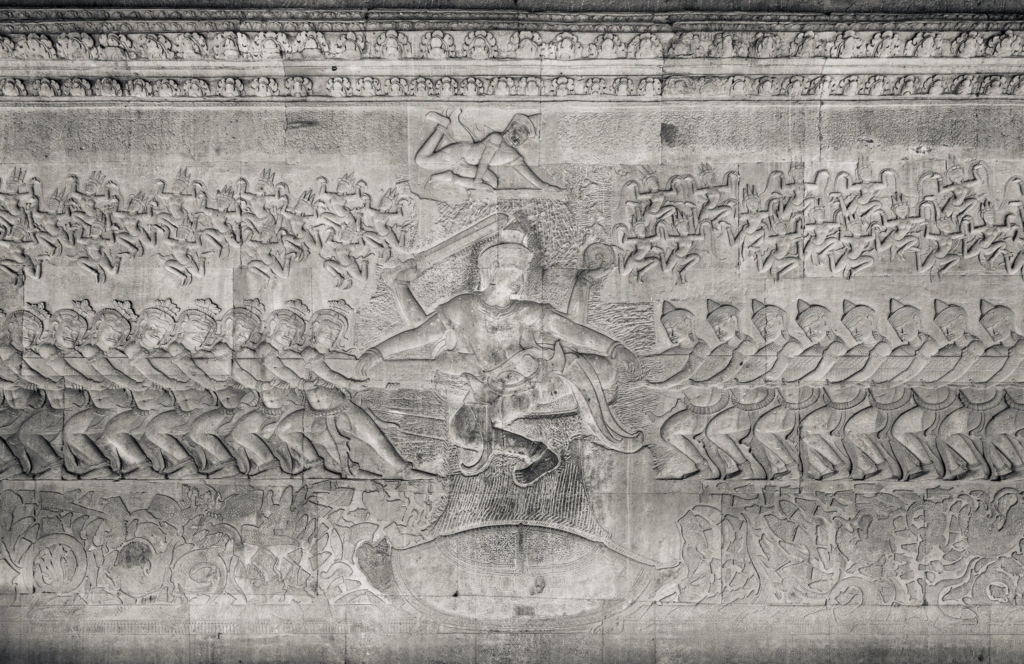
To the east, on the south wing, is one of Angkor’s most famous reliefs, The Churning of the Ocean of Milk, a classic of Hindu mythology. The details are stunning, with distinctly Eastern features, confirming that the temple’s artisans were indeed local.
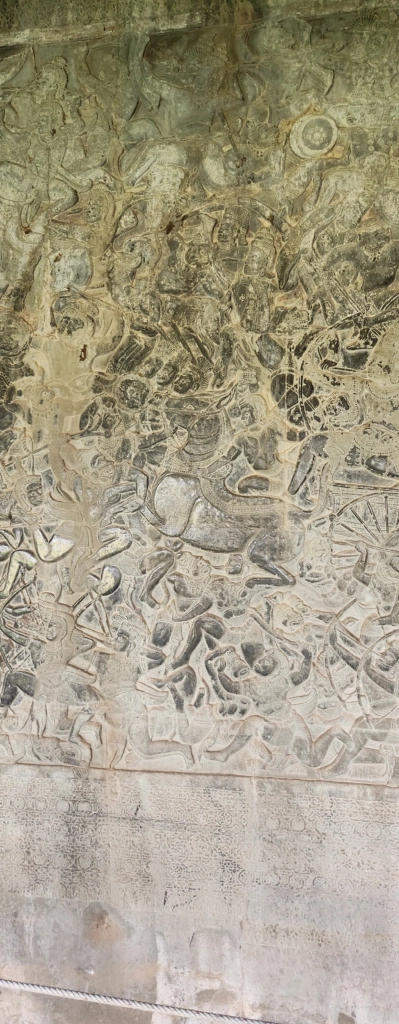

This gallery alone could occupy hours of exploration. Beyond its vast architecture, the outer gallery’s bas-reliefs stand out as one of Angkor Wat’s defining features. I recommend lingering here, walking the perimeter of the gallery and absorbing the artistry before moving deeper into the complex. Walking along the western wing, I couldn’t help but marvel at its sheer length, which emphasized the scale of the temple.
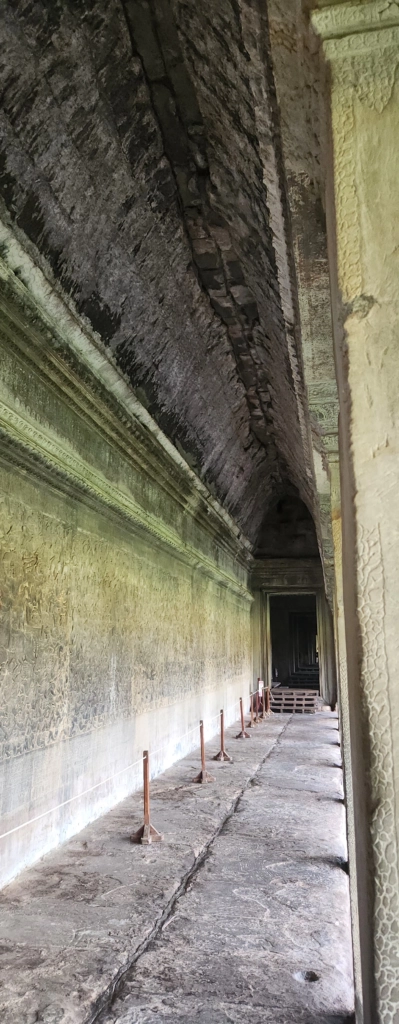
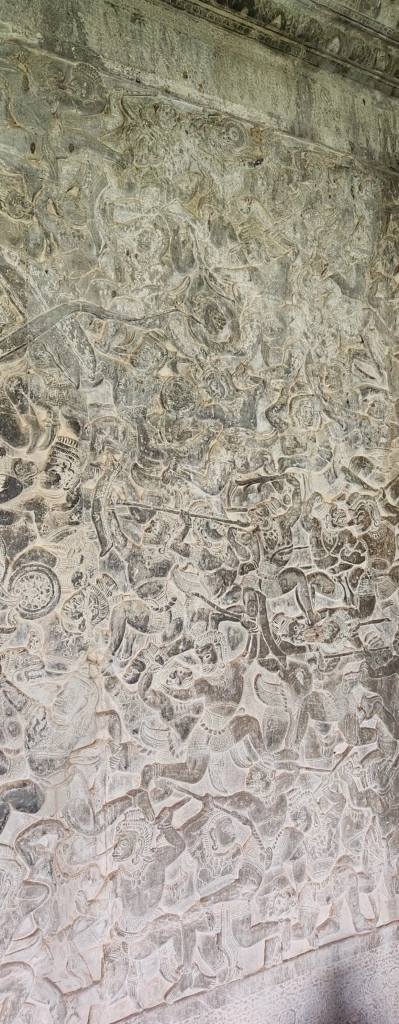
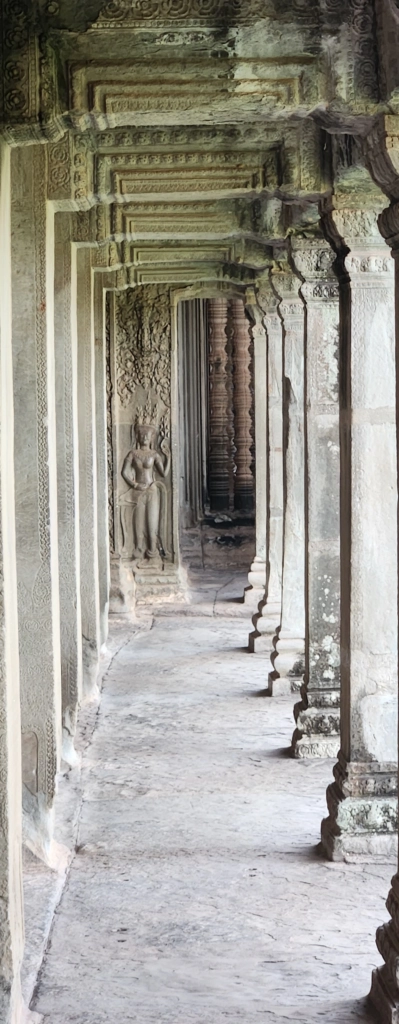

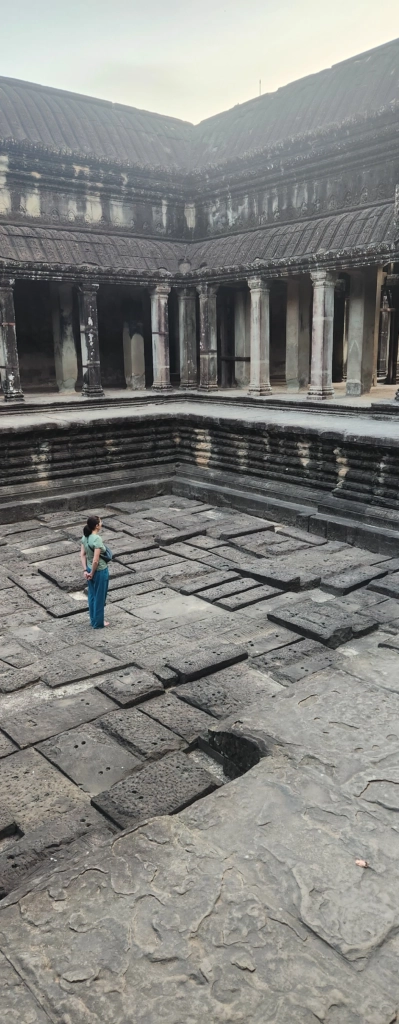
Past the gallery, we ventured into the temple’s core. Chambers, altars, and dry pools appeared, each meticulously crafted and adorned with sculptures.
Sieng and I kept circling back to the same question: why build such an enormous temple here, seemingly in the middle of nowhere? Curiously, with no trace of record or references. While Sieng shared theories, he admitted that the true origins remain a mystery—stories and interpretations have filled the gaps where history remains silent. Based on my conversations with Sieng and others, I’ve pieced together my own interpretation, why Siem Reap was the location. I have shared this at the end of this article. Click here if you wish to skip ahead and read it now.
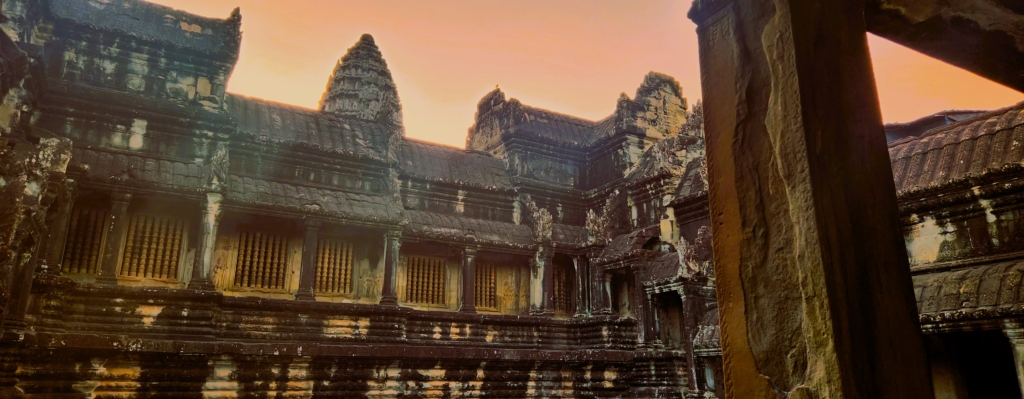
Level 2: The Apsaras’ Realm
We strolled down the corridor, gradually climbing a few steps, barely noticing we were ascending to the second level of the temple.
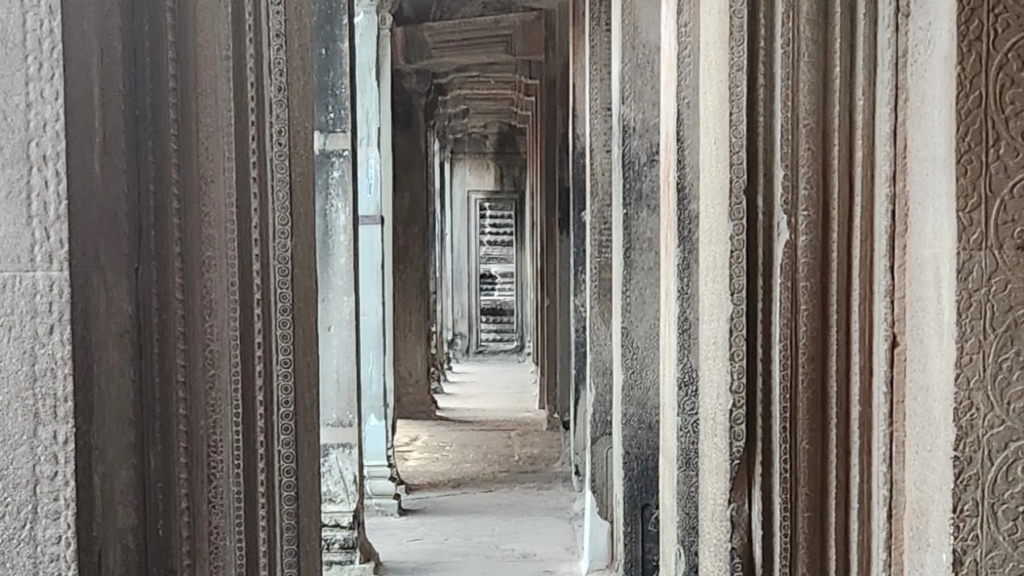
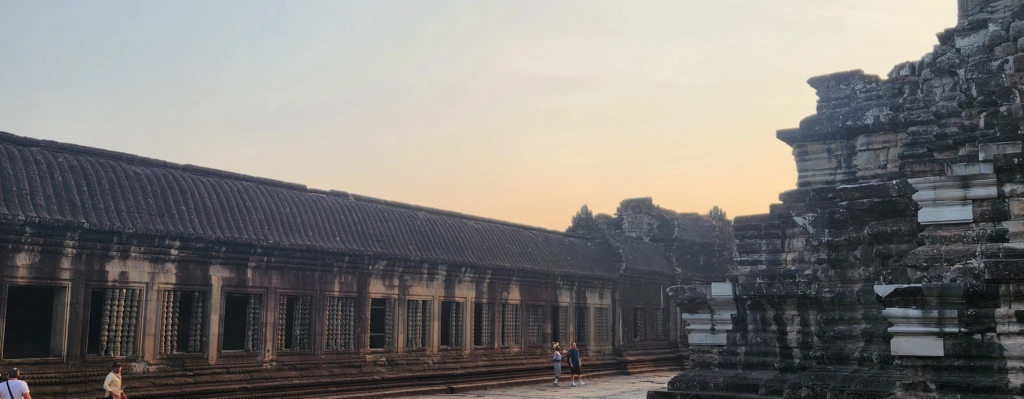
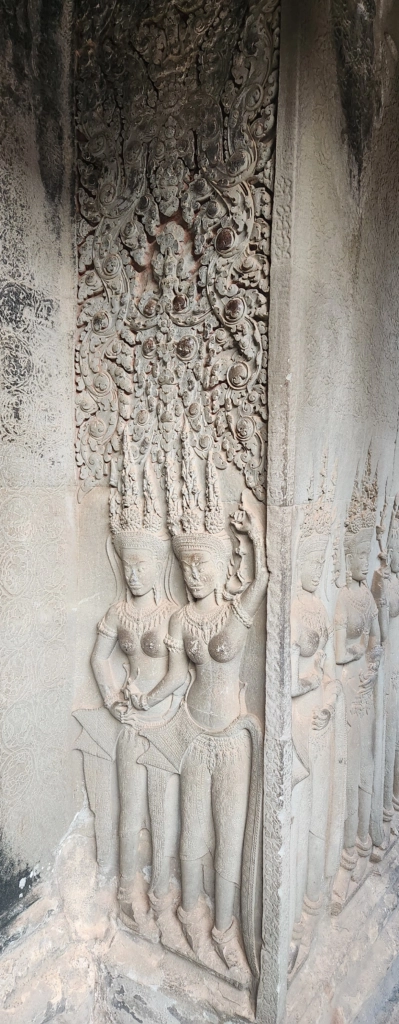
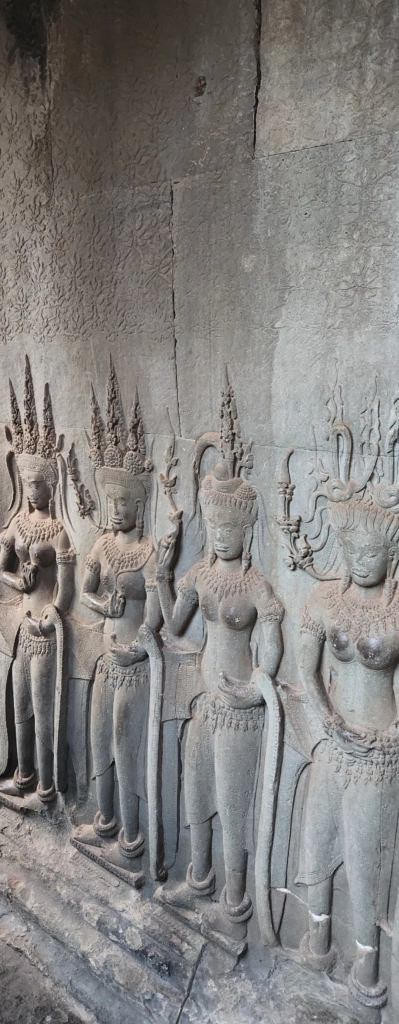
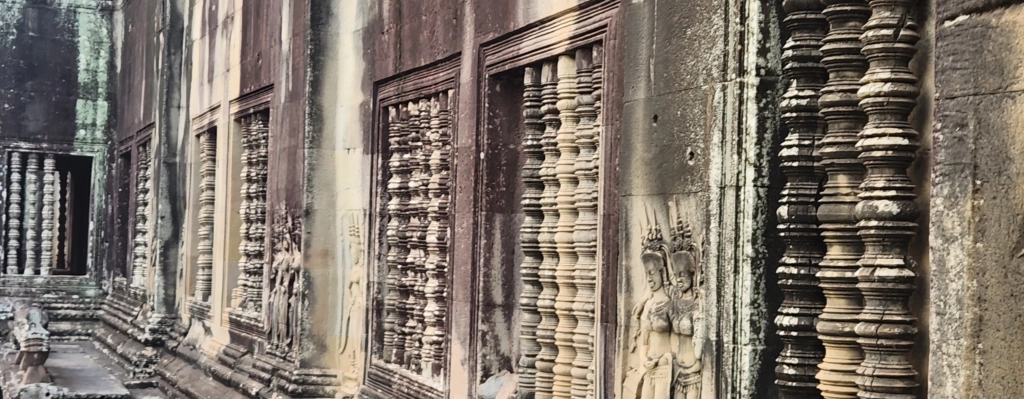
The courtyard walls on this level were alive with countless carvings of Apsaras, celestial dancers caught mid-movement in vibrant gestures. According to Sieng, over 1,500 Apsaras grace these walls, each one unique in her pose, creating an endless dance of spiritual enchantment. I smiled and agreed with him, mesmerized by their delicate beauty.
This level is open to the sky, and the heat urged us to find some shade as we planned our next steps. As we sat in the cool shadows, Sieng pointed out an exposed patch on the pyramid structure of the third level where the sandstone overlay had worn away, exposing the hidden core of laterite—a porous red stone. “The sandstone is easier to carve,” he explained, “but the laterite gives the structure its strength.” I couldn’t help but quip, “So, it’s beauty and brains?” Sieng chuckled softly, shaking his head at my joke.
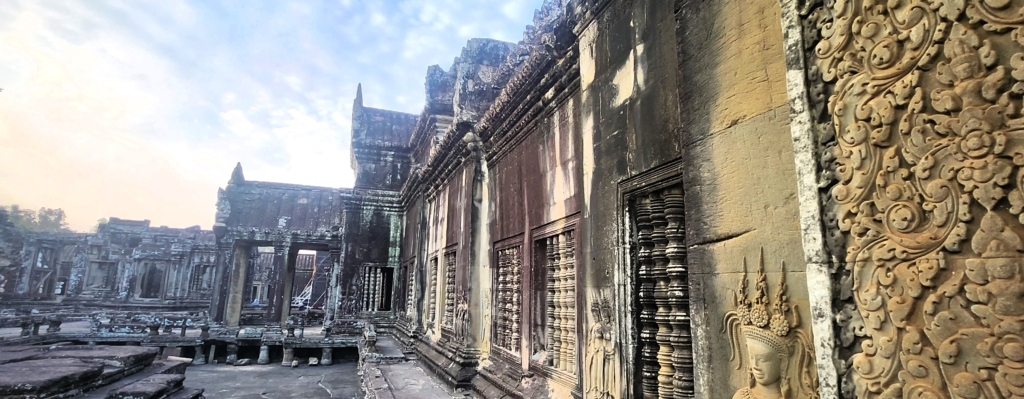
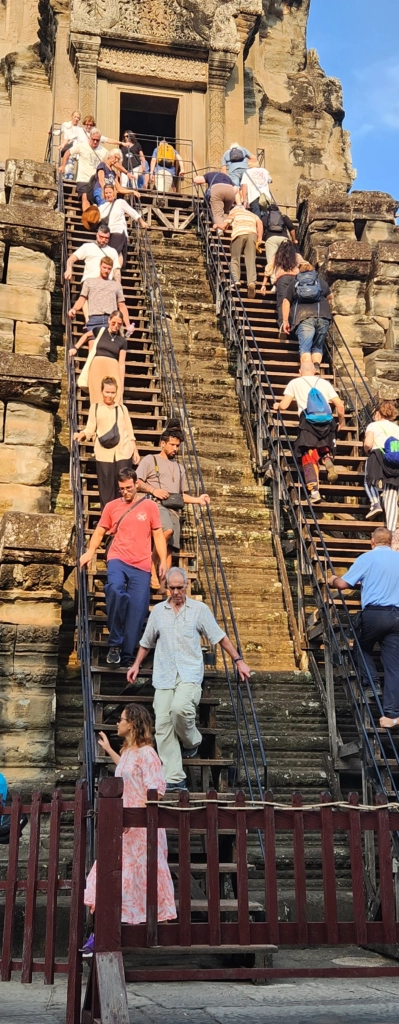
The courtyard here serves as a platform for the ascent to the final terrace – the sanctuary crowned by the iconic five towers. The original stairways leading to the third level have weathered over the centuries. Even in their prime, I imagine few would have dared to scale their steep ascent. The current makeshift-staircase to the main sanctuary rises at a steep angle of about 70 degrees; the original incline was likely even steeper – perhaps close to 80 degrees.


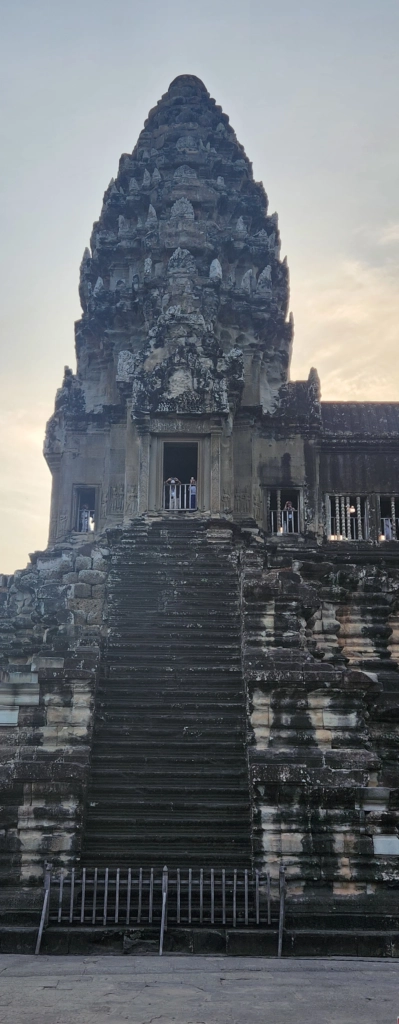
“Climbing those stairs was a symbolic act,” he said, “a way to separate oneself from the earthly world”. I couldn’t resist winking at him, telling him I was more than ready to take on the spiritual journey. Sieng, with a slight smile, urged me to reconsider, but from that day on, he never questioned my spirit. And to be fair, he was by my side every step of the way – a true friend through every ascent and journey.

Level 3: The Bakan Level
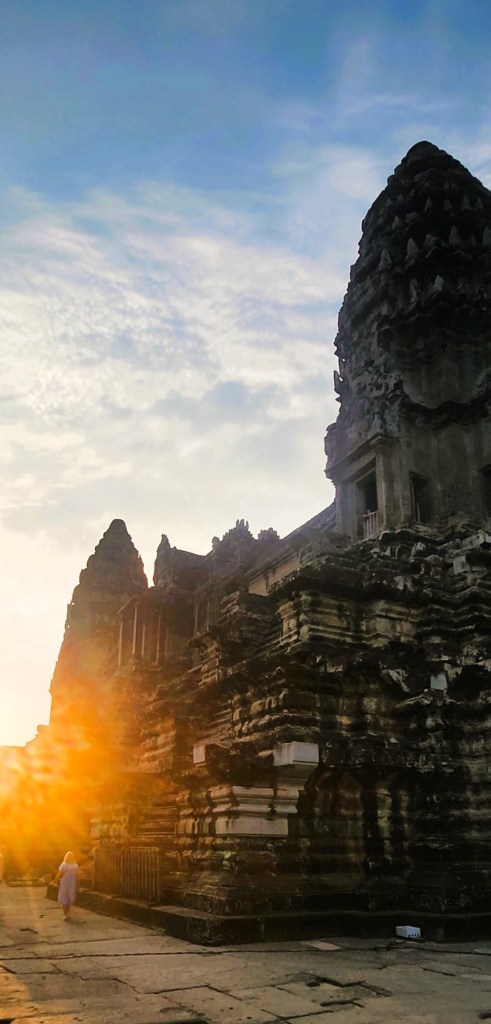
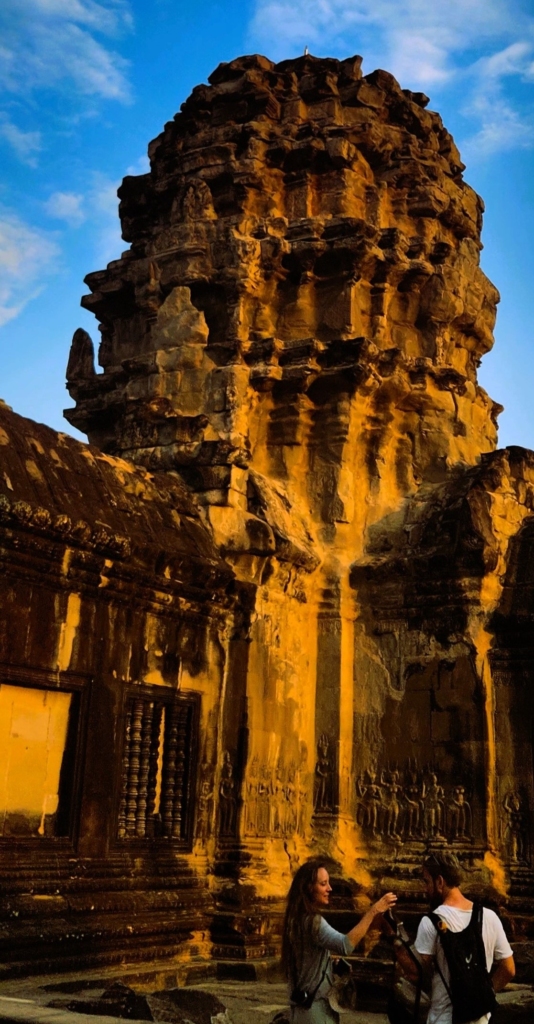
Finally, at the top of the stairs, about 30-40 meters up, we arrived at the third level—the temple’s highest point. A gallery walkway circled the perimeter, and from each corner rose the majestic towers, with porticos that offered panoramic views of the surrounding jungle.


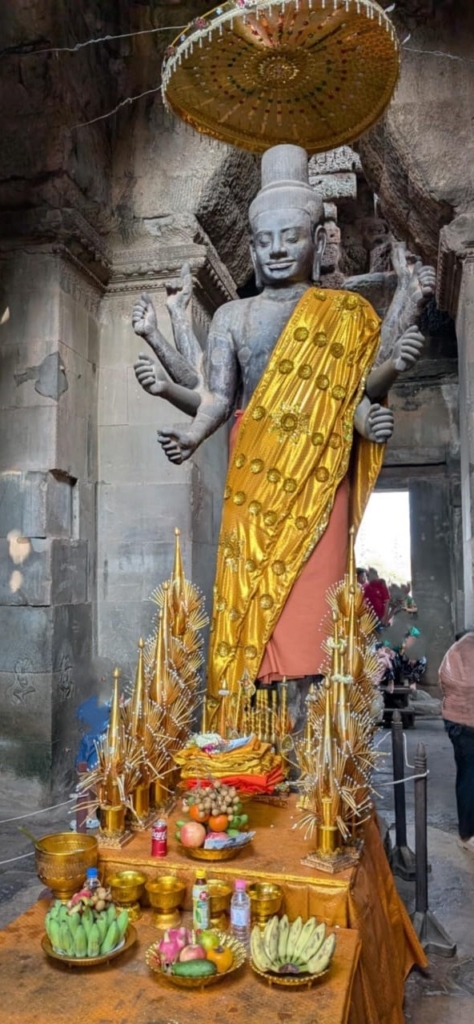
At the heart of this level lay the inner sanctuary, a square gallery beneath the central spire. Sieng explained that this sanctuary once housed a statue of Vishnu, the temple’s original deity, though the statue is believed to have been moved to the first level centuries ago. The central tower itself soared an additional 42 meters above the platform, a feat of architectural brilliance. We lingered for a moment, taking in the details and the serenity of the space, before beginning our descent.
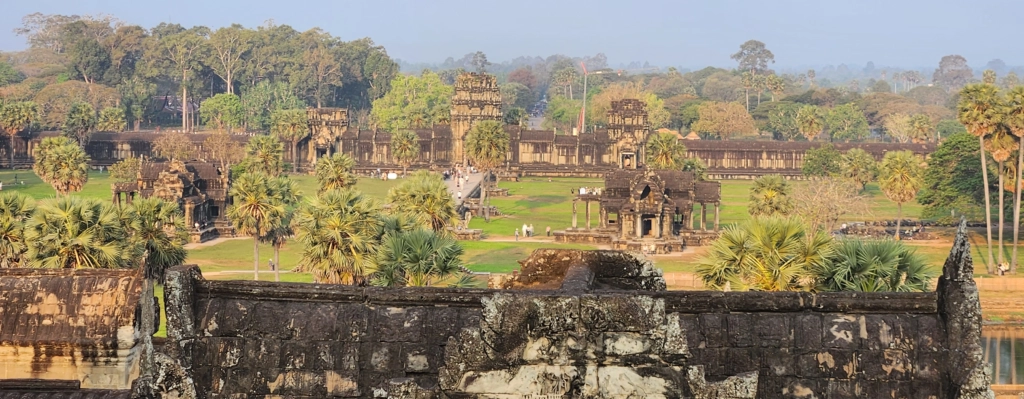
Mindful of our time and energy, we decided to conclude our Tour de Angkor Wat and set off for our next stop – Angkor Thom. As we walked back to the parking lot, the pathway from the temple to the moat was lined with Naga balustrades on either side, with the serpent’s body elegantly unfurling and ending in seven-headed sculptures. Massive stone lions stood guard near the entrance. Sieng pointed out how the Nagas and lions are iconic features in Cambodian monuments, each carrying layers of symbolism tied to protection and cosmic balance.



As we left Angkor Wat, I glanced back at its soaring towers, now bathed in harsh morning sunlight. The temple is more than a wonder of engineering or a masterpiece of art; it’s a profound testament to the spirit of an era—a place where faith, ingenuity, and ambition came together to create something truly eternal. Every step through its corridors felt like stepping into another realm, where each stone seemed alive, recounting stories of gods, kings, and the centuries they had watched unfold. But one thing was certain—Angkor Wat had left an indelible mark on me, much like it has on the countless visitors before me and undoubtedly will on those yet to come.

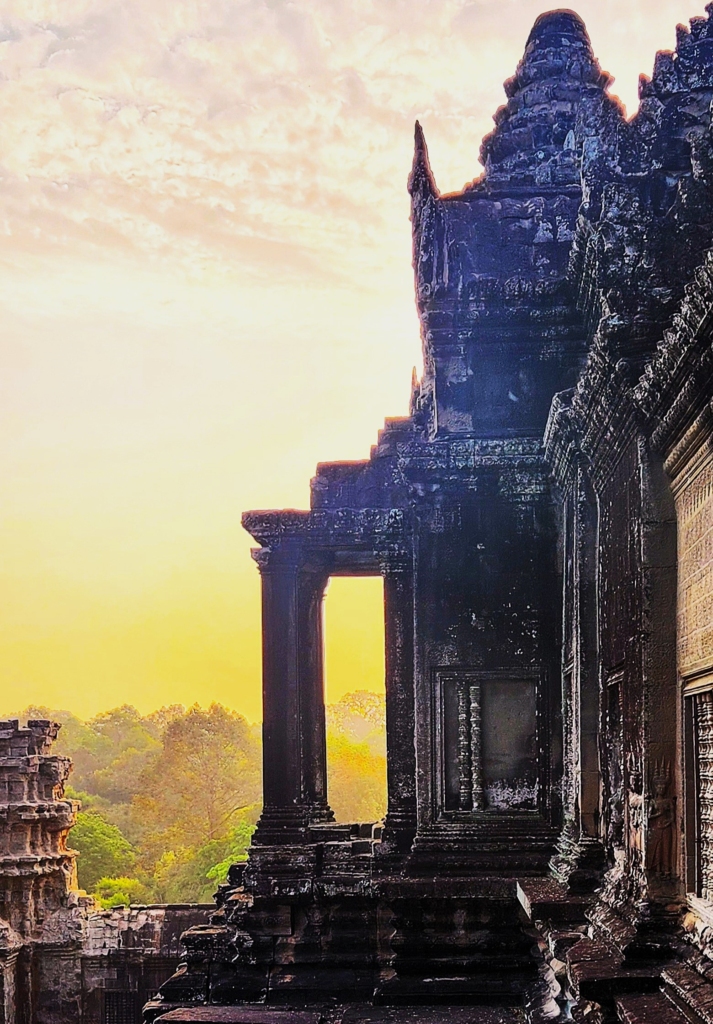
Over breakfast by the parking lot, I couldn’t help but reflect on the surreal experience Angkor Wat had given me. I mulled over the mysteries of this incredible place. Why here? Why then? And how? Some answers linger in its stones; others, perhaps, are lost to time.
Nota Bene (NB)
Brief Overview of Architecture of Angkor Wat
As we strolled back from the temple, I couldn’t help but marvel at the feat of engineering that Angkor Wat represented. The entire structure appeared to have been built from the inside out, laid upon a robust foundation with a precision that left no room for error. The three ascending levels were not just feats of design but of meticulous planning and execution, each gallery, corridor, and hall aligned with absolute accuracy to the cardinal directions. “Zero-degree error,” Sieng added with a grin, “not bad for a 12th century compass?” Remarkably, the entire temple was likely completed in around 40 years, a rapid construction by ancient standards.
What astounds me most is the mind of the architect who conceived this integrated marvel. It was a structure unlike anything the world had seen before, and nothing since has quite replicated its scale, symmetry, and harmonious design.
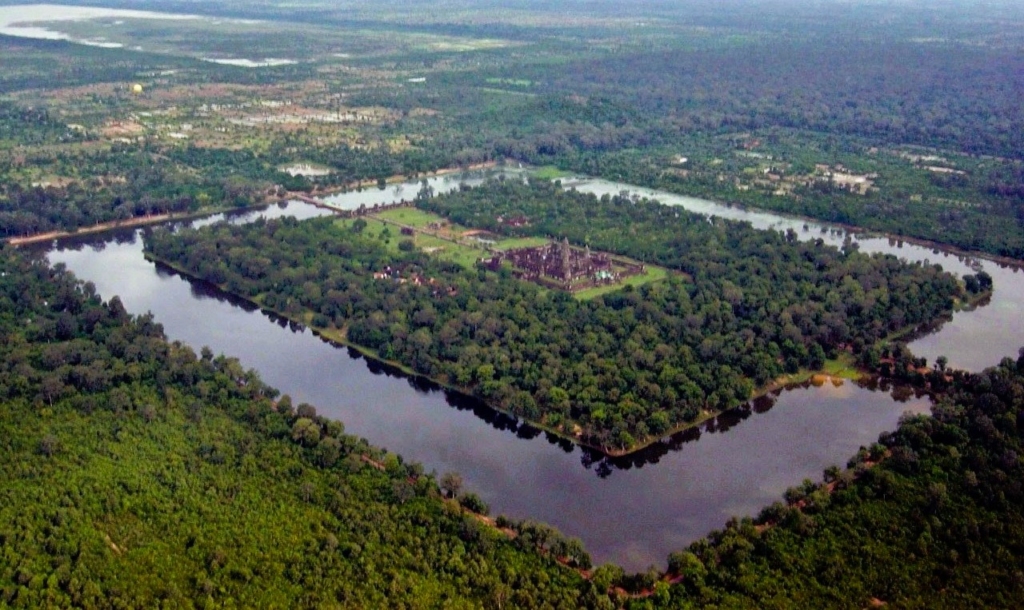
The hydraulic sophistication of the temple’s ponds, likely linked to the surrounding moat, also speaks volumes of their understanding of water engineering. This outer moat, which stretches north to connect with the moat of Angkor Thom and drains south toward the Tonle Sap, South-East Asia’s largest freshwater lake, is believed to play a stabilizing role. Sieng pointed out that the moat may support the temple’s stability by balancing groundwater levels beneath it, though no concrete evidence confirms this theory. Near the southern reflection lake lies a small vantage point – a place where all five towers of Angkor Wat can be seen rising in splendid symmetry.

The grey sandstone used for the temple came from a quarry in Phnom Kulen, some 50 kilometres away (“Phnom” meaning “mountain” in Khmer). Transporting these immense blocks involved canals, rafts, and a network of ramps along the Siem Reap River – a journey as impressive as the temple itself. To conserve sandstone for intricate carvings, the builders used laterite, a porous red rock, for the core (rock-fill) of the structure.

To put Angkor Wat’s scale into context, consider the Great Pyramid of Giza, which covers about 13 acres; Angkor Wat sprawls across 21 acres. While the Great Pyramid is estimated to weigh six million tonnes, Angkor Wat is composed of five to ten million stone blocks, weighing a total of around five million tonnes. And though these monuments are separated by more than 3,000 years, they share a legacy of mystery and wonder. Egypt is now firmly on my list.
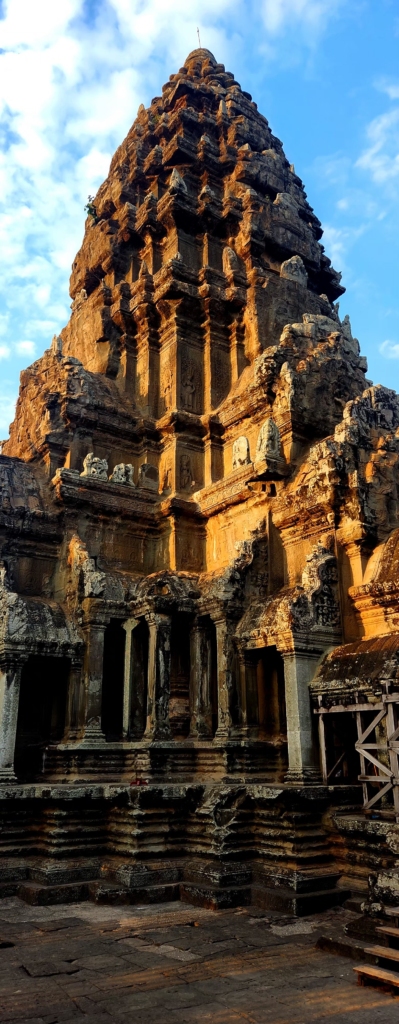
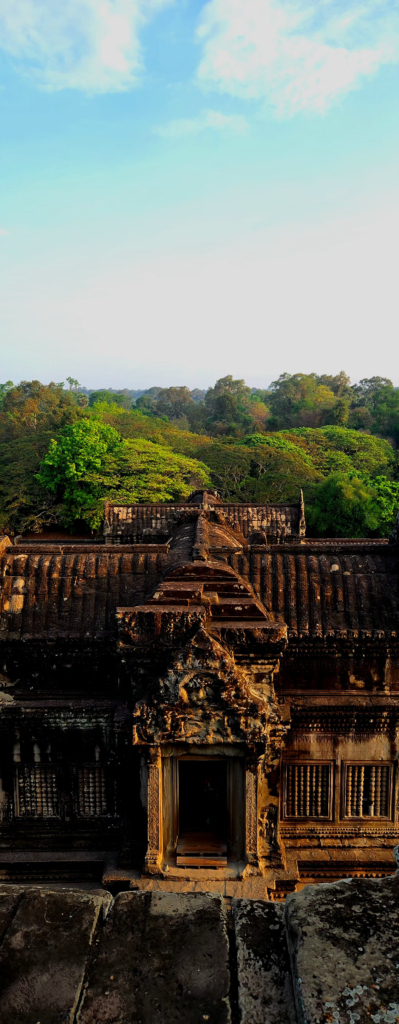
But as I left Angkor Wat, new questions filled my mind: Why was Siem Reap, this seemingly remote spot, chosen as the Khmer capital? And how did the Khmer Empire muster the resources to build something so immense and intricate as Angkor Wat? These are questions that linger, clues hidden in the stones and waters of this ancient wonder.
Why Siem Reap?
“Why build capital city in the middle of nowhere?” I asked as we reached the parking lot. Sieng’s answer, as always, was layered with history.
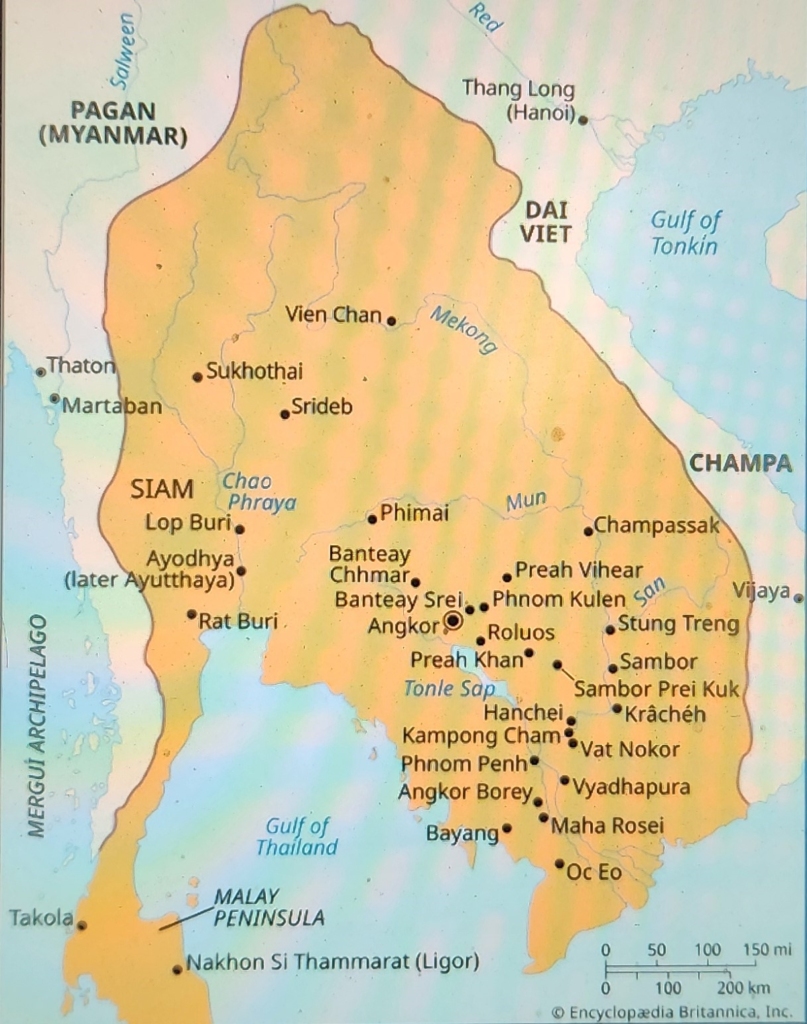
He began, “In its prime, Yasodharapura—what we now call Siem Reap—lay at the center of the kingdom stretched across what is now Cambodia and parts of Thailand, Laos, Vietnam, and even parts of the Malay Peninsula. Its central location within the empire made it ideal as a capital, and its proximity to the Tonle Sap, Southeast Asia’s largest freshwater lake, ensured access to abundant resources.
The Khmer people were masterful engineers, building an intricate network of reservoirs and canals to harness the seasonal floods of the Mekong River. This irrigation system allowed them to cultivate rice three to four times a year – an impressive feat when most civilizations were lucky to harvest twice at best. This bounty meant a steady food supply, and the canals ensured a year-round supply of fish, a crucial resource for the empire’s prosperity.
As the empire flourished, yet another lifeline developed: a trade route on the Old Silk Road, connecting southern India, via the Mekong, to China, with Yasodharapura at the heart of this vibrant trade network. This wealth from trade poured into the empire, fuelling the construction of grand monuments like Angkor Wat, each structure a testament to the riches and ambitions of the Khmer Empire. Siem Reap was more than just a capital; it was a thriving hub of innovation, culture, and spirituality – a fitting seat for an empire that aspired to leave a legacy for the ages.
Churning of the Ocean of Milk – Hindu Mythology
Angkor Wat’s layout is steeped in cosmic symbolism, designed as a physical embodiment of Mount Meru (also known as Mt. Sumeru) – the mythical five-peaked mountain believed to be the sacred dwelling of the gods in Hindu cosmology. Rising from its core are the iconic towers shaped like lotus blossoms, a tribute to Vishnu, the preserver and protector of the universe. In Hindu mythology, Vishnu is often depicted as a regal deity, standing gracefully on a double lotus pedestal, embodying divine authority and cosmic balance. The surrounding enclosure walls and encircling moat represent the mountain ranges and vast oceans thought to surround Mt. Meru, creating a miniature cosmos within the temple’s boundaries.
In Hindu tradition, Vishnu is a principal deity, alongside Brahma and Shiva, forming the divine trinity. Known as the god of preservation, Vishnu often manifests through avatars to protect the cosmic order. His incarnations, such as Krishna and Rama, have earned a place in the hearts of millions. Yet, it was notably uncommon among Khmer rulers to elevate Vishnu above Shiva as the primary focus of worship, making Angkor Wat’s dedication to Vishnu particularly striking. The reasons behind this choice remain a mystery, adding to the allure of Angkor’s history.
One of the most awe-inspiring mythological scenes at Angkor Wat is the Churning of the Ocean of Milk, a story that captures the eternal struggle between good and evil and the quest for immortality. This bas-relief, central to the temple’s spiritual message, illustrates the myth where devas (gods) and asuras (demons), under Vishnu’s guidance, join forces to release Amrita, the elixir of immortality, from the depths of the ocean. Using Mount Mandara as the churning rod and Vasuki, a giant serpent, as their rope, they engage in an epic tug-of-war. The devas hold Vasuki’s tail, while the asuras grip its head, pulling rhythmically to churn the ocean.

In the myth, the churning effort initially fails as Mount Mandara sinks into the ocean’s depths. Vishnu, embodying a tortoise, heroically supports the mountain on his back, allowing the churning to continue. As the ocean foams, Apsaras – celestial maidens – emerge, a recurring motif celebrated in exquisite carvings throughout Angkor Wat. On the bas-relief itself, you can spot 88 gods on one side, facing off against 92 demons on the other, locked in this cosmic struggle. At the center, Vishnu (representing Mt. Mandara) stands resolute atop his tortoise form, embodying the balance and perseverance needed to attain the Amrita.
This tableau tells a story beyond mythology – a reflection of human resilience, unity, and the enduring victory of light over darkness. It’s no wonder the Churning of the Ocean of Milk is among the most captivating narratives engraved on Angkor Wat’s walls, underscoring both the majesty of the gods and the human spirit’s unyielding quest for harmony.
March 2024
If you’re planning a trip to Angkor Wat / Siem Reap or travelling through Cambodia, we at HappyHorizon would be thrilled to curate holiday plans to enhance your travel experiences. Feel free to reach out to us: connect@happyhorizon.in
Day 2 (Part 2): Angkor Thom – Read More
Gallery





Sukumar Jain, a Mumbai-based finance professional with global experience, is also a passionate traveler, wildlife enthusiast, and an aficionado of Indian culture. Alongside his career, which includes diverse roles in international banking and finance, he's working on a wildlife coffee table book and enjoys sculpture and pottery. His interests span reading non-fiction to engaging in social and global networking.