
Day 2 (Part 1): Angkor Wat – Read More
Day 2 (Part 2): Angkor Thom
Background
Just 5 km. from the iconic Angkor Wat lies Angkor Thom, the enduring heart of the Khmer Empire and one of the crown jewels of the Angkor Archaeological Park. In Khmer, Angkor Thom translates to “Great City” or “Big City”, and its name is a fitting testament to its grandeur and historical significance.
As we drove towards Angkor Thom, Sieng, my ever-knowledgeable guide, offered a vivid glimpse into its storied past. He spoke of the prosperity of the Khmer Empire, a magnet for invaders like the Cham and Siamese (Thai). To counter these relentless attacks, King Jayavarman VII, in the late 12th century, envisioned and built Angkor Thom – a walled city, symbolizing resilience and invincibility. Spanning nine square km., Angkor Thom is laid out as a perfect square, with each side stretching 3 km. A 100-meter-wide moat encircles the city, emphasizing its defensive genius.
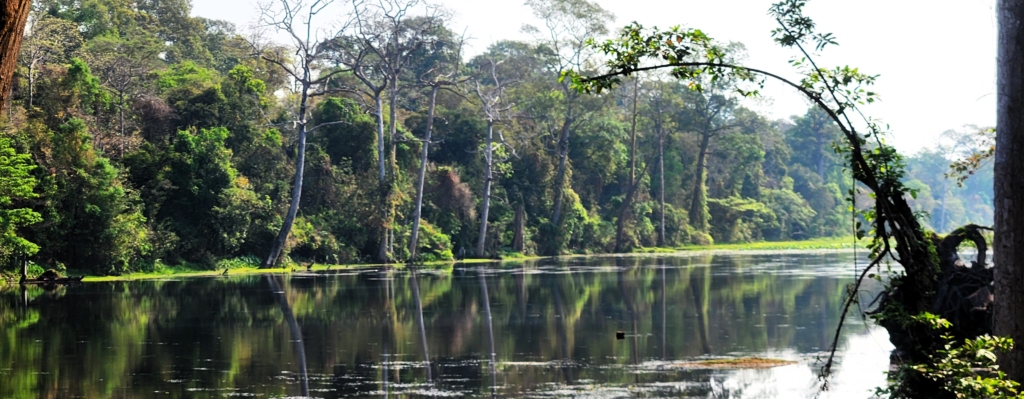
There are five monumental gates to enter the city – four aligned with the cardinal directions, and a fifth on the eastern side, the “Gate of Victory”—for good measure! At its heart, geographically and spiritually, is the enigmatic Bayon Temple, but our first stop was the South Gate, also known as Tonle Om.
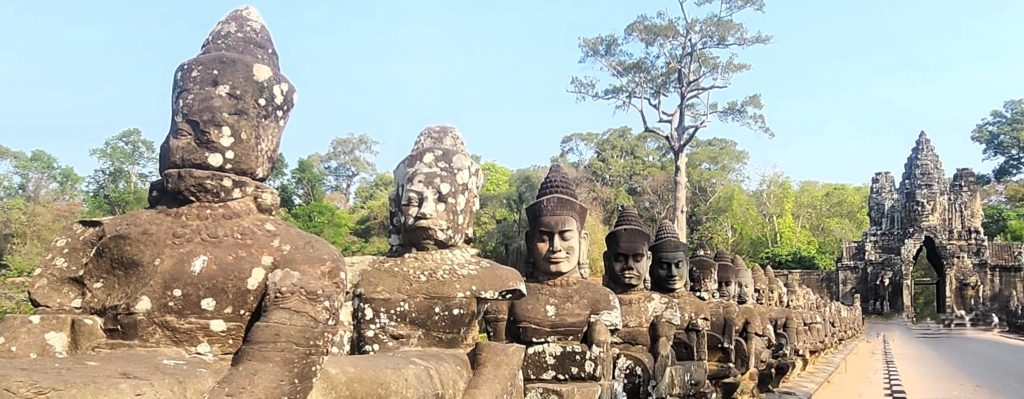
This city would become the last great capital of the Khmer Empire and also hold its reign until the 15th century. It was my second visit to a walled city this year, the first being the sprawling ancient marvel of Hampi.
Tonle Om (South) Gate
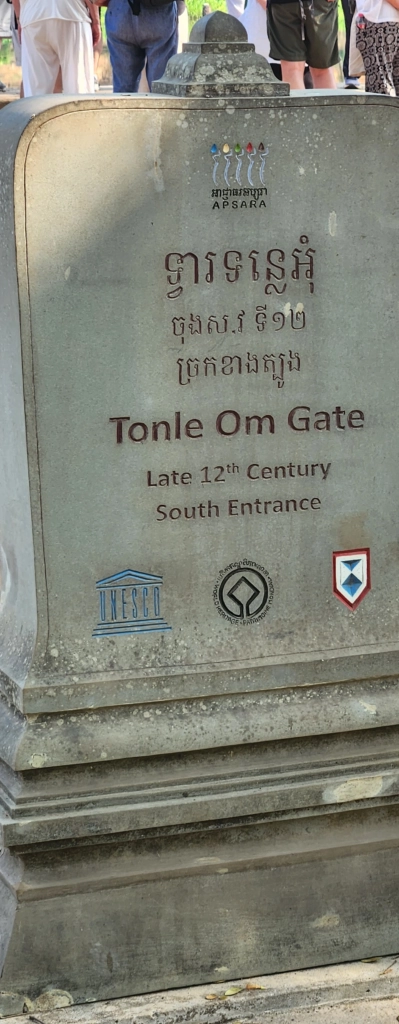
Our journey began at Tonle Om (South Entrance) Gate, the most well-preserved entrance to Angkor Thom. Tonle Om is a Khmer term that generally refers to a reservoir or pond located in front of a temple entrance.
As we neared the causeway, Sieng paused to explain its intricate details. He warned me there would be no parking nearby, so I would need to explore the passage by myself while he would wait on the other side of the entrance gate.
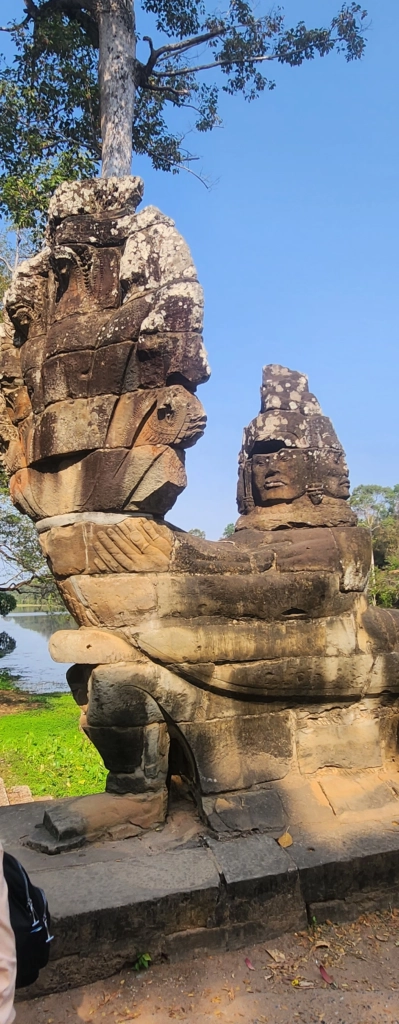
The approach to the gate was mesmerizing. The beginning of the causeway is adorned with immense stone carvings of the seven-headed Naga serpent.
Flanking either side of the causeway, a row of 54 colossal figures – Devas on the left and Asuras on the right – stand locked in a perpetual tug of war, each gripping the serpent’s body, which forms the balustrade.
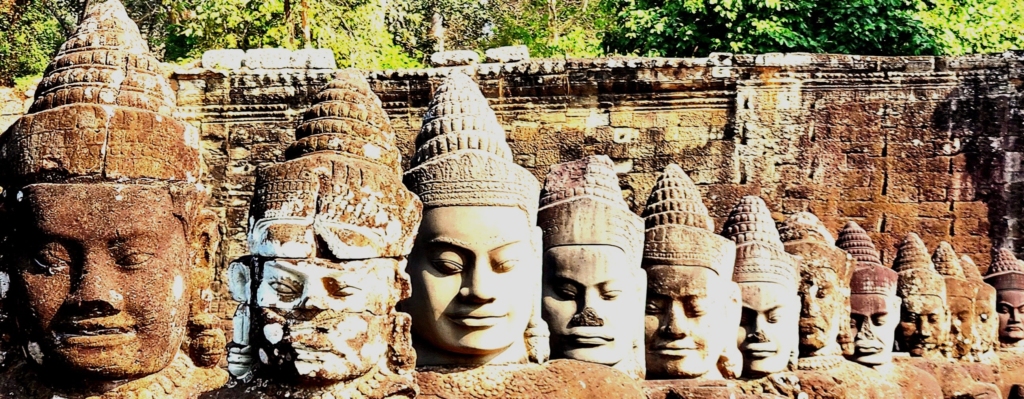

The serene faces of the Devas contrast sharply with the grimacing, bulging-eyed Asuras, symbolizing the cosmic struggle between good and evil. This imagery is a direct reference to the Samudra Manthan, the Hindu myth of the “Churning of the Ocean of Milk”, also beautifully depicted at Angkor Wat.


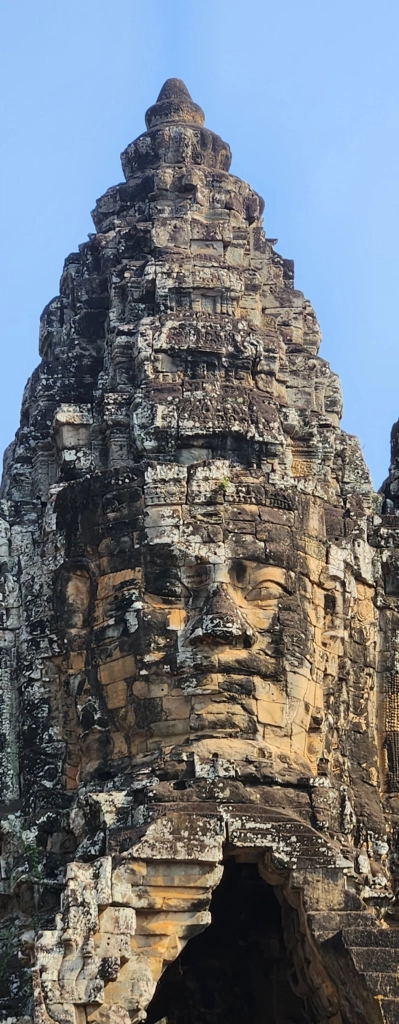
The entrance gate itself is a marvel. The towering gate stands 23 meters tall, crowned with four serene faces gazing in each cardinal direction – a signature of Khmer artistry.
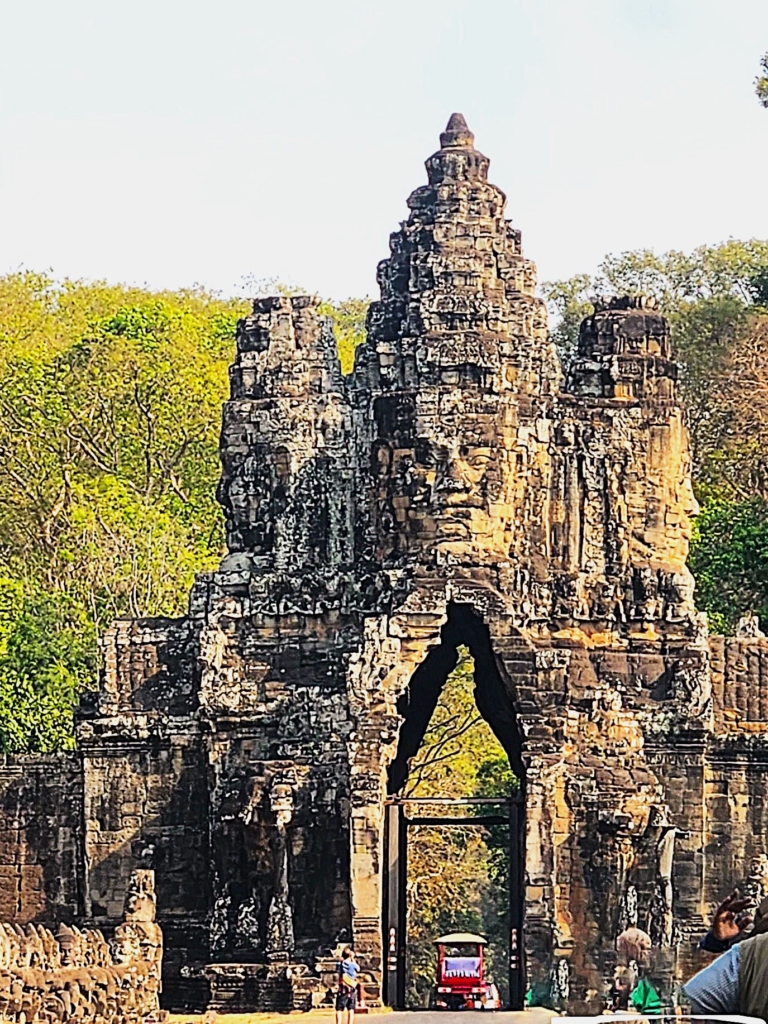
Its narrow entrance, designed for the passage of a single elephant at a time, bears the marks of centuries that has passed-by. Bats now make their home here, adding an eerie yet natural charm.
As I walked the ancient causeway, the rows of stone figures towering over me, I felt an undeniable connection to the past. This gate, this path—it had witnessed centuries of life, from bustling processions to solemn pilgrimages. It was once the threshold of a city teeming with activity, the heart of a mighty empire. Now, it stands as a storyteller, whispering its tales to those who pause to listen.
When I reached the other side, Sieng was waiting, as promised, leaning casually against the car. “Ready for more?” he asked with a wink. And I was. After all, Angkor Thom had only just begun to share its secrets. Sieng explained that the South Gate, while among the most iconic, shares its design with the other four gates though each has its unique details.
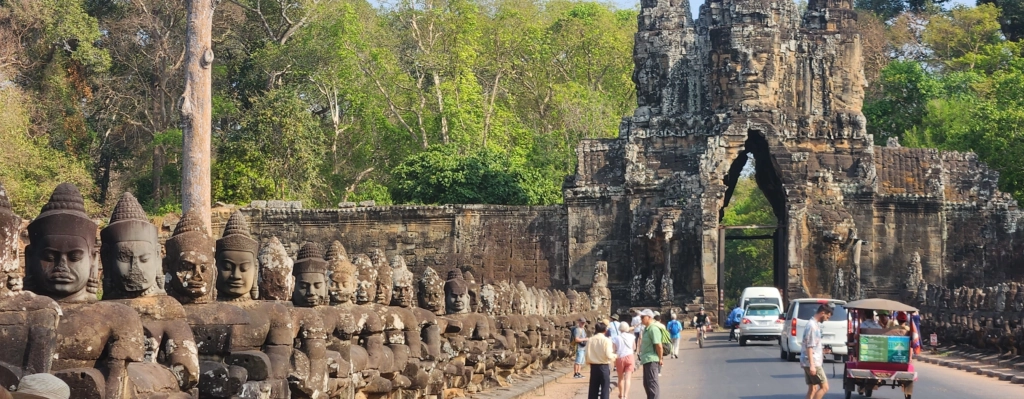
He added that the lower half of the tower is supposedly sculpted to resemble three-headed elephants with their trunks gracefully plucking lotus flowers, the Hindu god Indra, who is said to ride atop them, flanked by celestial Apsaras. However, these finer details have worn but not erased by time, echoing the timeless splendour of Angkor Thom. Elephants also play a prominent role in the nearby Terrace of Elephants, seamlessly blending into the grandeur of the royal pavilion.
Temple of Bayon
Add little touch of lighter tone – As we approached the eastern gates of Bayon, a sense of awe washed over me. A weathered plaque at the entrance announced its origins, dating back to the late 12th century. Known as the “Triumphant Mountain”, Bayon evokes the mythical Mt. Mandara encircled by the Ocean of Milk – a cosmic scene central to ancient Hindu mythology. A sense of mythology seemed deeply woven into the fabric of Khmer life.
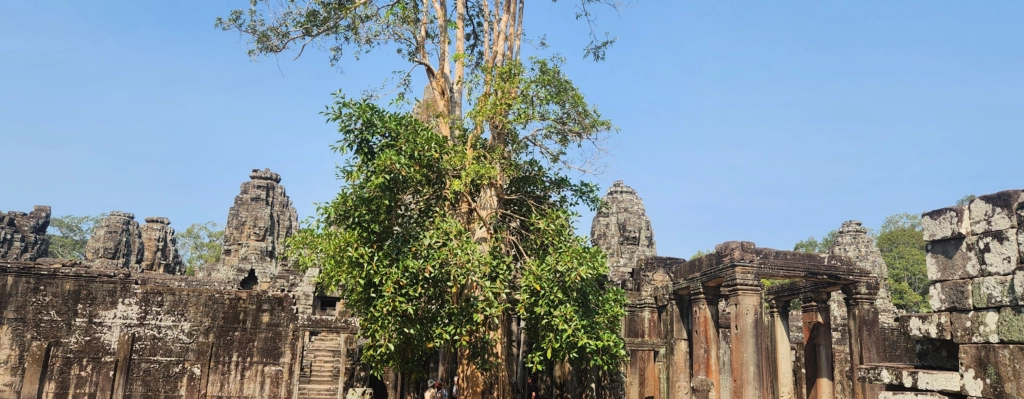
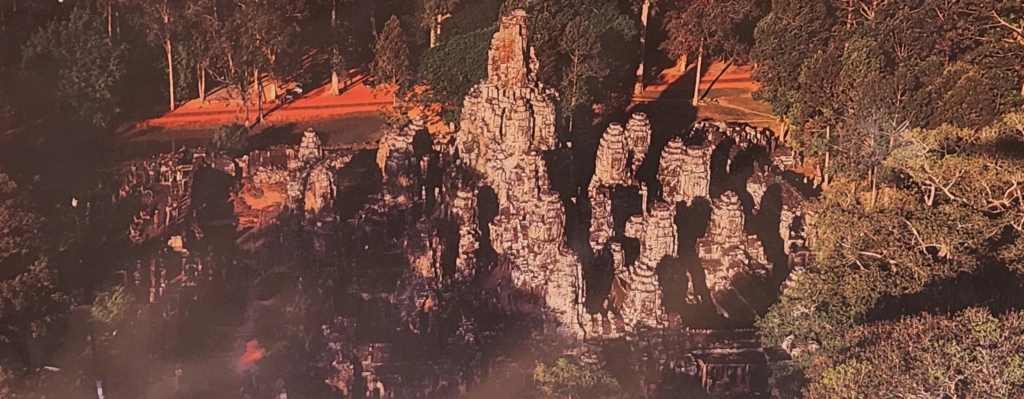
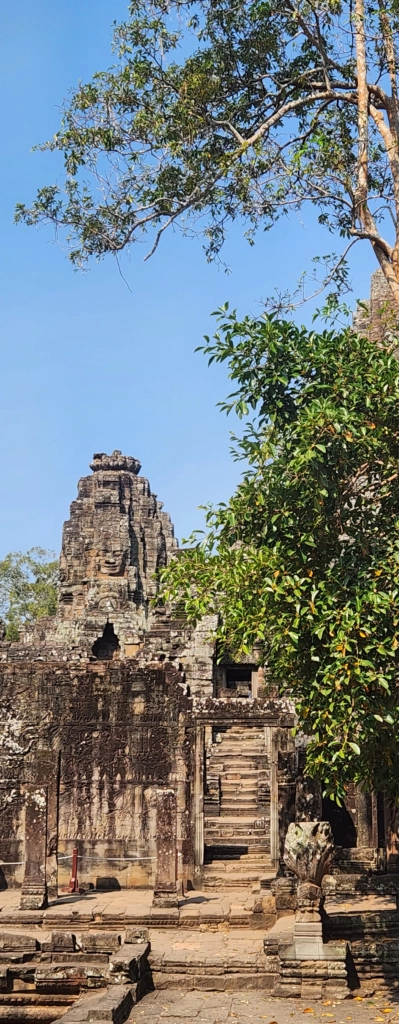
Stepping into the temple felt like entering another world. Sieng, ever the insightful guide, explained Bayon’s three-tiered design, constructed combination of massive sandstone blocks and laterite.
Like Angkor Wat, its layout follows a three-tiered concept, but its charm lies in its simplicity. The first two levels feature bas-relief galleries, while a striking circular central sanctuary crowns the third tier.
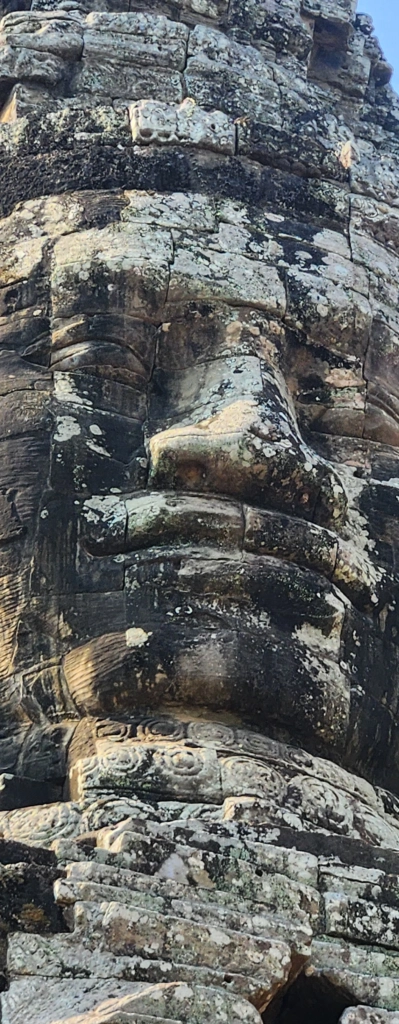
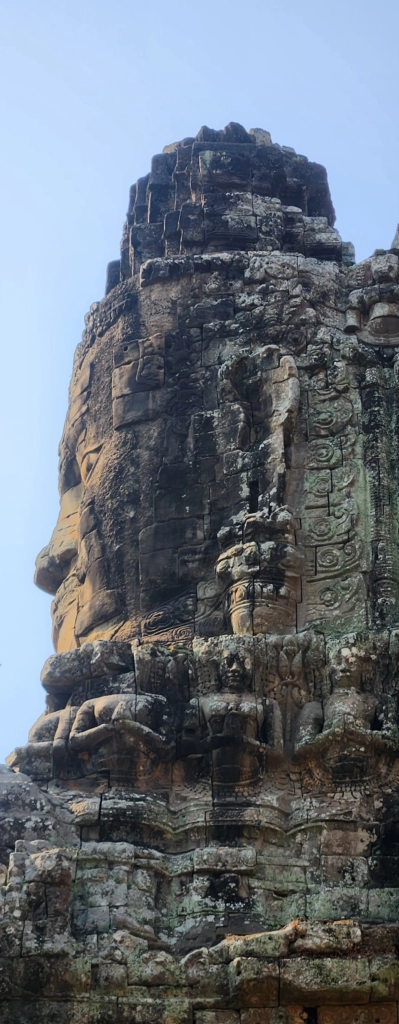
What captivated me most were the iconic face-towers. Lining the galleries and rising above the temple, these towers are adorned with four colossal carved faces, each gazing serenely in a cardinal direction.
Crowned with lotus flowers – a symbol of purity in both Hinduism and Buddhism – the faces radiate calm and authority. The central tower, soaring 45 meters high, is the temple’s crowning glory.
Unlike ancient Khmer’s grand depictions of Hindu gods of Vishnu and Shiva, Bayon’s bas-reliefs tell stories of the human experiences, maybe through a Buddhist lens. The outer galleries depict epic battles – Khmer warriors locked in combat with the Cham armies, parades of soldiers, and victorious processions. In contrast, the inner galleries focus on the rhythms of daily life – vivid market scenes and glimpses of domestic routines. These narratives of history and ordinary life are interwoven without a clear pattern, a reminder that conflict and mundane simplicity coexist in society.
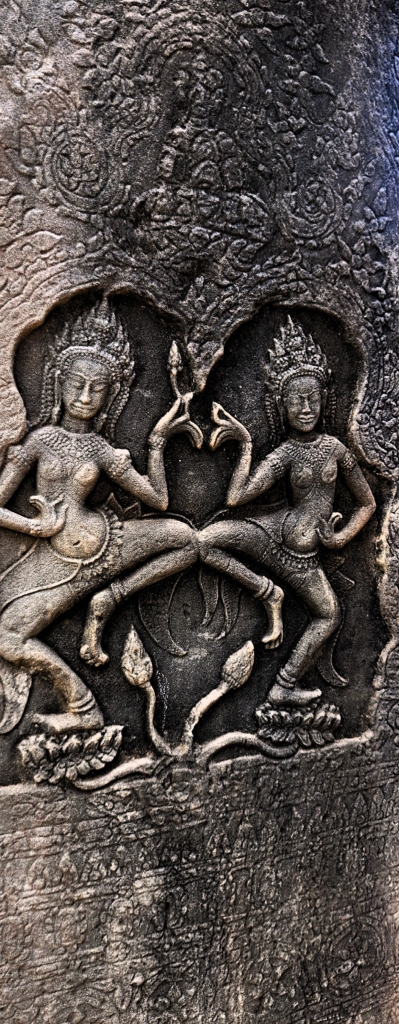
The identity of these countless faces remains a mystery, but their striking features – full lips curling upwards at the corners – have earned them the title of the ‘Smile of Angkor’. Each of the face-towers is believed to represent a divine guardian, protecting the Khmer Empire. In this context, the Bayon temple embodies the assembly of the divine, a symbolic “Judgement of the Gods”. Though over 200 faces once graced Bayon, fewer than 150 remain, many of these have weathered by centuries of nature’s embrace.
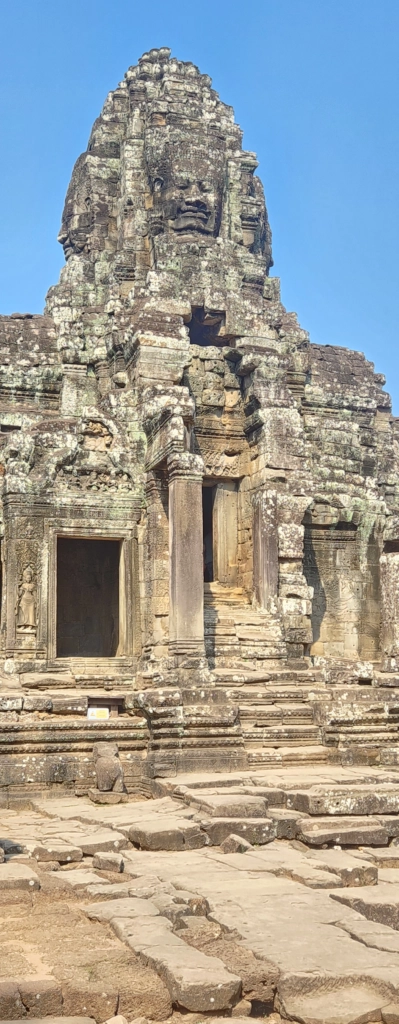
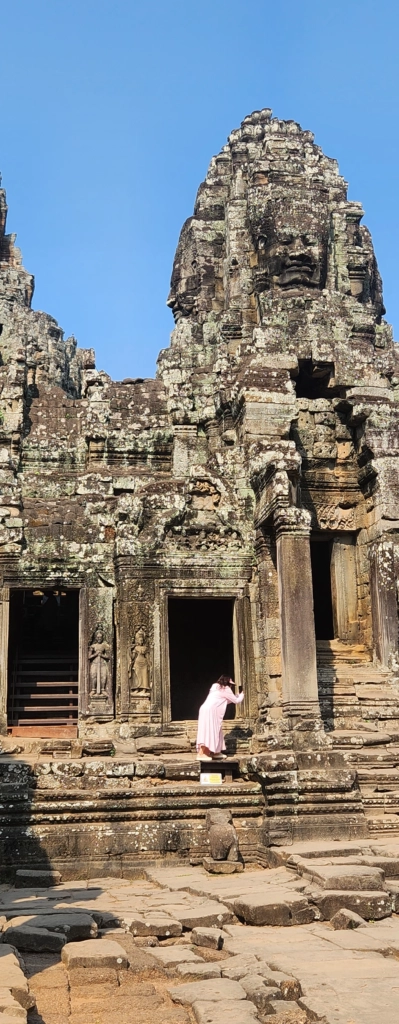
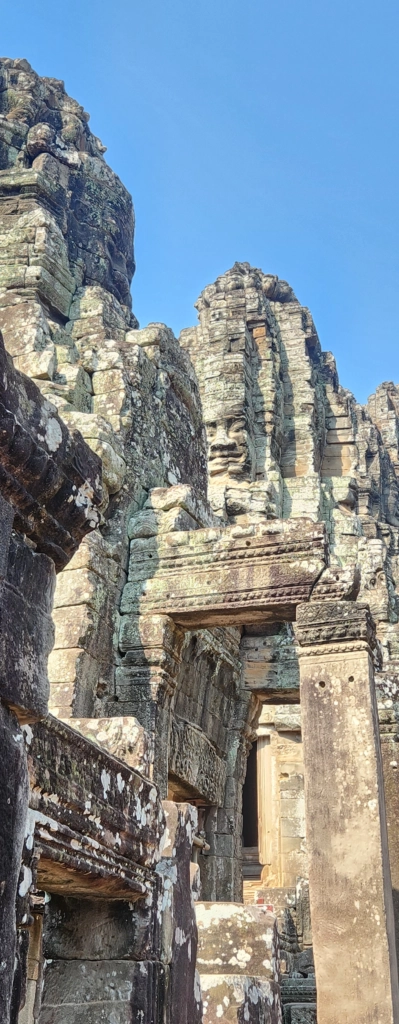
While deeply influenced by his wife’s Buddhist devotion, the king didn’t entirely abandon Hindu traditions. Bayon seamlessly blends both faiths, with Buddhist motifs interwoven into the Hindu cosmology that had long defined Khmer art and architecture. According to another local folklore, the faces may represent Bodhisattva Lokeshvara, embodying compassion and offering divine protection to the Khmer Empire. Yet, the true meaning behind these enigmatic faces remains a matter of perspective, influenced by the prevailing religion of the region and the historians who pen its narrative.


Bayon is more than a temple – it’s a testament to the tolerance and unification of Jayavarman VII’s reign. These faces, according to Sieng, may very well also symbolize King Jayavarman VII himself, embodying his vision of divine rule and protection for his people. The ambiguity of their identity only deepens their allure.
Despite the conjectures about which king contributed what to the temple’s construction over the centuries, the temple stands as a monument to the convergence of divine inspiration and human ingenuity.

Sieng remarked that the lack of inscriptions leaves much to interpretation, allowing every visitor to form their own connection with Bayon’s mysteries.
As we exited the temple, Sieng reminded us that Bayon was the last grand temple built in Angkor, a finale to centuries of architectural brilliance. With its blend of spirituality, history, and artistic mastery, Bayon left me spellbound – a reflection of a kingdom’s grandeur and its fleeting impermanence.
The mysterious face-towers is unforgettable – a serene expression that transcends time.
Next on our journey through the Angkor complex was Ta Prohm, the “Jungle Temple,” lying just beyond the walled city. Bayon’s mysteries still lingered in my mind as we moved forward, the road ahead promising more wonders of the ancient Khmer Empire.
Baphuon Temple
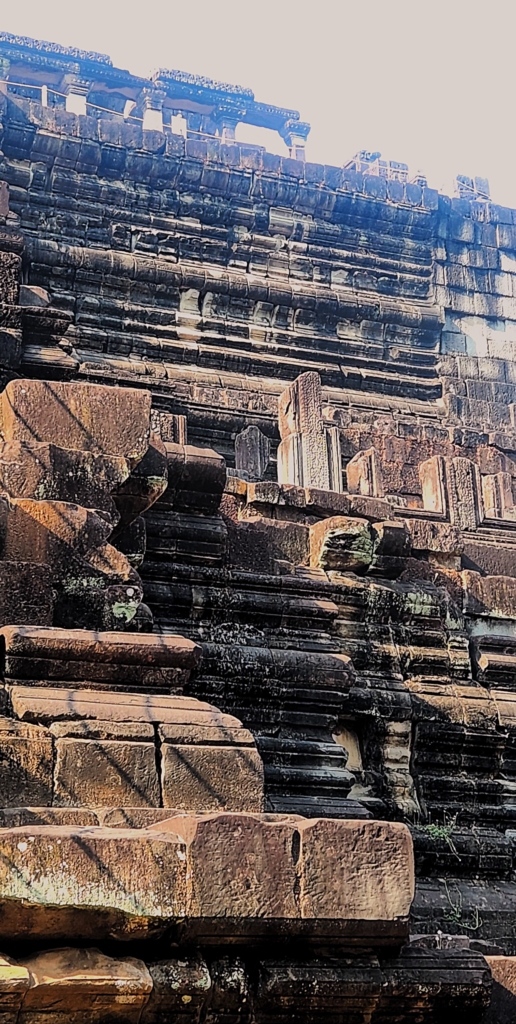
As we approached Baphuon Temple, Sieng shared an intriguing nugget of history: this grand structure predates Angkor Wat by nearly a century. Built in the mid-11th century during the height of the Khmer Empire, Baphuon was originally dedicated to Shiva, the powerful Hindu god – part of the Trinity. At the time, Shiva’s influence dominated Khmer spirituality, shaping not only their beliefs but their monumental architecture.

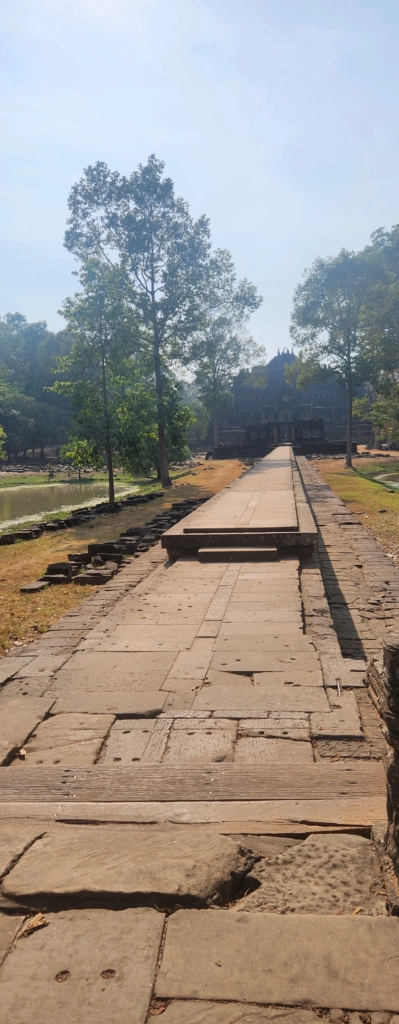
We entered Baphuon via a 200-meter-long sandstone causeway, gracefully elevated on sturdy pillars. The causeway, flanked by two elongated lakes mirroring its symmetry, stretched ahead like a timeless corridor through history. The pathway led us to an arched gateway that opened into the courtyard and, finally, the temple mountain itself.


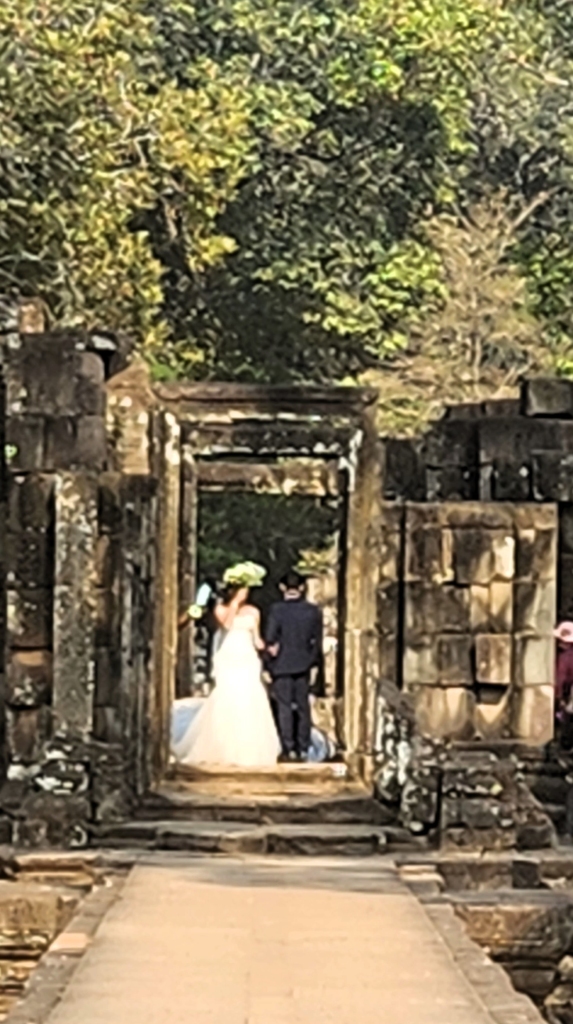
The beauty of Baphuon’s entrance and its picturesque causeway makes it a magnet for photographers, especially couples seeking a magical setting for their pre-wedding shoots.
As we strolled along the platform, we watched a couple braving the relentless sun in full wedding attire. Their photographer and assistants bustled around, adjusting makeup, arranging poses, and cracking jokes to coax smiles from the couple.
The pair looked both radiant and just a little bit frazzled, like they’d already survived a marathon of “smile-for-the-camera” moments.
It struck me as fascinating – this Christian couple had chosen a Hindu-Buddhist backdrop to celebrate their union. It was a vivid reminder of how love, like nature, transcends religion. Watching them, a simple thought kept circling my mind: “Luckily, neither nature nor love is bound by faith”.

As we reached the base of the platform, Sieng, with his characteristic humour, teased me about climbing the steep stairs to the top. He winked and promised a panoramic view that would rival even Angkor Wat’s.
But the scorching heat had already sapped my energy, and I politely declined, joking that I’d reached my climbing quota for the day. Still, I couldn’t help but admire the steep original stairs from below – they seemed a challenge worth conquering on a cooler day.
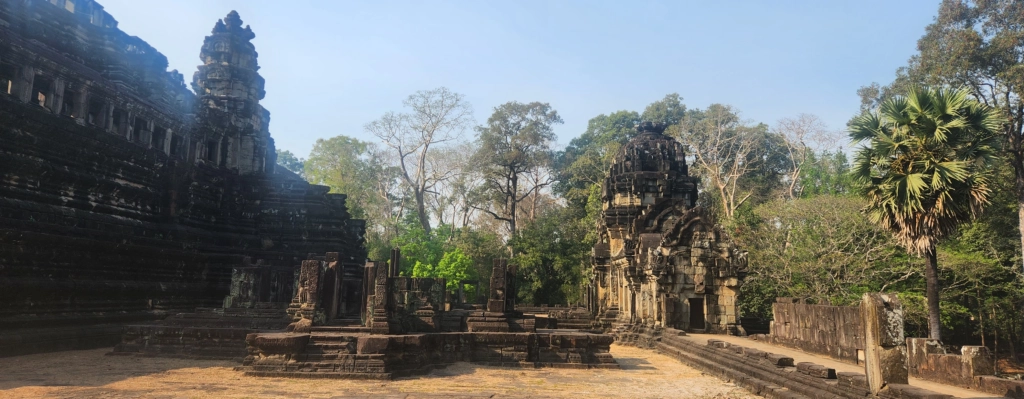
As we explored further, Sieng pointed out Baphuon’s highlight – the massive reclining Buddha. At first glance, its outline doesn’t immediately register amid the temple’s intricate stonework. Only when someone points it out does the reclining figure emerge, hidden yet monumental, carved into the western wall. The transformation of Baphuon from a Shiva temple to a Buddhist sanctuary took place in the 16th century. This shift symbolized the evolving beliefs of the Khmer people, where gods once revered were subtly replaced to align with new spiritual horizons.

Curiously, though the temple now lies within the boundaries of Angkor Thom, the walled city was built much later, almost enveloping Baphuon in its embrace. This layering of eras lent the temple a timeless quality, as though it were a bridge between the grandeur of Hindu traditions and the Buddhist influence that followed.
A funny thought crossed my mind as I stood before the Buddha: how the fate of gods seemed tied to the whims of human civilizations. With changing empires came changing beliefs or vice versa, and even the ruling deities were not immune to the tides of time. Shiva once reigned supreme here, yet centuries later, the same temple bore the image of the Buddha. It felt poetic in a way. While gods are said to shape our destinies, we, in turn, seem to shape theirs – deciding which deities hold sway, which stories endure, and which temples remain in use. Perhaps, in this cosmic interplay, there’s a humbling truth about our interconnectedness with the divine.
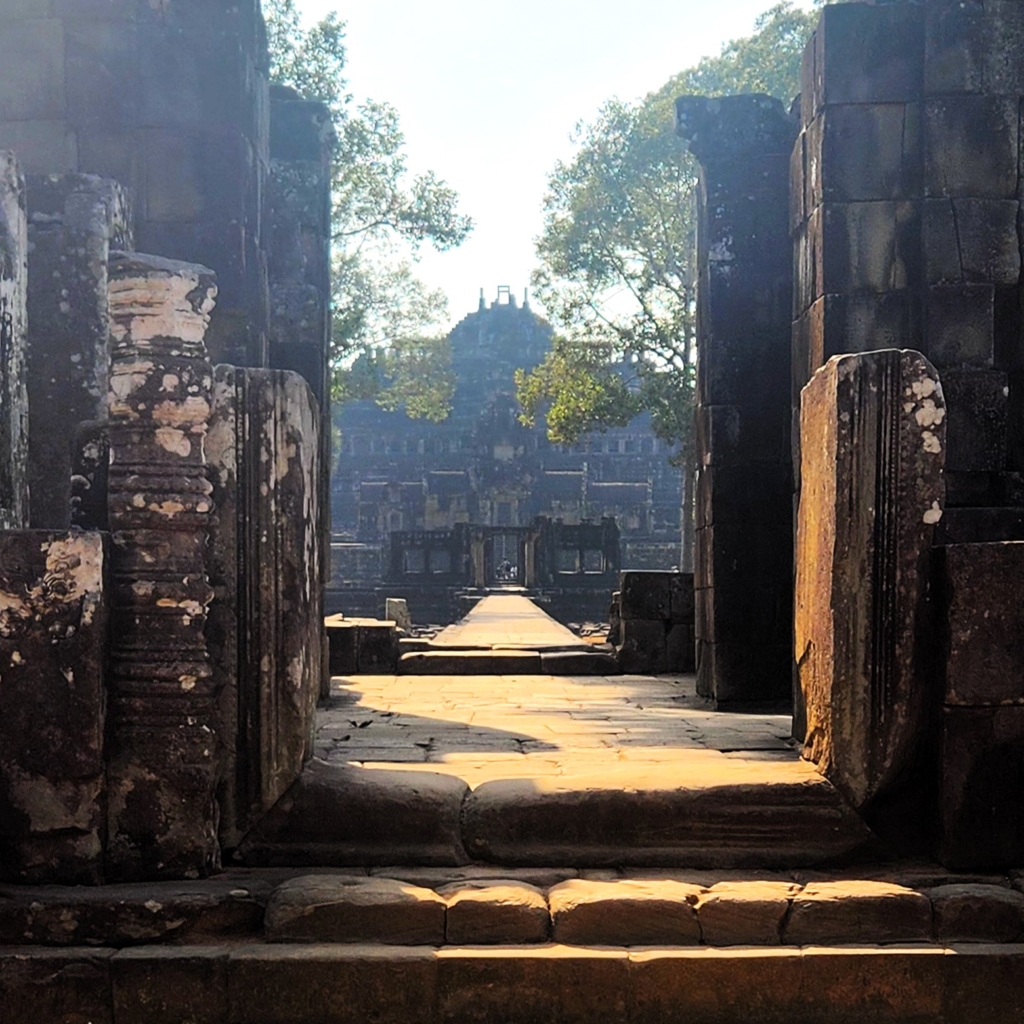
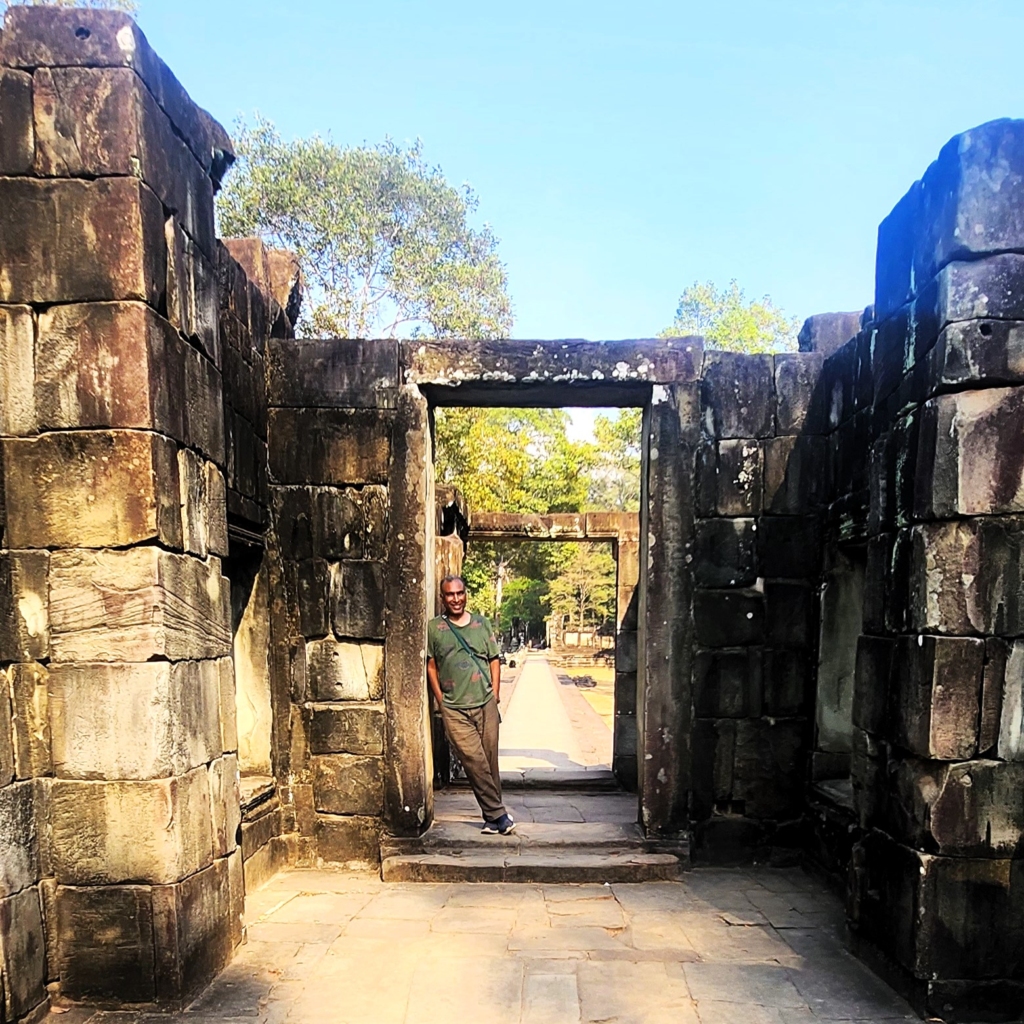
With these musings, we bid farewell to Baphuon and made our way back through its grand causeway. The day’s explorations had been as enlightening as they were enchanting, leaving me eager for the stories still waiting to be uncovered in Angkor’s timeless ruins.
The Royal Terraces
After retracing our path from the grandeur of Baphuon, Sieng led me to the Royal Terraces, that once served as a hub of royal activities. Together, the Terrace of the Elephants and the Terrace of the Leper King embody the opulence and mystique of Angkor Thom’s regal past.
The Terrace of Elephants: A Stage of Glory
The majestic three-headed elephant, Airavata, flanked on either side of the stairs to the platform – add a celestial touch to the platform. It wasn’t hard to imagine the Khmer king and his court perched here, watching the spectacle of warriors, dancers, and elephants unfolding in the field below – a scene of timeless majesty brought to life by the delicate carvings.
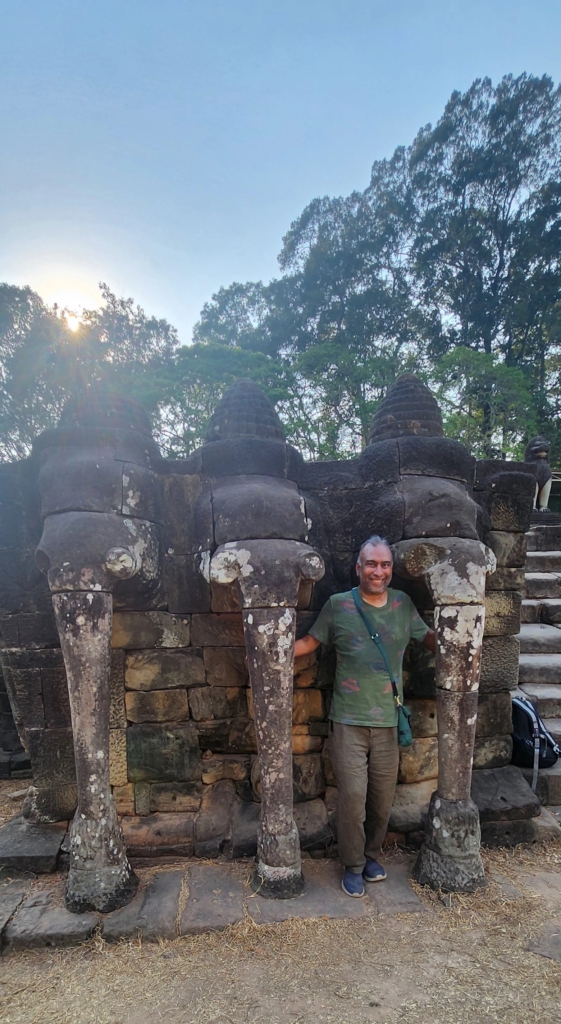
Standing in an open field, the Terrace of Elephants stretched before me like a silent witness to an era of grand pageantry. Sieng explained that this royal pavilion was likely used by the king as a viewing stand for grand processions, military parades, and public ceremonies. Intricate carvings of elephants parade along the walls, interspersed with mythical beings and divine figures.
The Terrace of the Leper King: A Mystery Left Unvisited
As Sieng and myself discussed about my travel / blog, he pointed about the missing content – Terrace of the Leper King. Reflecting on my journey months later, I realized I had no photographs or vivid memories of this enigmatic structure. Perhaps in the rush to fit Angkor’s vast treasures into my tight itinerary, I had possibly overlooked it. A pang of regret crept in.
Sieng had mentioned it was one of the highlights of Angkor Thom, its name derived from a moss-covered gallery to depict a king afflicted by leprosy. The terrace is famous for its hidden inner walls adorned with intricate carvings of celestial beings and mythical creatures. Unfortunately, the whirlwind pace of the day blurred the lines between sights seen and those missed.
After soaking in Angkor Thom’s allure, we paused for some refreshments before returning to the homestay for an afternoon siesta. Sieng suggested reconvening closer to sunset, when the golden hour would drape Angkor in its soft light.
March 2024
If you’re planning a trip to Angkor Thom / Siem Reap or travel through Cambodia, we at HappyHorizon would be thrilled to curate your holiday plans to enhance overall travel experience. Feel free to reach out to us: connect@happyhorizon.in
Day 2 (Part 3): Ta Prohm – Read More
Gallery




Sukumar Jain, a Mumbai-based finance professional with global experience, is also a passionate traveler, wildlife enthusiast, and an aficionado of Indian culture. Alongside his career, which includes diverse roles in international banking and finance, he's working on a wildlife coffee table book and enjoys sculpture and pottery. His interests span reading non-fiction to engaging in social and global networking.