Day 3: Rolling, Flying, Exploring: Bamboo Train, Bats & Battambang – Read More
Day 4: Banteay Srei & Kbal Spean
Banteay Srei – A Window into Cambodia’s Hindu Past
Siem Reap – Banteay Srei: 35 km. / 50 min.
Since breakfast wasn’t included in my stay, I decided to wander through the French influenced neighborhood and see what I could find.
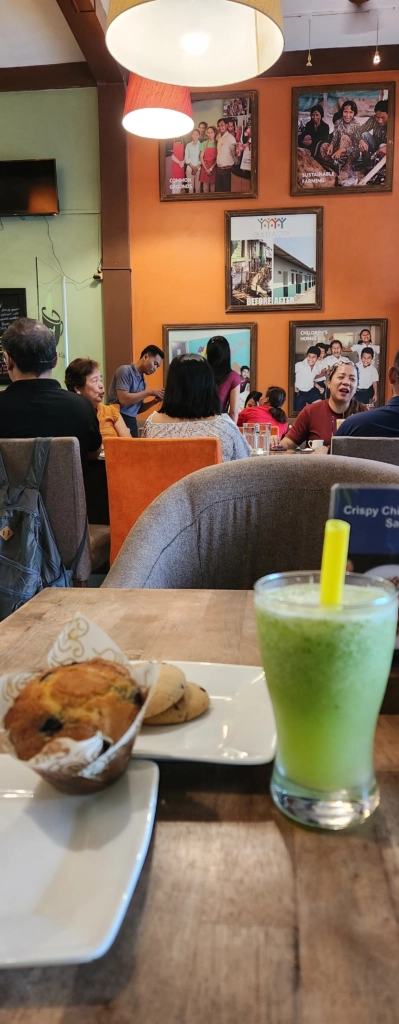
Just around the corner, a charming boutique café caught my eye. A perfect spot to ease into the day. With a blueberry muffin, some cookies, and fresh juice on my table, I was all set for a slow, quiet morning—until I spotted Sieng marching past the café, scanning the street like a man on a mission.
Apparently, I had been officially hunted down. This guy was always on time, and I admired that about him. After a quick check-in at my new hotel across the river, we wasted no time.
First stop of the day—Banteay Srei.
The drive was short but scenic. During our drive towards the Banteay Srei temple complex, Sieng gave me a quick history lesson. “This temple complex predates Angkor Wat”, he explained. “Built in the 10th century, but lost to the wilderness for centuries. It was only rediscovered in 1914 by a French explorer”. Every historical monuments in Cambodia is benchmarked against Angkor Wat.
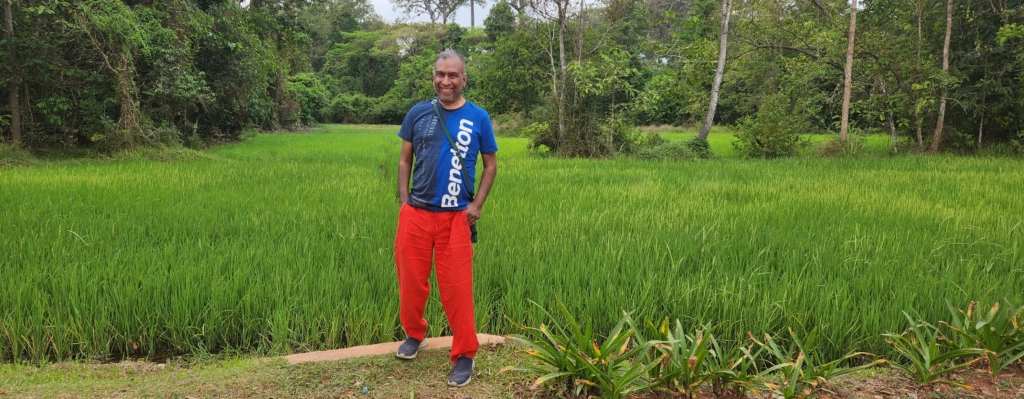
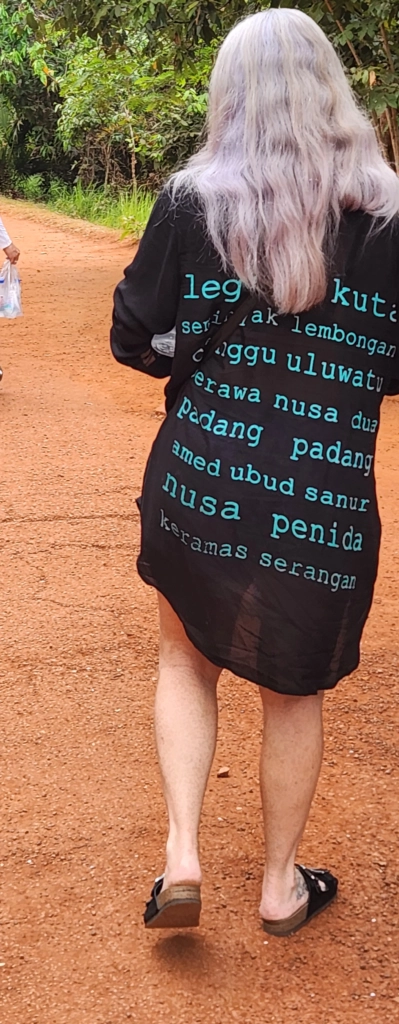
As we walked towards the temple complex through the paddy fields, my camera caught sight of a woman dressed like she had walked straight out of a Tour de Thai Islands.
Now, while most temple complexes in Cambodia are no longer active places of worship, dressing modestly is still a mark of respect. I had overdressed the entire trip just to stay on the safe side, despite the blazing heat.
If you’re planning a trip, December and January are ideal. The weather is manageable, and there’s an added visual treat—most of the moats, ponds, and lakes surrounding the temple complexes will still have adequate monsoon water, making the entire landscape even more magical.
Sieng said that Banteay Srei is one of the oldest Hindu temple complexes in Cambodia, though not the absolute oldest—there are a few temples around Angkor that predate it. But in terms of intricacy and artistic finesse, this place stands in a league of its own.
Walking through these ancient ruins, it’s easy to wonder how much history has been lost to time. The grand stone temples remain, but what about the wooden structures that must have once existed? Civilizations leave behind clues—inscriptions, carvings, temple remains—but much of what once stood has simply faded away. Sieng shared that Banteay Srei was originally named Tribhuvanamaheshvara, meaning “Great Lord of the Threefold World”, and the surrounding area was called Ishvarapura—City of Shiva. Banteay Srei was a Shiva temple in its early days, but by the 11th century, as Vaishnavism gained influence in Cambodia, new structures dedicated to Vishnu were added, depicting mythological tales from his avatars.
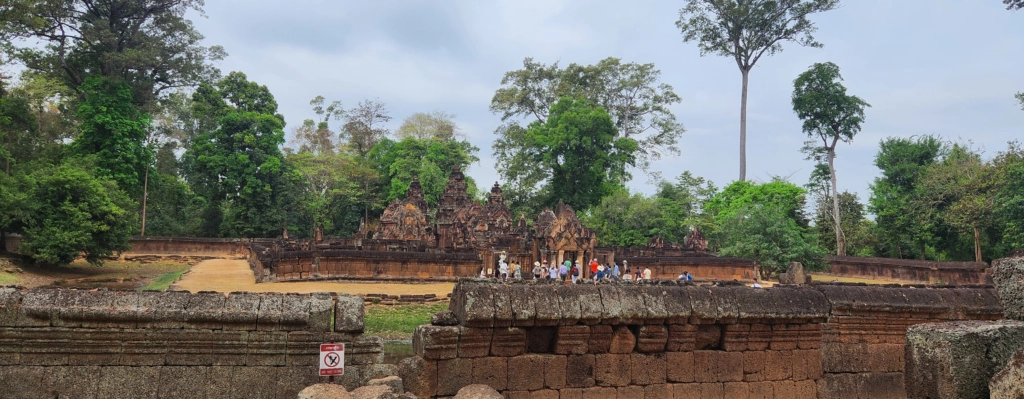
As we stepped into the complex, the first thing I noticed was the ruined boundary walls, which have stood test of time. I’ve always wondered why Khmer temples—big or small—were enclosed within such grand fortifications.
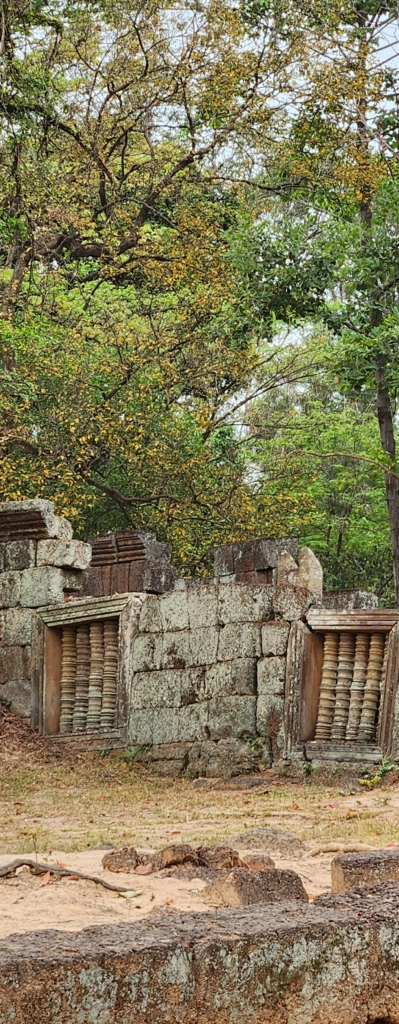
It made sense for massive city-temples like Angkor Wat or Angkor Thom, but for a temple complex like Banteay Srei? What was the logic behind these elaborate defenses? Perhaps it wasn’t about defense at all. Maybe these walls symbolized something deeper—separating the sacred from the ordinary, creating a spiritual boundary rather than a physical one.
I have a theory—perhaps the Khmer Empire wasn’t a single, unified religious entity as Hinduism stared to spread into Cambodia. The Khmer Empire might have consisted of various tribes with different beliefs, including Animism, which was likely the dominant faith before Hinduism arrived.
Banteay Srei has several inscriptions in both Sanskrit and Old Khmer, suggesting a blend of local traditions and Hindu influences. One of the most intriguing aspects of Khmer history is how multiple belief systems coexisted and more interestingly, while Hinduism has been replaced by Buddhism, Animism still exists.
Its highly likely that both Shaivism and Vaishnavism must have arrived together in South East Asia and coexisted rather than competing. Probably it was easier to sculpt the symbolic lingam’s than full blown statue of Vishnu (or his avatars). The presence of these symbolic representations—lingam’s, suggests that Shaivism may have been the earliest Hindu influence around the world, laying the foundation of Hinduism before Vaishnavism gained prominence in later centuries.
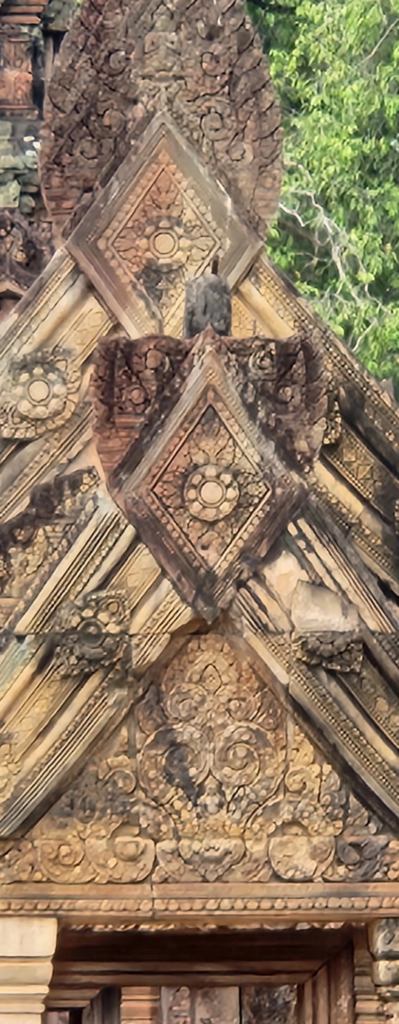
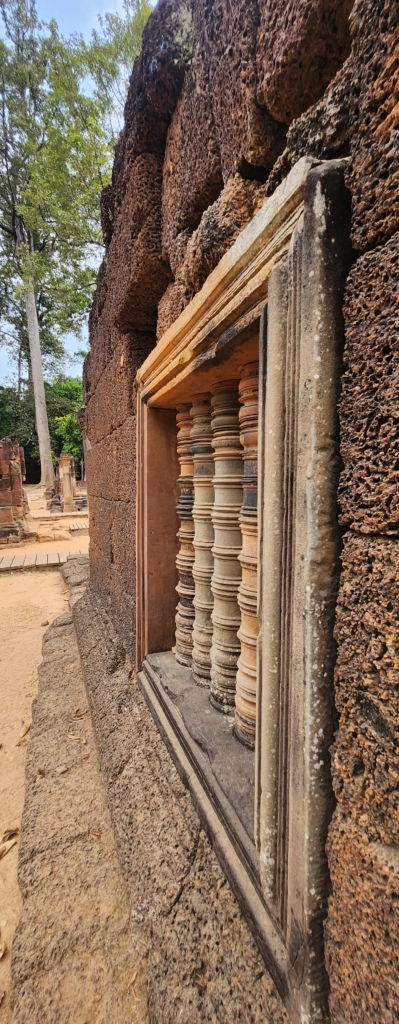
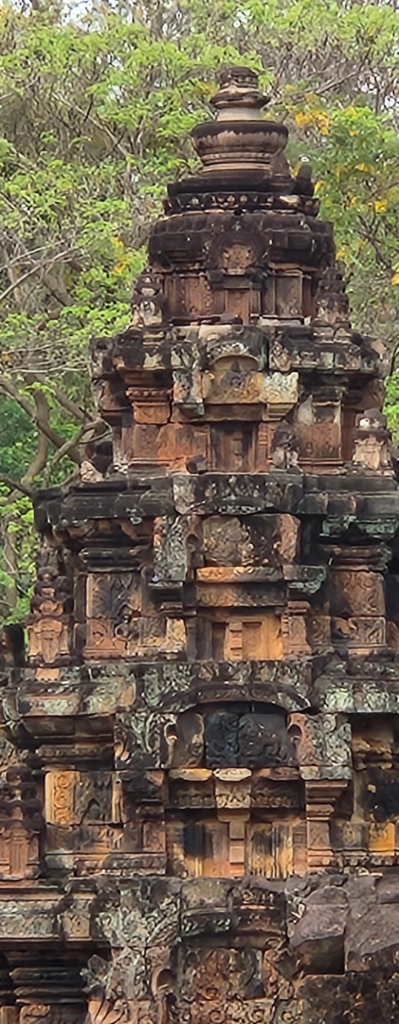
One thing is clear—the Khmer people didn’t just adopt Indian influences; they embraced them willingly. Hinduism wasn’t forced upon them; rather, Khmer rulers likely saw it as a tool for governance, a way to legitimize their divine right to rule. Over the centuries, Khmer rulers probably switched their allegiance between these sects, depending on economic and political factors. If a particular belief system brought prosperity, stability, or stronger alliances, it made sense for the ruling class to embrace and promote it.

The process of Indianization in the Khmer Empire wasn’t just about religion—it shaped art, architecture, language, and governance. And while Cambodia eventually transitioned to Buddhism, the footprints of Hinduism remain etched in stone, in stories, and in the very identity of places like Banteay Srei.
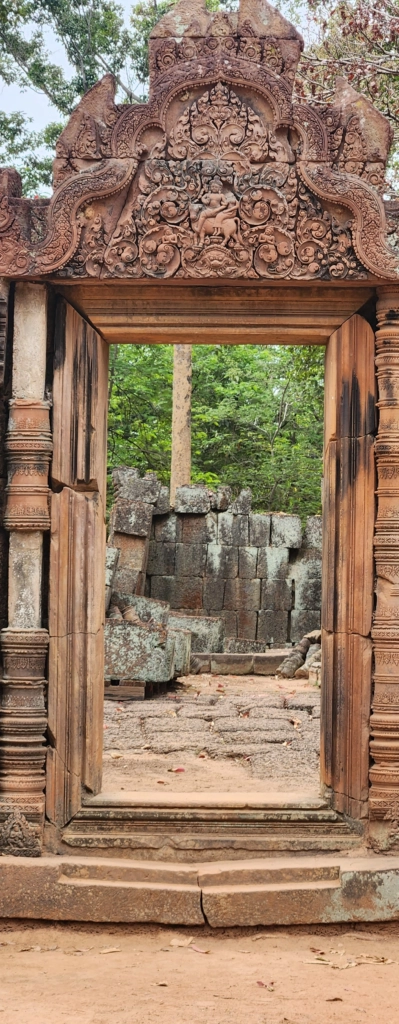
The door-frames along the causeway welcomed us warmly, leading us to the inner-most temple sanctuaries—though curiously, there were no real enclosures behind them.
They stood like silent sentinels, remnants of a time long past, seemingly built not to guard but to invite. Their rich carvings echoed the grandeur of an era gone by, their presence still commanding despite their shorter stature compared to other temples.
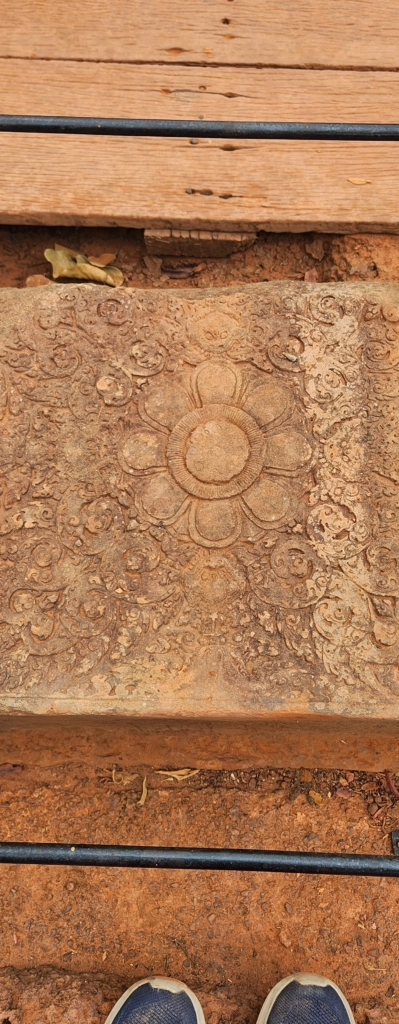
These doorways (including the pillars forming the frame) bore the weight of intricately carved lintels and pediments, each depicting Hindu mythological tales, as if whispering stories to those who passed through. At the doorstep of each frame, beautiful motifs adorned the stones, a reminder that even the smallest details in Khmer architecture were crafted with devotion.

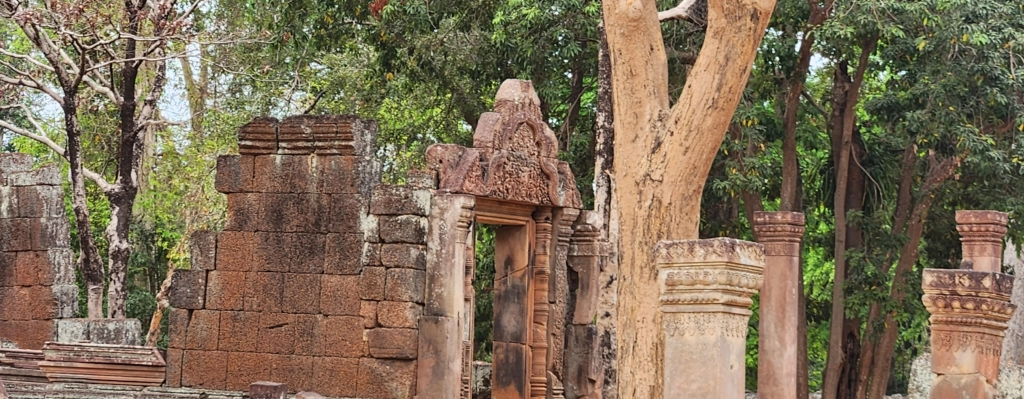
Looking at these free-standing frames, I couldn’t help but think—perhaps an ancient architect’s vision had unknowingly inspired modern-day wonders. Who knows? Maybe these very ruins sparked the concept for Dubai’s famous “Frame”.
As we continued, a Naga balustrade ran gracefully alongside the causeway, its presence so common in Cambodian temple complexes that I had almost stopped questioning it. But today, curiosity won over. “What’s with the serpents everywhere?” I asked Sieng. He smiled knowingly. “That traces back to Princess Soma, who led the Naga (Serpent) dynasty before marrying a Hindu trader-statesman”.
That one sentence explained so much—the seamless blend of Hinduism and local Khmer traditions, woven into every stone, carving, and myth. The Khmer Empire didn’t just adopt Hinduism; it merged it with its own legends, creating something uniquely Cambodian.
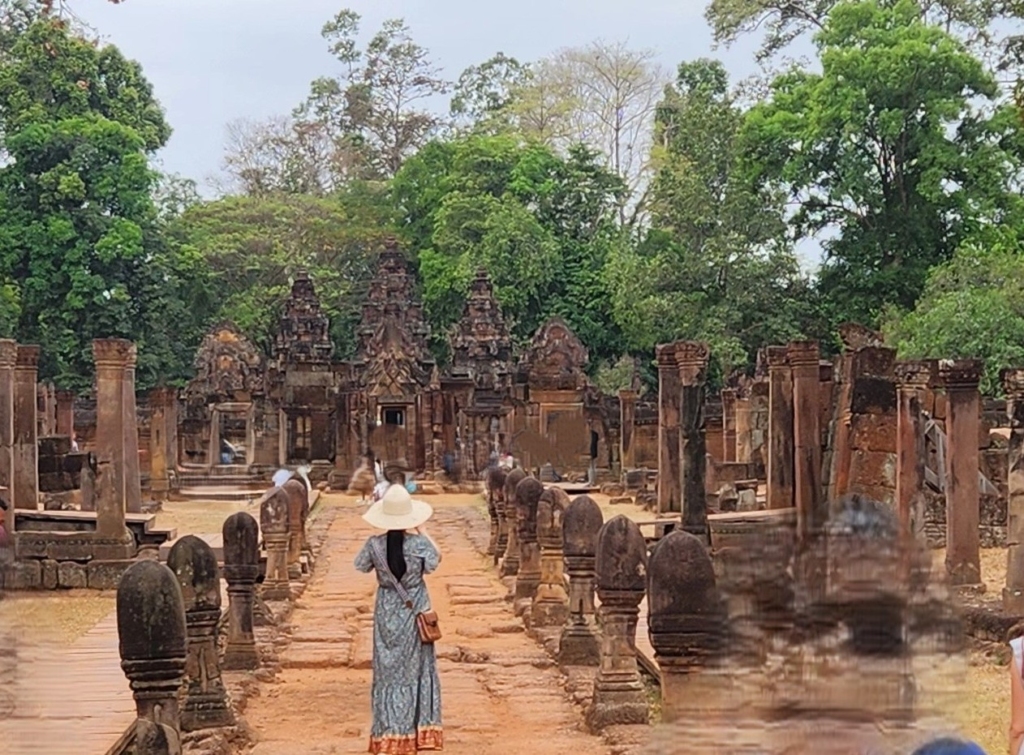
Beyond the causeway, pillars stood in an orderly formations, weathered but resilient. They had clearly carried something grand on their shoulders once, but time had reduced them to silent remnants. It’s hard to say whether it was war, weather, or simply the passing of centuries that caused their fall. But whatever the reason, the fact that some still stood was a testament to the strength of Khmer craftsmanship.
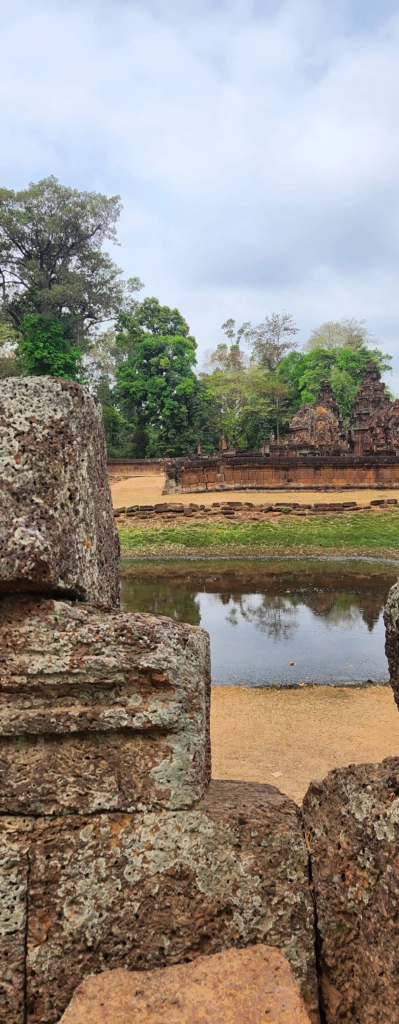
Further inside, two massive ponds flanked the causeway, now mostly dried up. At first glance, they seemed like ornamental water bodies, but later I learned that these were once part of a concentric moat system, a common feature in Khmer temple cities. These moats weren’t just decorative—they were life-giving. They ensured that temple complexes could sustain an entire ecosystem within their walls, providing water for drinking, farming, and rituals. With such a vast enclosed space, it’s easy to imagine civilians growing rice and vegetables, living self-sufficiently without ever needing to step outside. Khmer Empire did not built just a temple—it was a microcosm of an entire way of life. A civilization that understood balance—between mythology and reality, between human needs and nature’s gifts, between past and future.

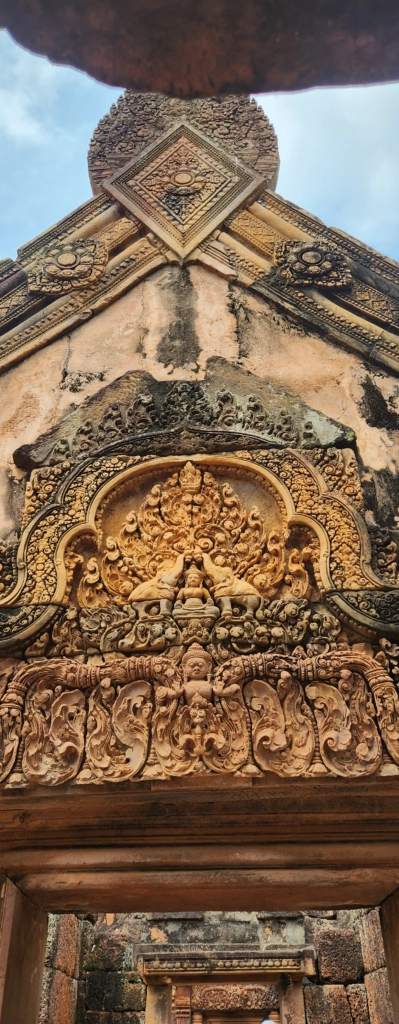
After weaving through several roofless door-frames, we finally arrived at the heart of Banteay Srei. The very first thing that catches the eye is the rich, deep pinkish-red sandstone, unlike anything I had seen in Cambodia’s other temple complexes. The stone had barely weathered over the centuries, preserving the extraordinary detail of its carvings. The structures / sculptures had been physically damaged more than weathering. The artisans of the time had used a specific, rare type of sandstone, both in color and quality, that isn’t found in any other Cambodian temple. It made me wonder—where did they source it from? And what made them choose this particular stone? A mystery lost in time.
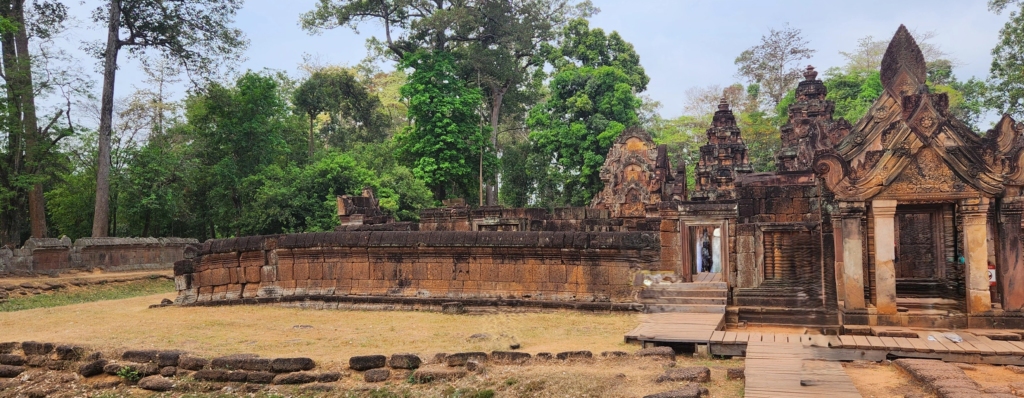
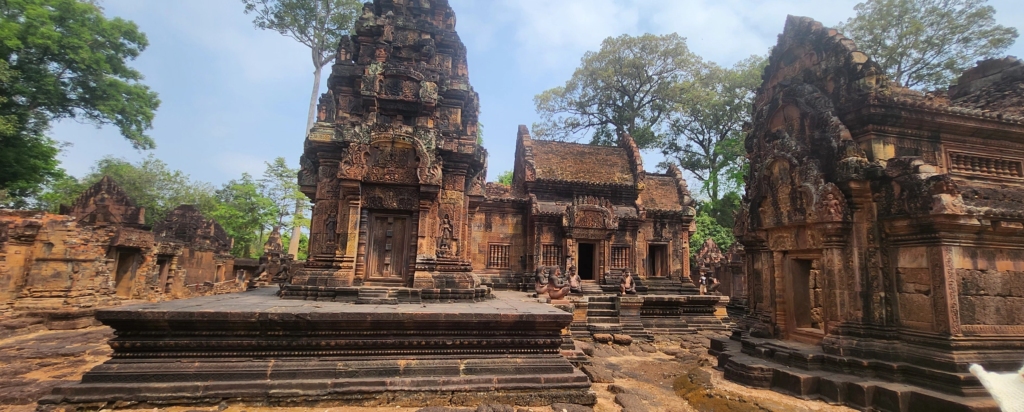
Banteay Srei isn’t just unique in its stone and detail, but also in its proportions. Unlike the grand, towering structures of Angkor Wat, this temple is built on a much smaller scale. And then there’s the temple doorways—so small that most people have to stoop to enter. The miniature-sized temples within the complex are tiny in comparison to the colossal Khmer monuments, yet their intricacy makes up for their size. It’s a stark contrast to the massive Angkor Wat, where the grandeur is meant to awe. Here, the humility of scale makes the temple feel more intimate, almost personal. Unlike most major temples in Angkor, Banteay Srei was not built by a ruler. It is believed to have been constructed by a Hindu counsellor to the King, which may explain its modest scale compared to royal temples.
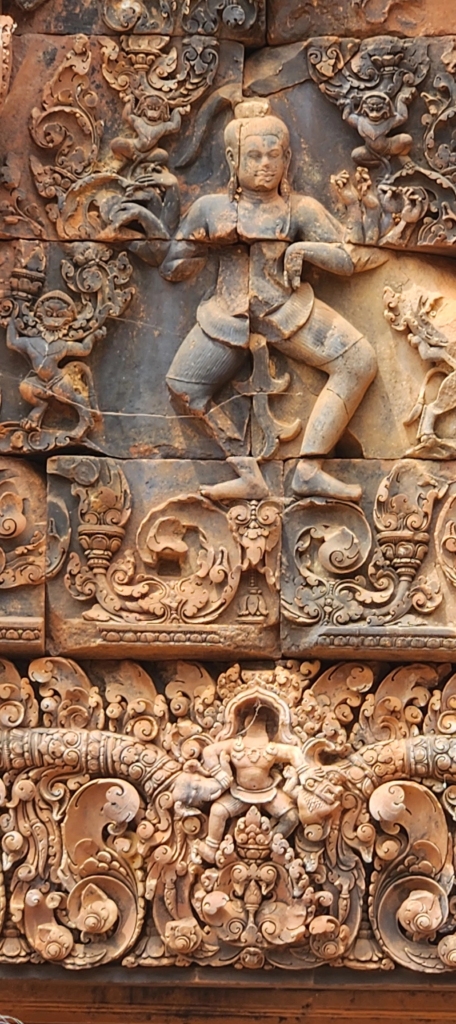

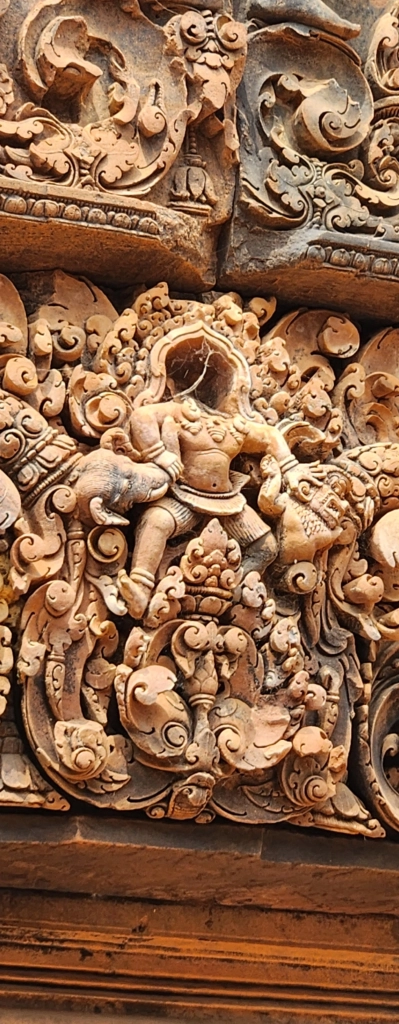
In a way, comparing Banteay Srei to Angkor Wat is like comparing a sea horse to a blue whale—both have their own charm, their own purpose, their own place in the grand scheme of things. Size doesn’t always define greatness. Despite its smaller size, the temple reflects an era of immense prosperity—a time when the Khmer Empire was growing in wealth, power, and influence. What’s clear is that this was a labour of love and devotion.
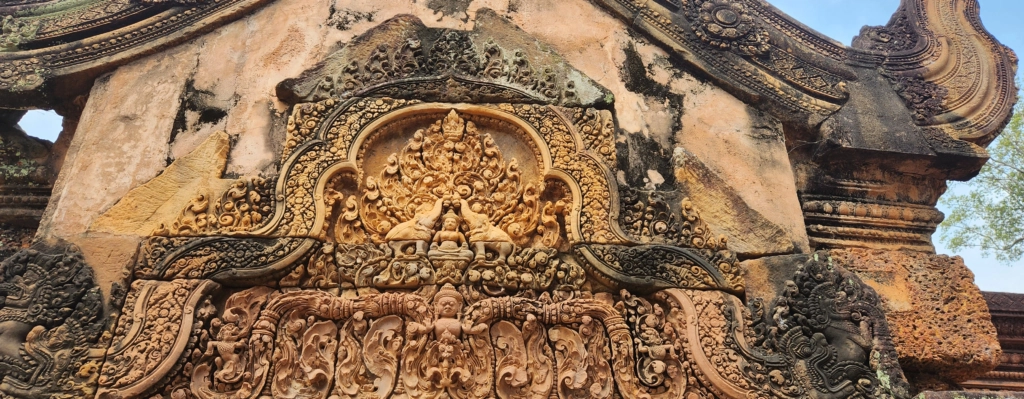
The temple isn’t used for worship today, and entry into temples are off-limits to visitors, but the walkway around the complex is designed in such a way that you can admire the incredible craftsmanship up close. Nearly every surface of the temples are covered in intricate carvings, except for a few spaces deliberately left uncarved—perhaps to enhance the contrast and bring out the beauty of the detailed portions. The walls are adorned with celestial dancers, floral patterns, and Hindu mythological depictions. As I walked through the temple’s intricate pinkish-red sandstone carvings, I couldn’t help but admire how history isn’t just about what we remember—it’s also about what we choose to preserve.
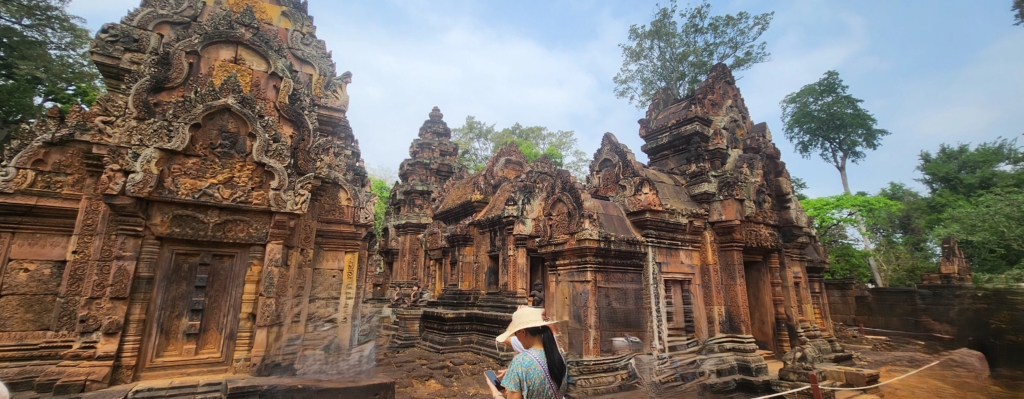
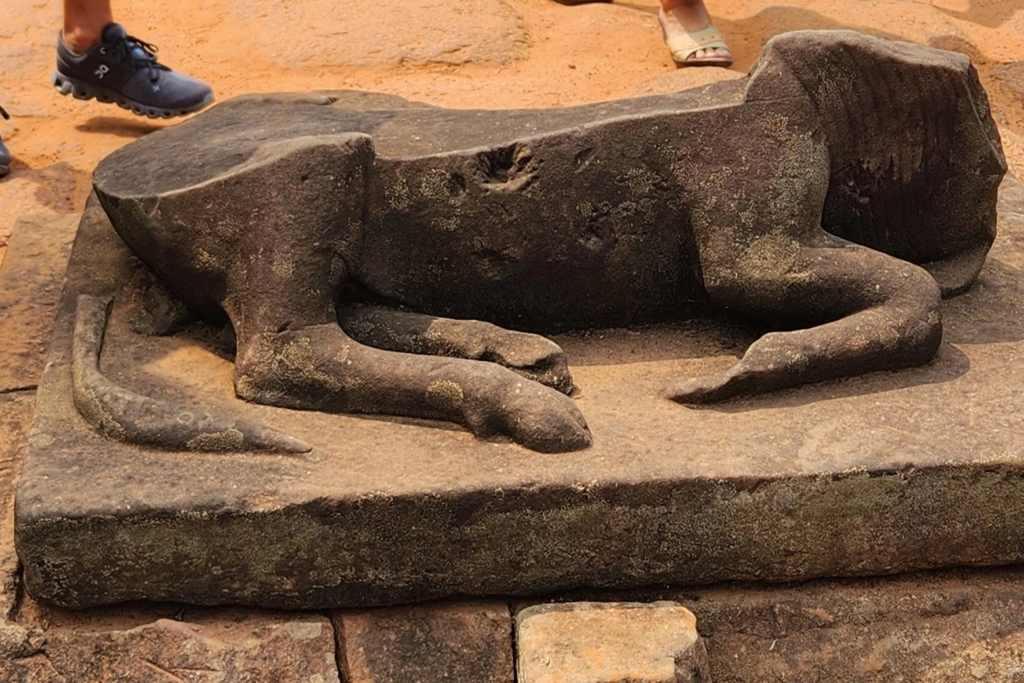
The sandstone lintels and pediments are among the finest in the Khmer world, depicting scenes from Hindu mythology—stories of gods, demons, and celestial beings, frozen in time on the temple walls. One of the more poignant sights in the temple is the remains of a bull statue—most likely Nandi, the sacred vehicle of Lord Shiva. The statue has been destroyed beyond recognition, with only its folded legs in a sitting position still intact. A silent witness to centuries of history, worship, and conflict.
Banteay Srei is not just a temple; it is a masterpiece of sculpture and architecture. The delicate floral motifs, the exquisite free-standing statues, and the harmonious design showcase a level of craftsmanship that few places in the world can rival. Standing there, surrounded by walls that tell stories, I couldn’t help but wonder—was this temple meant to be a sanctuary, a piece of art, or both? Maybe, just maybe, it was built to prove that beauty and devotion can outlast time itself.
Walking through Banteay Srei feels less like visiting a temple and more like flipping through the pages of an ancient, intricately carved storybook. Every surface tells a tale, and the level of detail is so exquisite that the sculptures seem almost alive.

One of the most striking carvings in the complex is a lintel and pediment depicting an episode from the Mahabharata.
The scene is set in a dense, lively forest, where trees, birds, and animals create an almost cinematic backdrop. At the heart of the story, Agni, the Hindu god of fire, has supposedly set the forest ablaze in an attempt to kill “Takshaka”, the Naga King. But Indra, the ruler of the heavens (and rains), mounted on his mighty elephant, summons torrential rains to extinguish the fire and help his serpent friend escape.
But fate has other plans. Krishna, the eighth avatar of Vishnu, and his disciple Arjuna appear on either side of the pediment, their chariots drawn, unleashing a hailstorm of arrows to block Indra’s rain.
The entire battle plays out in a single frame—a masterpiece of storytelling carved in stone.
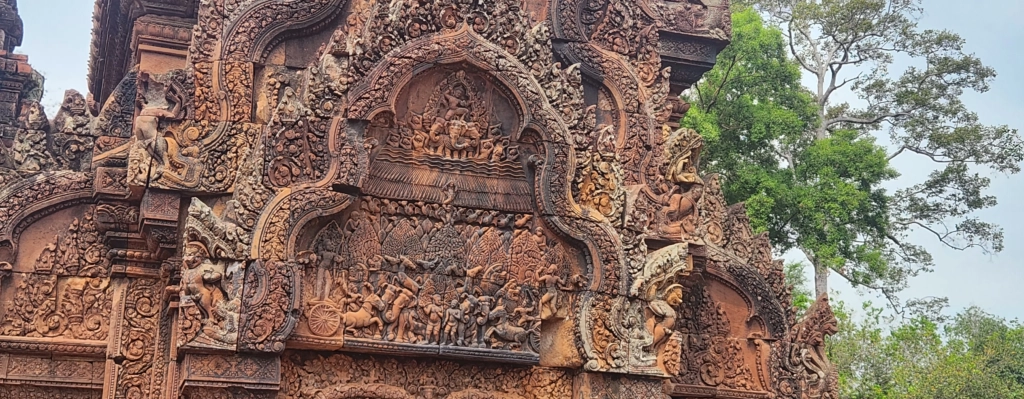
Nearby, another pediment captures a scene from the Ramayana—Lord Shiva calmly pressing his feet thumb-toe down to stop Ravana (you can see Ravana’s 10 sets of hands) from lifting Mount Kailash, Shiva’s heavenly abode. It’s an image of divine power meeting mortal arrogance, frozen in time.
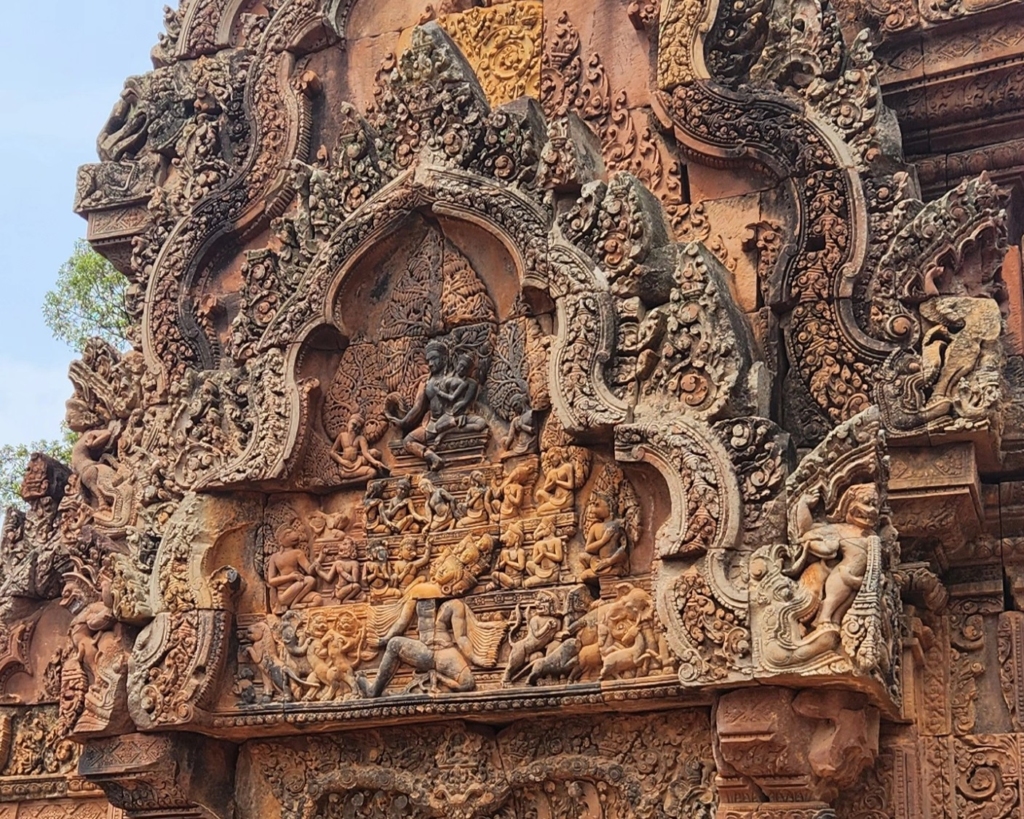
The carvings at Banteay Srei are so intricate, so delicate, that they resemble woodwork more than stone sculpture. This unparalleled craftsmanship is why the temple’s original name was later replaced with “Banteay Srei”, meaning the “Citadel of Beauty”. Unlike the grand, towering structures of Angkor Wat, Banteay Srei felt more delicate, intricate, almost feminine. Some believe the name honors the female sculptors who were supposedly employed to carve these intricate bas-reliefs. The theory suggests that male hands would not have had the precision needed for such fine details, leading to the speculation that women artisans played a significant role in the temple’s creation. Alternatively, the name might have been inspired by the numerous Apsaras (celestial dancers) and fairies carved along the temple walls. This has led to an alternate translation—the “Citadel of Women”. Whoever the artists were, their skill was nothing short of extraordinary.

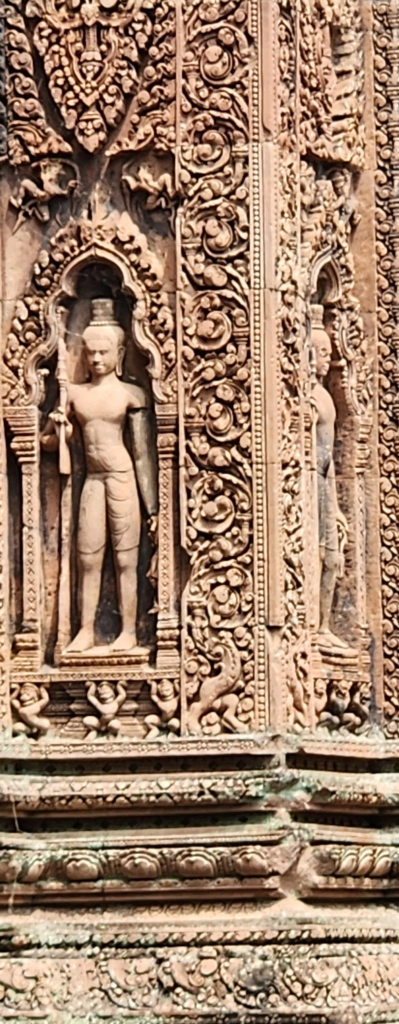
Another fascinating architectural mystery lies in the false doors amongst the temple structures.
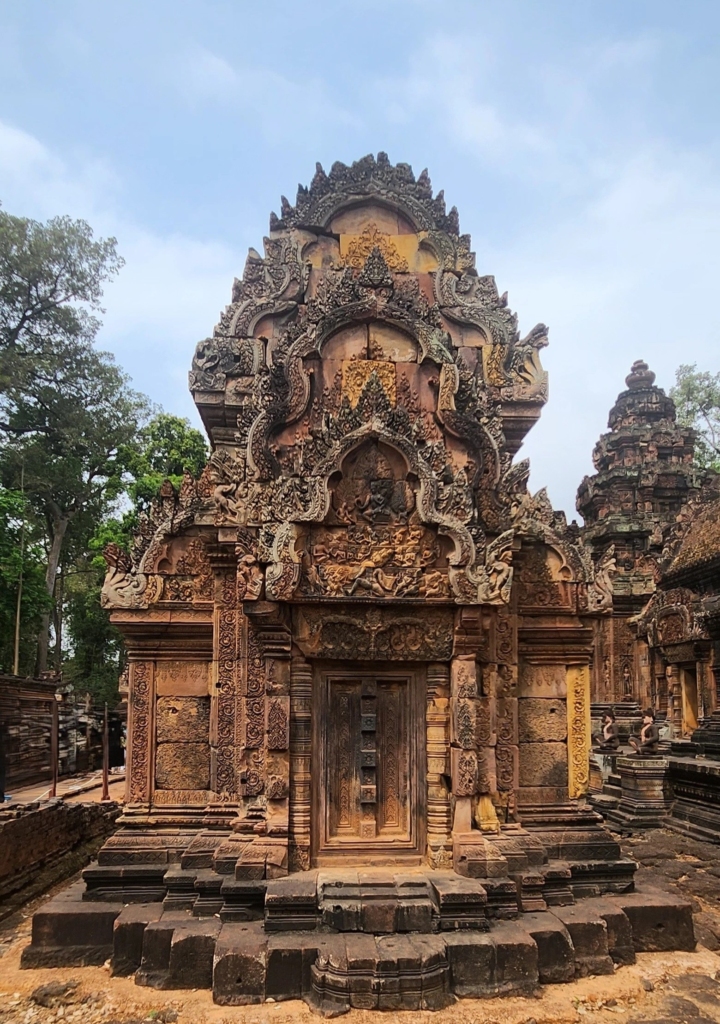
These doors are so meticulously carved, with such a realistic three-dimensional effect, that you almost feel compelled to open and walk through them.
But why create doors that can’t be opened? Was it symbolic, representing a gateway to the divine realm? Or did it serve a more practical or ritualistic function now lost to time?
We may never know, but I would give anything to rewind history and witness the construction process firsthand.
As I stood there, surrounded by these ruins that had outlived empires, I realized this wasn’t just a visit—it was a conversation with history itself.
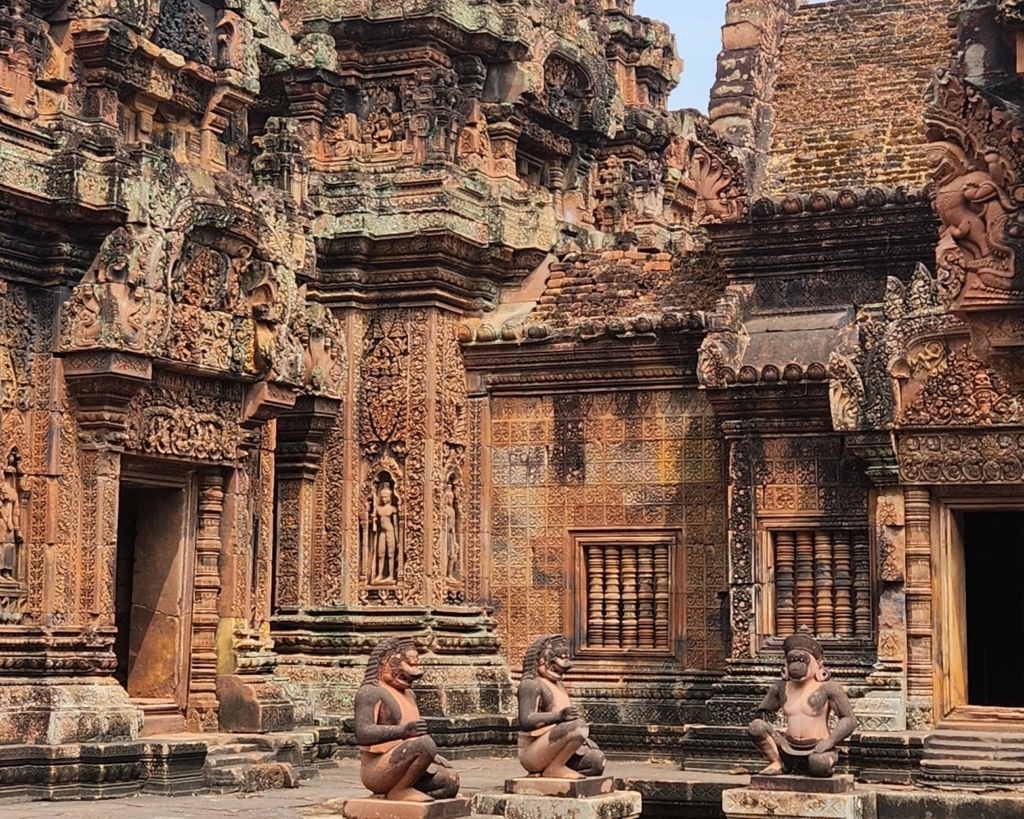
Most temples in Cambodia have Dvarapalas—armed temple guardians—usually in the form of lions. But here, Banteay Srei stands out yet again. The Dvarapalas at this temple take different forms, possibly depicting:
- Hanuman, the devoted disciple of Lord Rama
- Garuda, the mighty eagle mount of Vishnu
- Narasimha, the fierce lion-man incarnation of Vishnu
Each of them sits watchful and unwavering, protecting the sanctity of the temple.
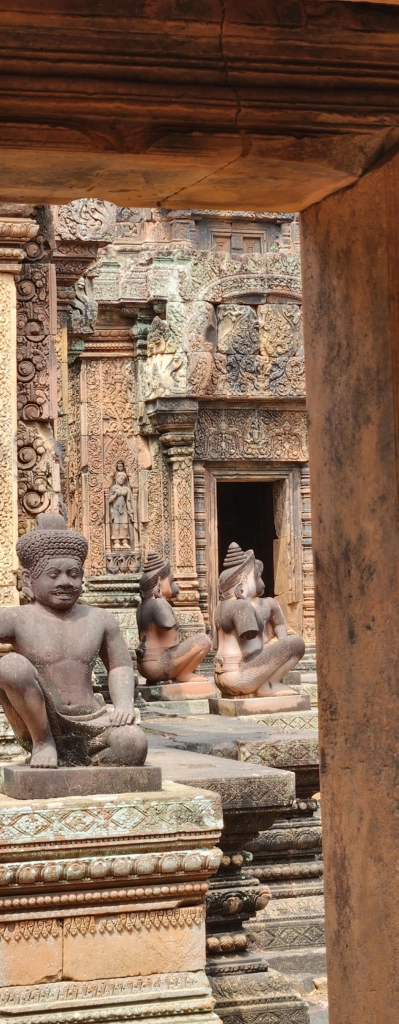
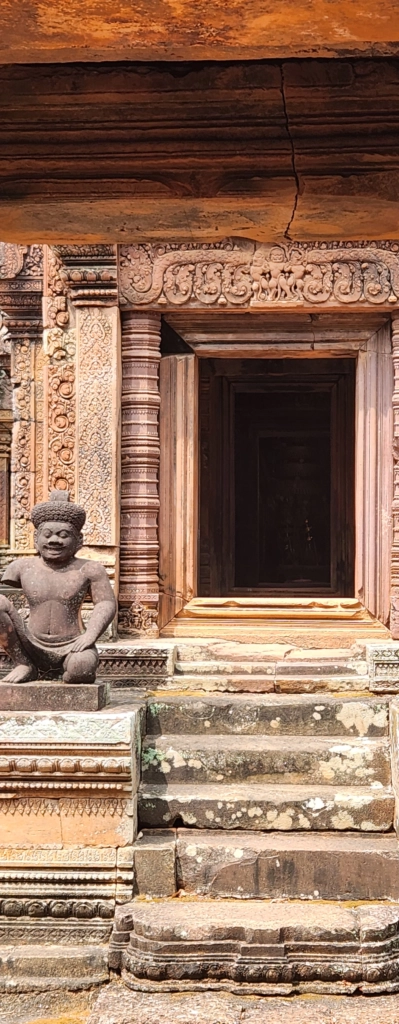
While every Khmer temple carries traces of Indian influence, Banteay Srei is the only complex where I felt a strong blend of two distinct architectural styles—Indian and Oriental. Perhaps both local and Indian craftsmen worked on this project, fusing their artistic traditions into something entirely unique. Yet, for all its grandeur, Banteay Srei eventually disappeared from public memory, swallowed by dense jungle until its rediscovery in 1914. Given its miniature dimensions, it’s easy to see how the overgrown vegetation could have completely hidden it from sight for centuries.
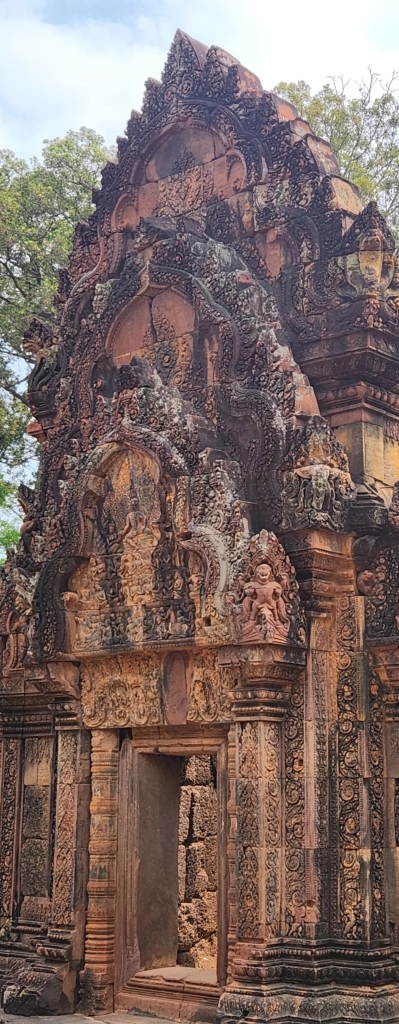
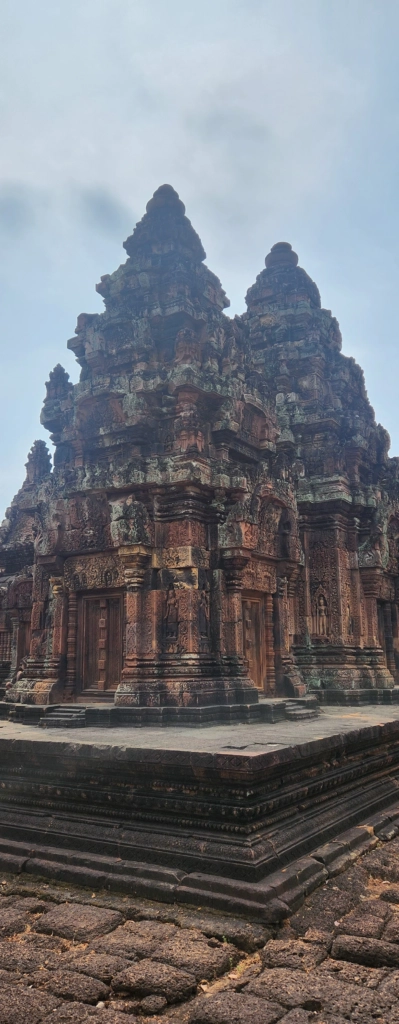

If you’re in Siem Reap, don’t make the mistake of skipping Banteay Srei. It may not have the size of Angkor Wat, but its beauty lies in its detail. A temple that proves that sometimes, the smallest wonders leave the biggest impressions. Don’t Miss This Hidden Gem!
With the morning already packed with stories, nostalgia, and ancient wonders, we had the rest of the day ahead—ready for more unexpected discoveries.
Mountain Trek to Kbal Spean: An Unexpected Gem
Banteay Srei – Kbal Spien: 12 km. / 15 min.
Somehow, Kbal Spean managed to sneak its way onto my itinerary, and honestly, I couldn’t be happier that it did! Sieng, my trusty guide, was just as surprised by the short-list, but he gamely went along for the adventure. Now, let’s be real—Kbal Spean isn’t exactly the hot spot for most run-of-the-mill tourists. Perhaps it’s the 2 km uphill trek that keeps the crowds at bay. But trust me, that gradual gradient at the start of the trail, leading up to the majestic
Kulein Mountain, is a sneaky little challenge.
Here’s your early warning: only include this trek in your travel plans if you’ve got a decent fitness level and are up for a moderate challenge for about an hour each way. And don’t even think about hitting the trail without sturdy footwear! Staying hydrated is key, so pack plenty of water—refreshments and other conveniences can only be found back at the parking lot.
Upon arriving at Kbal Spean’s parking lot, Sieng double-checked to see if I was still game to tackle the uphill trail. There’s a clever setup along the route with markers showing how far you’ve come and how much further you’ve yet to go—what a brilliant idea! At first, the trek felt like a piece of cake, but halfway up, I was panting and reconsidering my life choices. Thankfully, Sieng had my back, encouraging me to take it slow, savor the journey, and rest on the boulders whenever I needed to. There’s even a charming little rest area nestled in the woods, where you can find some shade and relax.
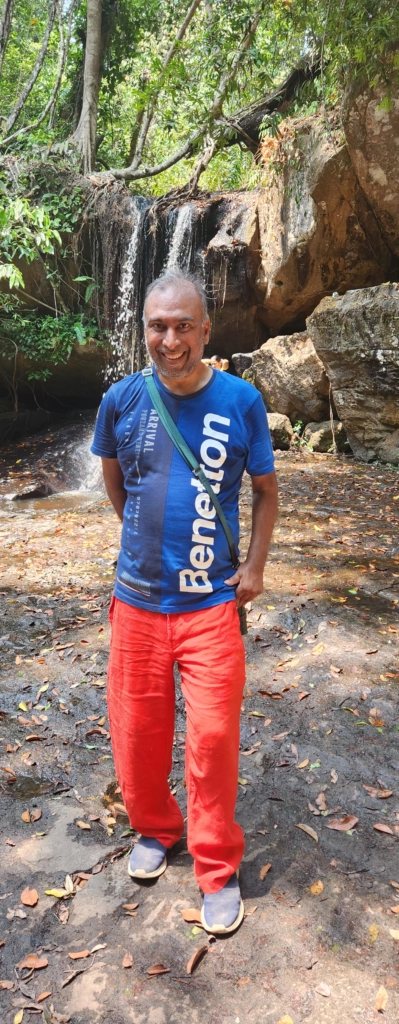


The forested trail is absolutely stunning—the air filled with the cheerful chirping of birds, and the occasional stunning view of the plains peeking through the trees.
Finally, we reached our destination: a breathtaking waterfall! A lively group of locals were having a blast bathing under the falling water, and for a moment, I was tempted to join them. But alas, we hadn’t packed a change of clothes, so I had to settle for enjoying the view. Just a heads up, the rocks around the waterfall can be slippery because of moss, and I witnessed a young kid take a tumble—fingers crossed she bounced back quickly!
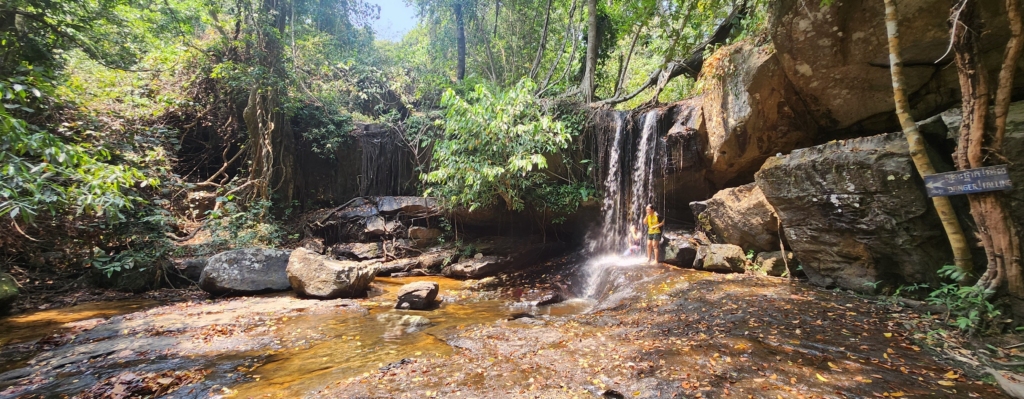
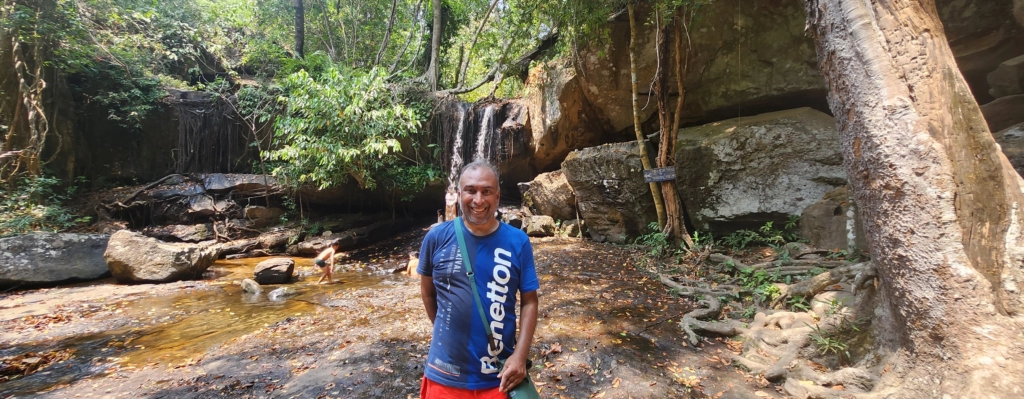
We settled near the waterfall, soaking in the tranquil atmosphere while colorful butterflies danced around us like little jewels in the air. One stood out in particular—a brilliant butterfly with bright blue wings. It got me thinking about how rare such vibrant colors are in the animal kingdom—kingfishers come to mind as one of the few other examples I know of!

As we strolled along a quaint walkway hugging the edge of the waterfall, I was drawn by the gentle gurgle of the river. With early summer gracing us, the normally boisterous river had settled into a gently flowing stream, a cozy trickle weaving through the lush jungle. What made this spot even more fascinating? It’s all under the careful watch of archaeological supervision, preserving its rich history.
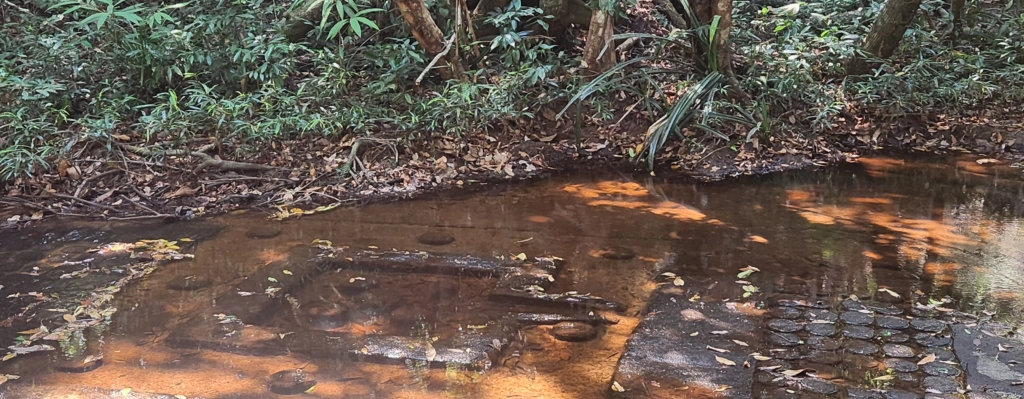
Ascending the staircase and veering a few meters along the riverbank, I found myself submerged in the cool, crystal-clear waters of the stream. There, nestled in the dark sandstone riverbed, were circular, worn-out bumps—stone sculptures that beckoned with intriguing stories. These were no ordinary rocks; they represented lingams, the essence of the Hindu god Shiva.
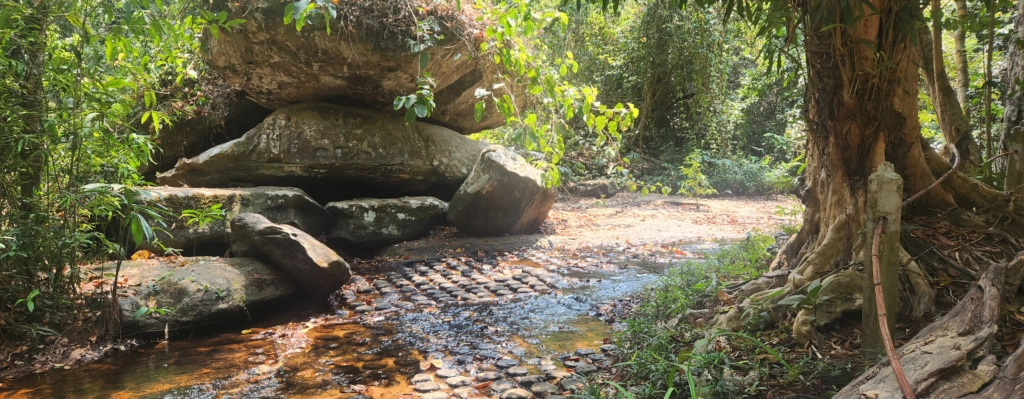
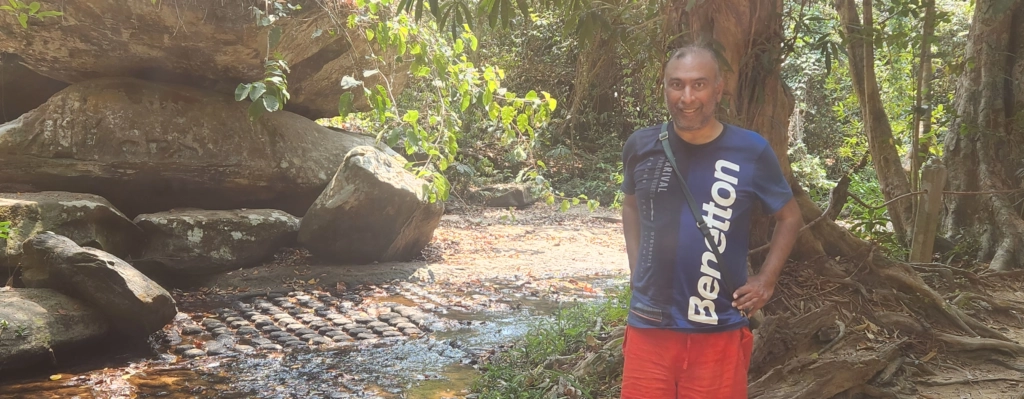
My eyes widened at the sight—thousands of these carvings, of a uniform size and arranged in meticulous grid patterns, covered the riverbed, paired with yoni, symbolizing the goddess Shakti. Together, the lingam and yoni embody the divine dance of creation and regeneration, the harmonious union of feminine and masculine energies.
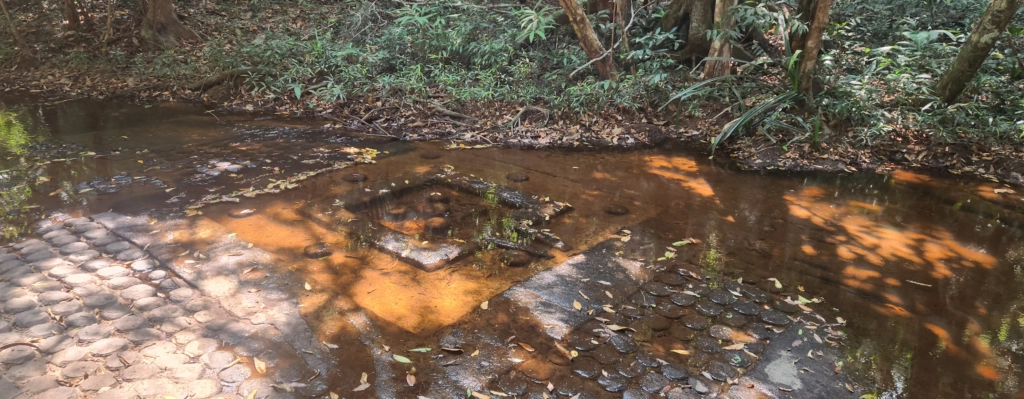

Kbal Spean is nothing short of breathtaking, often referred to as “a spectacularly carved riverbed, set deep in the jungle just outside Angkor”. The sandstone formations cradle an array of architectural gems depicting scenes from Hindu mythology, earning the moniker “River of a Thousand Lingams”. These sacred carvings, each integrated into the very bank and riverbed, come alive with water sparkling over them, emphasizing their significance. On days like this, when the water levels dip, hidden inscriptions peek through, adding an element of mystery to the allure.
Marveling at these delicate carvings, surrounded by the cheerful chatter of birds and the gentle babbling of the stream, filled my heart with a joy I hadn’t anticipated. All the sweat and struggle of the trek were instantly worth it in this enchanting forest sanctuary.
The Kbal Spean river, which meanders serenely over these thousand lingams, rises in the Kulein Mountains and flows downstream into the Siem Reap River, eventually cascading into the majestic Tonle Sap Lake, before winding its way through the plains and the awe-inspiring Angkor temple complex. Legend has it that the Siem Reap River is blessed as it courses over the sacred lingams, a flow of divinity.
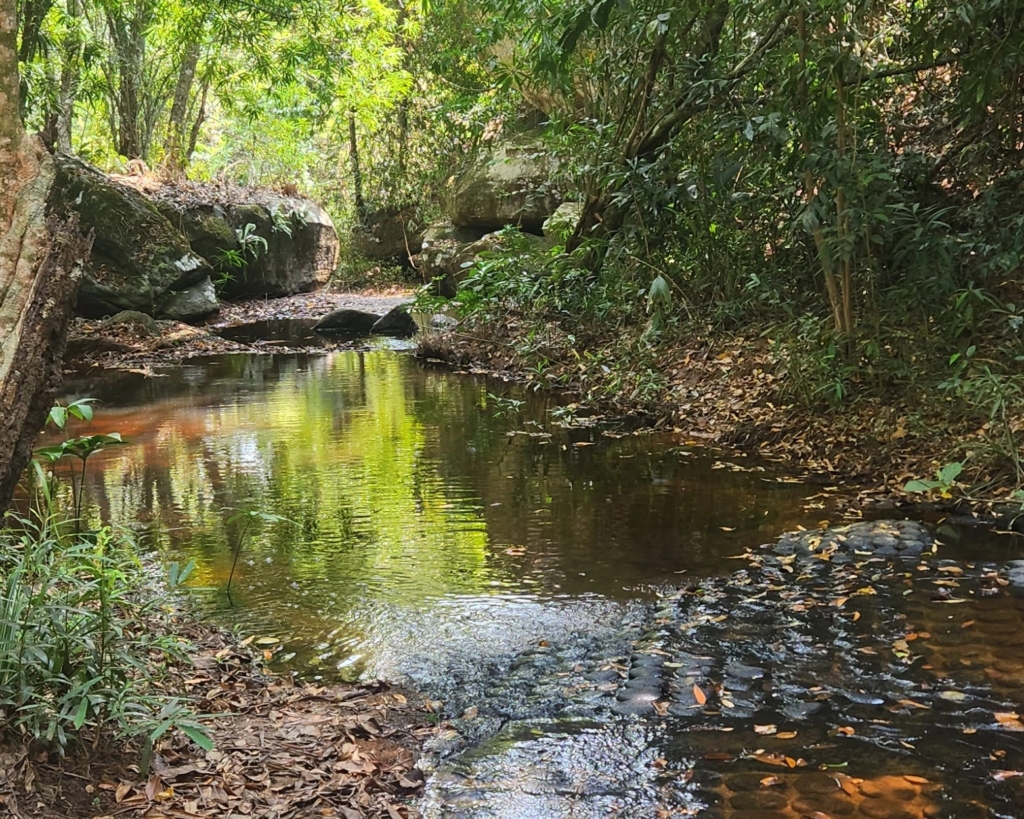
A little further upstream, I encountered the natural sandstone bridge that lends Kbal Spean its name—Khmer for “bridgehead”. Here, the riverbanks came alive with more mythological motifs and bas-reliefs, intricately carved into the rock. The 11th-century artistry depicted the Hindu trinity: Brahma, Vishnu, and Shiva. In one spellbinding relief, I spotted Vishnu reclining with Lakshmi on the serpent Ananta, while Shiva was captured in a tender moment with Parvati, seated upon the bull Nandi. And there was Brahma, gracefully perched on a lotus, emerging from Vishnu’s navel.
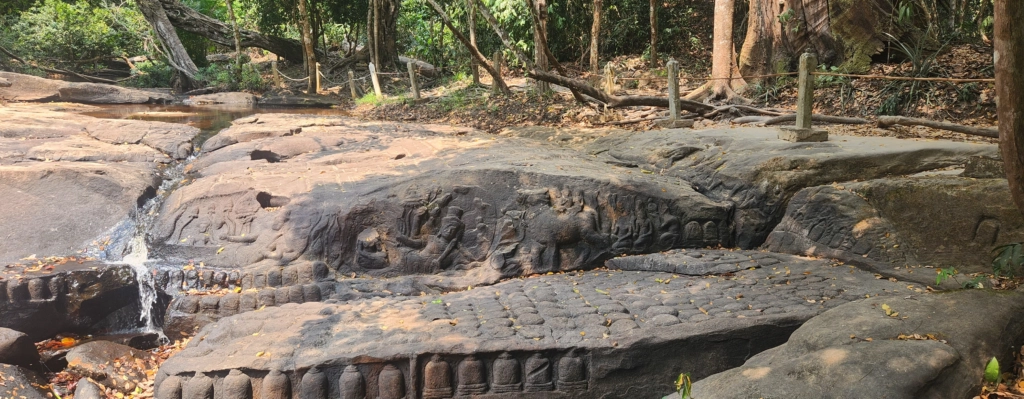
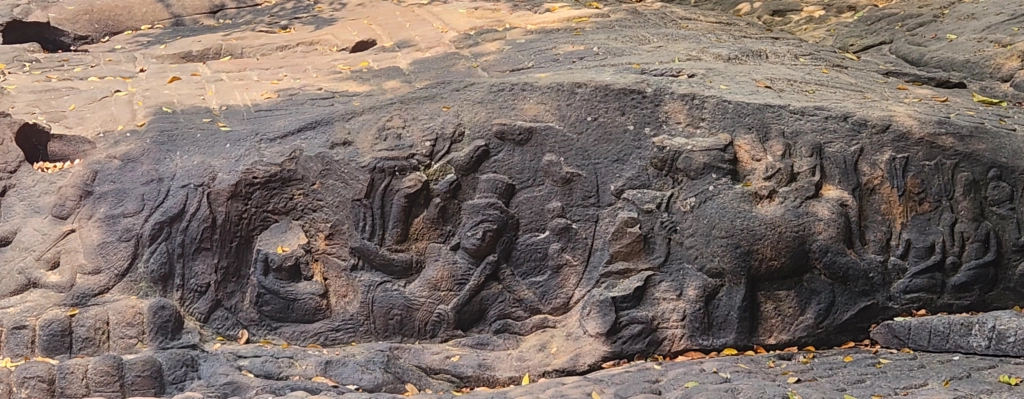
As I meandered further along the carved wonders of Kbal Spean, my eyes landed on a striking depiction of a crocodile, its tail gracefully held by a woman. In the rich tapestry of Hindu mythology, this crocodile—affectionately known as “Makara”—is no mere reptile. It’s a symbol of divine power, a steadfast guardian of gateways and water bodies, and even serves as the majestic mount for river goddesses like Ganga. For the ancient Khmers, the hills surrounding me echoed the magnificence of the Himalayas and the revered Ganges, making this spot truly sacred. Witnessing these divine figures, intricately etched in stone amidst waterfalls, chirping birds, and the embrace of the jungle was nothing short of magical. It felt as if time paused, allowing me to absorb the beauty and significance of this sacred space—an unexpected treasure along my journey.

Contemplating the evolution of Hindu sculptures in Southeast Asia, especially here in Cambodia, it struck me like a bolt of inspiration. I couldn’t shake the thought that local artisans, perhaps alongside Indian traders, traveled to India, soaking in the art, history, and mythologies before bringing it all back home. If it had been Indian artisans sculpting these deities, their features and designs would’ve taken on a distinctly Indian flair. Just a little theory I’ve concocted about the flourishing of one of the world’s most magnificent civilizations!
Descending the hill, however, proved to be more taxing than the ascent. With each step, it felt as if gravity had taken on a personal vendetta against my knees. I paused more often, soaking in the sights and savoring the last moments of my jungle adventure. Sieng must have tested his patience with my frequent breaks, but the beauty around made every bit of effort worthwhile. By the time we reached the parking lot, I was positively parched and famished. I quickly ordered some refreshing fruits—finding a vegetarian meal outside the city seems to be a bit of a quest in itself!
So, if you ever find yourself pondering a trek that isn’t on everyone’s radar, consider Kbal Spean. It’s a hidden treasure waiting for those intrepid enough to seek it out!
Once back at my homestay, nestled in the early evening glow, my Cambodian-Burmese hosts treated me to a light lunch that hit the spot. I barely registered my head hitting the pillow before I succumbed to an enticing nap, recharging my adventurous spirit.
Around eight, my stomach let out a grumbling protest, demanding attention. At the front desk, a sprightly young boy waved me over and called for a tuk-tuk, whisking me off to an Indian restaurant near the bustling Pub Street. The city, which had slumbered like a dormant serpent during the day, was ablaze with vibrant energy now—think fiery dragon, ready to dazzle!
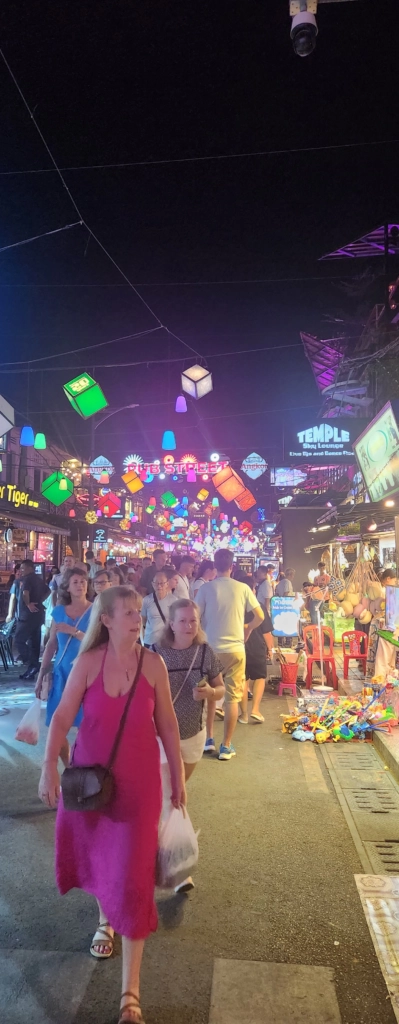
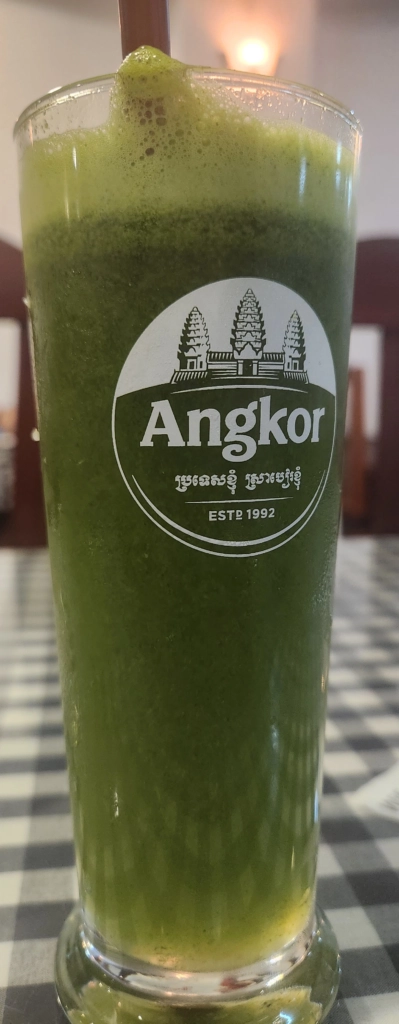
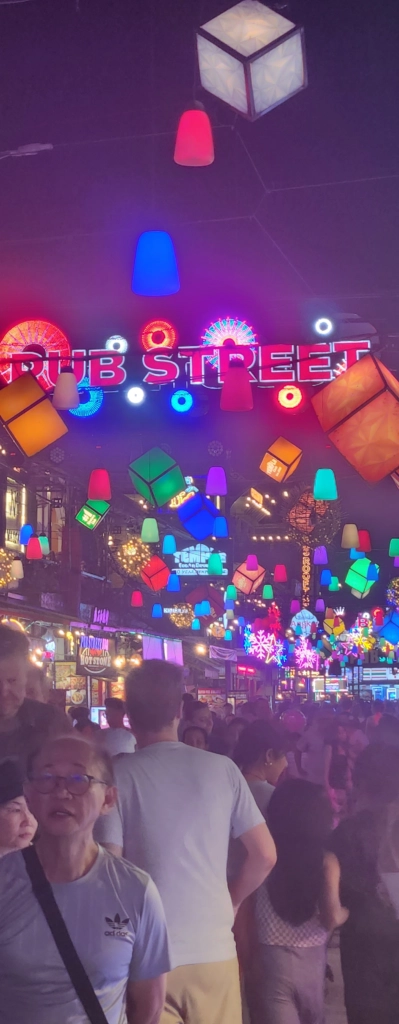
The Indian feast was a welcome embrace of flavors that reignited my energy, transforming me from weary traveler to enthusiastic wanderer once more. With a bounce in my step, I decided to walk back to my homestay, soaking in the lively atmosphere and glancing in at the various pubs and massage centers lighting up the night. Each corner pulsed with life, laughter, and the spirit of adventure—a fitting end to a day filled with exploration and enchantment.
March 2024
If you’re planning a trip to Angkor Wat / Siem Reap or travel through Cambodia, we at HappyHorizon would be thrilled to curate your holiday plans to enhance overall travel experience. Feel free to reach out to us: connect@happyhorizon.in
Day 5: Coming Soon!
Gallery
Sukumar Jain, a Mumbai-based finance professional with global experience, is also a passionate traveler, wildlife enthusiast, and an aficionado of Indian culture. Alongside his career, which includes diverse roles in international banking and finance, he's working on a wildlife coffee table book and enjoys sculpture and pottery. His interests span reading non-fiction to engaging in social and global networking.