
Day 9: Umling La – Read More
Day 10 (Part 1): Puga Valley
Hanle – Loma – Nyoma – Mahe – Sumdo – Puga Hot Spring: 115 km. / 3 hr. / Altitude: 14,000 ft. (Puga)
Hanle – Goodbye!
As dawn broke over Hanle, it was time for us to bid goodbye. Kaisang’s children were still asleep, their dreams unbroken as we loaded up. Although our tank could carry us to the next station at Nyoma, Danish erred on the side of caution, buying a few extra liters of petrol from a local vendor. With a steep 50% markup, it was the most extravagant purchase of our entire Ladakh journey, but a peace of mind was worth every rupee.
Before heading out, we made one last stop at the Milky Way Café, ordering our usual tea and coffee – a final toast to this quiet haven. The drive to Loma was uneventful; no villagers by the roadside in need of a lift, nor wild asses or herds of Pashmina goats to interrupt our path, aware that with each passing mile, Hanle was already slipping into memory. Still, the road kept us alert with its occasional roller-coaster dips and sharp inclines Navigating these drops would be treacherous in the dark, and it served as a firm reminder that Ladakh’s roads are best explored before sunset.

Nyoma: Changthang Valley
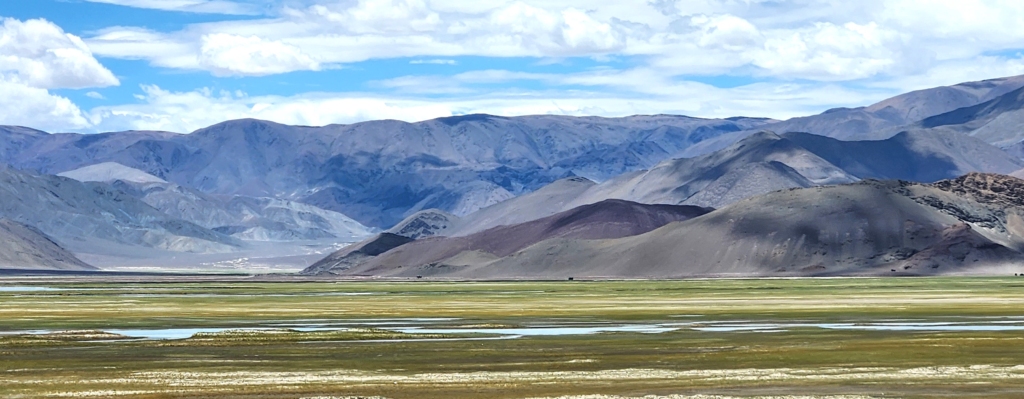
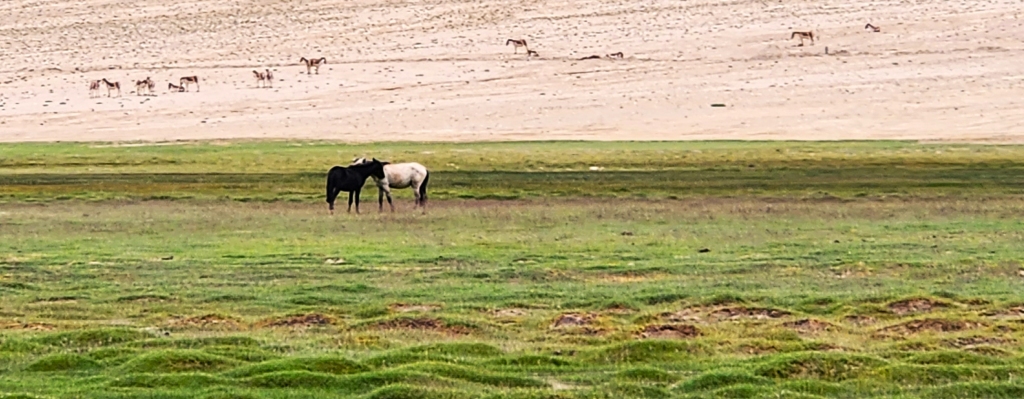
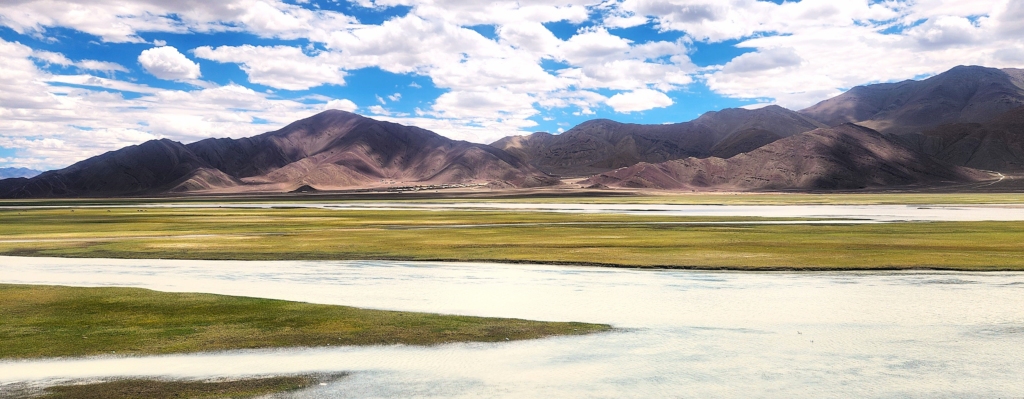
We had considered an alternate route to Karzok via Chumur, which would have led us through the lesser-travelled passes of Salsal La and Charchagan La, bypassing Loma altogether. But Danish preferred the familiarity of the tarred route, so we traced our steps back along the Indus River, which joined us at Loma and flowed faithfully beside us, revealing new shades of blue and green at every twist and turn. Reaching Nyoma, we filled up the tank, letting the stunning pastels of the Changthang Plateau unfold around us. The vast, flat land stretched endlessly, with the Indus winding through pastures dotted by peacefully grazing cattle.


In the distance, we spotted a small village, its gompa nestled against the hills. The subtle allure of the Changthang lay not just in its colors, but in its gentle quiet – a vastness unbroken but for the distant sound of a yak bell or the whisper of the river.
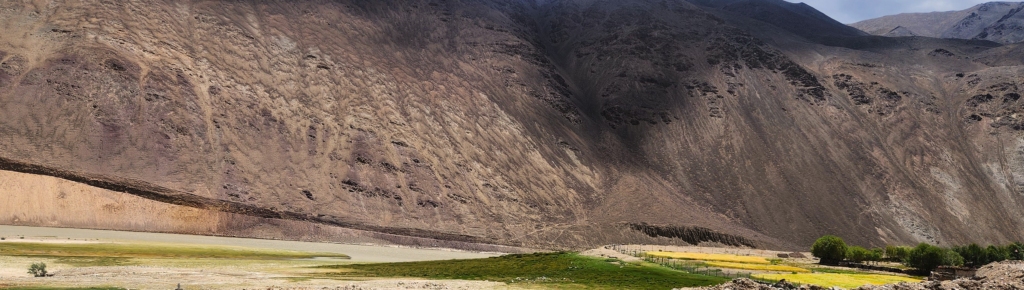
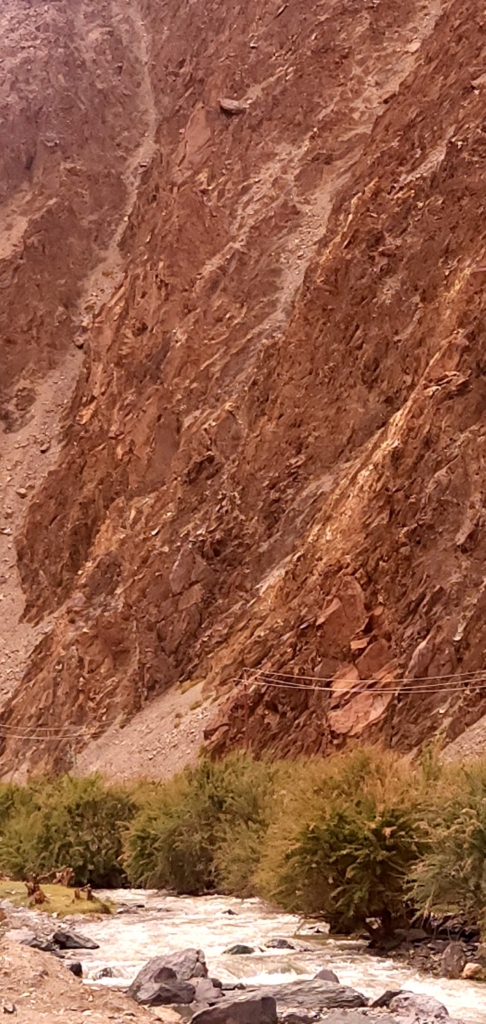
The exit toward Sumdo from Mahe was unmarked, it could be easily missed. Luckily, a check-post confirmed we were on track, and we crossed the Indus via a narrow bridge. The road from Mahe to Sumdo cut through rugged mountains, with a small stream running alongside, mirroring our solitary journey. Our only company the steady rumble of tires on gravel. Ladakh’s roads have a way of reminding you just how remote you are, and away from the popular tourist paths, you’re often left alone with only the wild nature for company.

Puga Hot Spring (Rushpo Valley)
At Sumdo, a tri-junction met us with choices: the left road beckoned toward Tso Moriri / Karzok, while straight ahead lay Puga, eventually connecting to the Leh-Manali highway via Tso Kar. The entire area which lies nestled between the serene lakes of Tso Kar and Tso Moriri, to the west of Mahe is known as Rushpo Valley. The valley is itself part of Changthang Plateau.
The name “Puga”, derived from the Tibetan word “pug-pa” meaning “the end of the mountains”. With mountains (although very small comparatively) all around, I wondered about the aptness of the name or it’s translation. We paused here, just for a moment, absorbing the tranquil, sprawling beauty. With patches of colourful wildflowers scattered across the grass, the valley had come alive in vivid hues against the soft green valley.
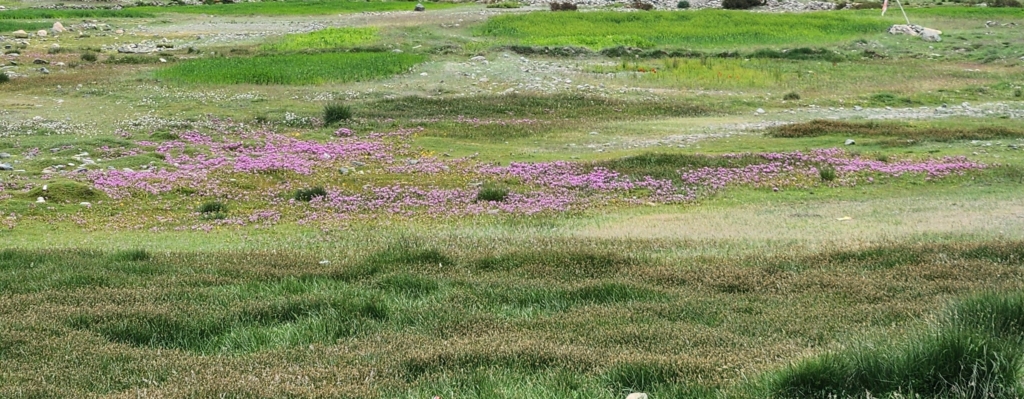
The wildflowers reminded me of a romantic couplet written by Urdu poet Mirza Ghalib:
jahāñ terā naqsh-e-qadam dekhte haiñ
ḳhayābāñ ḳhayābāñ iram dekhte haiñ
These poetic lines translates to “Wherever I see the traces of your footsteps, Every garden appears like the paradise of Iram”. In this couplet, the poet elegantly compares the beloved’s presence and the mythical paradise of Iram, suggesting that any place touched by their steps becomes as enchanting as paradise itself. In Urdu poetry, Iram refers to the legendary paradise or garden of unimaginable beauty.
The metaphor also hints at the idea that true paradise is not a distant, unattainable realm, but rather something brought to life by the presence of love itself.
We made a spontaneous call to detour to Puga Hot Springs before pressing on to Karzok. I had expected a small pool-like setup here, similar to Panamik, but Puga had surprises waiting. The road meandered through lush green fields dotted with peacefully grazing cattle, the scenery painting a gentle contrast to the rugged hills in the distance. Soon enough, we began noticing chemical deposits sprinkled along the roadside – an earthy hint of the geothermal wonder we were approaching.
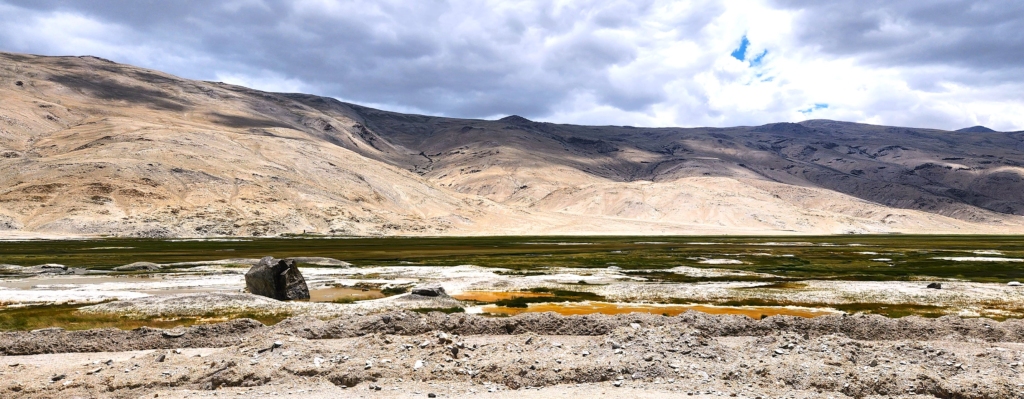
The Puga Valley is also famed for its rich borax (white chemical) deposits, lending a practical significance to this otherwise surreal landscape.

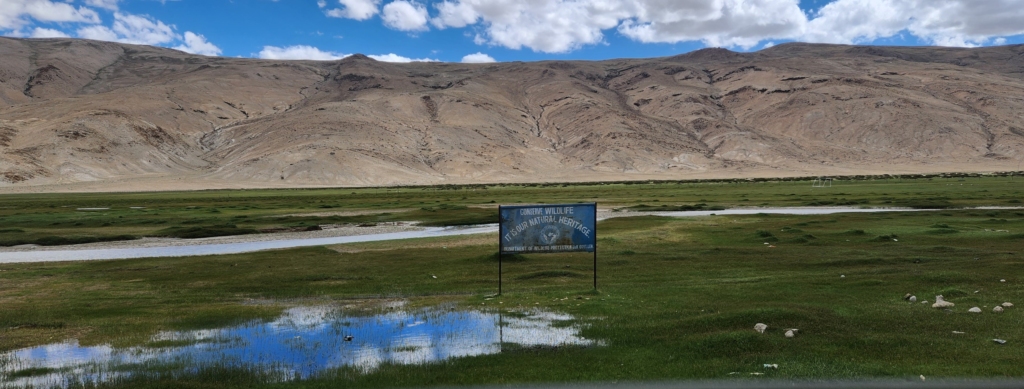
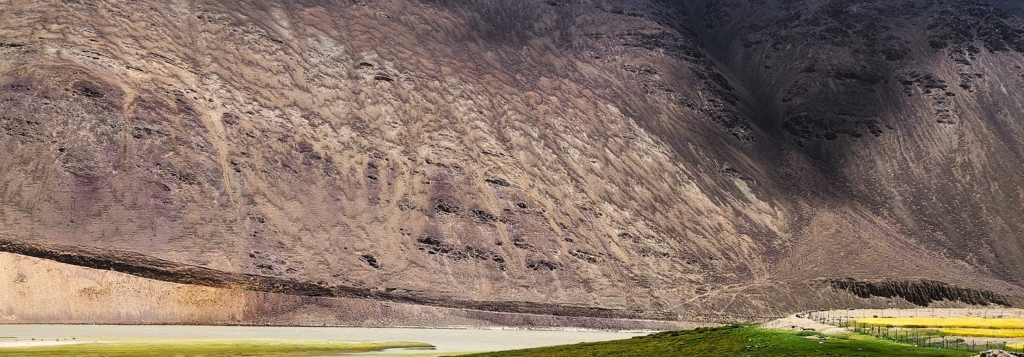
Stopping at a small dhaba to ask for directions, we were in luck – this was exactly the spot to set out toward the hot springs. Across a narrow stream lay an expansive grassland stretching to the foot of the barren mountains. The valley’s landscape, both stark and stunning, felt like a scene from another world. We found a shallow crossing in the icy stream, dipping our toes into the cold mountain water – a refreshing first for our Ladakh journey.
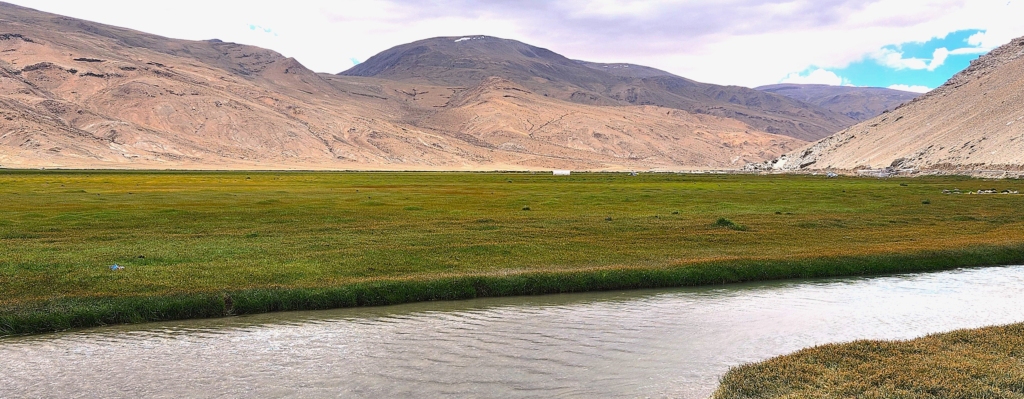
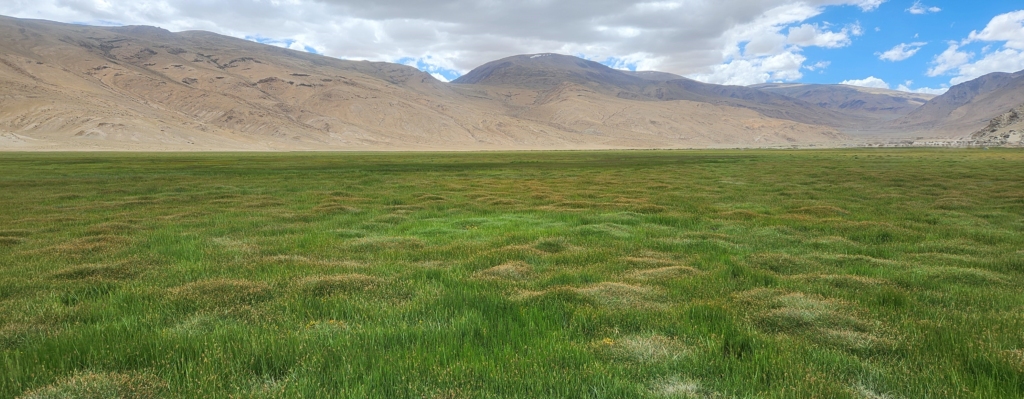

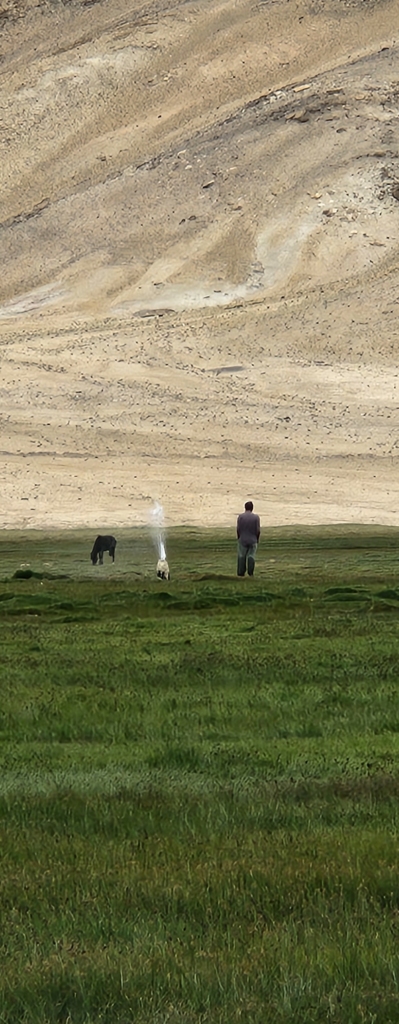
Ahead, the hot spring’s waters bubbled up from the ground in the heart of this vast, green expanse. Puga Valley, part of the Himalayan geothermal belt, revealed its extraordinary nature as we set foot on the grassland.
Walking here was a mindful journey – beneath the grass, marshy patches could plunge nearly two feet deep. Anyone venturing here, especially children or shorter folks, have to navigate carefully.
The warm water spilling from the hot spring created a marshy ecosystem, giving rise to this peculiar terrain. To one side, the icy stream flowed, and right alongside it, the grassland was warm and soft, almost as if nature itself had divided the valley into contrasting elements.
The grassland’s topography itself was striking. Small hummocks dotted the pasture, giving it the appearance of a vast landscape with goosebumps.
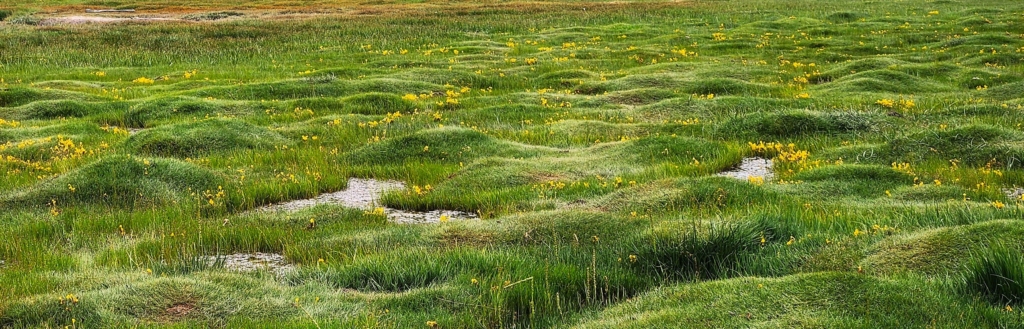

Pro Tip: Leave your shoes in the vehicle, roll up your pants or wear shorts above the knee. Walk slowly, one step at a time, and it’s best to stick together in a group – both for safety and to truly savour the wonder of this surreal landscape. The safest path to Hot Spring through the grassland was along the dry hummocks, which offered a firm grip and safe passage, perfect for capturing some uniquely scenic photos.

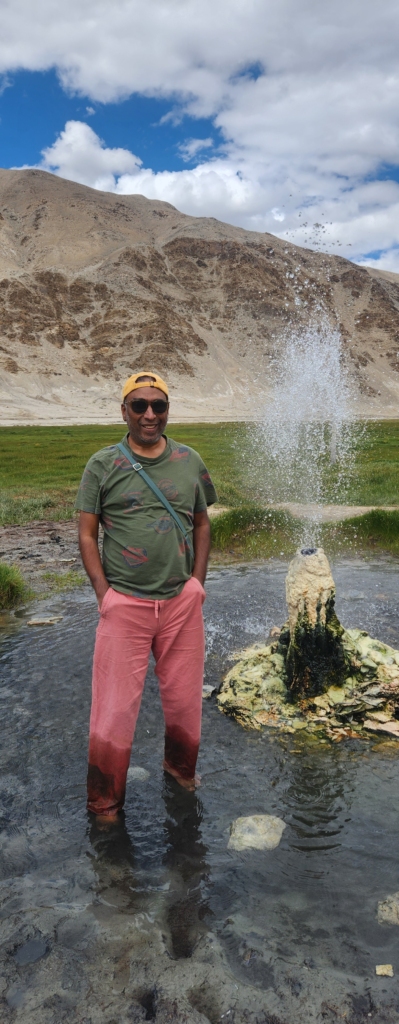
After skillfully navigating through the marshy terrain, we finally arrived at the hot spring. No clear, marsh-free path led to it, but the trek became an enjoyable adventure, each of us finding our way through the gentle quagmire. The bubbling pools and steaming sulphur springs make Puga Valley a truly fascinating destination – a geothermal treasure hidden in Ladakh.

At the heart of it all, a small vent in the ground spouted hot, sulphur-laden water, surging upward in boiling jets. This was no ordinary hot spring but rather a geyser, defined by its bursts of steam and heated water. Unlike hot springs, which continuously release warm water, a geyser like this erupts at intervals, a spectacle in itself.
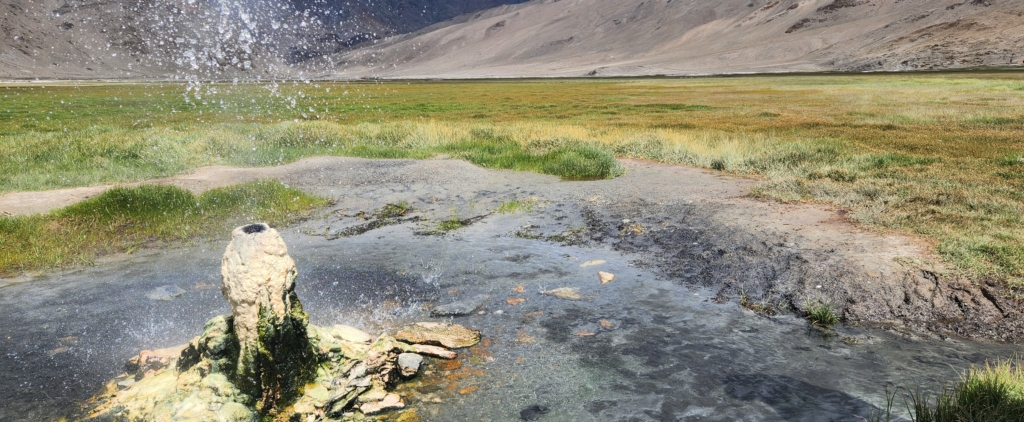
Standing there, I couldn’t help but wonder how this boiling water endures the freezing grip of Ladakh’s winter – who prevails in this duel of fire and ice?

Lunch @ Puga
After exploring, hunger struck, and we drove on, hoping to find a bite. A modest eatery soon appeared on the roadside, though its lunch options were nearly exhausted. The kind owner, however, boiled some eggs for Danish and cooked Maggi noodles for me. As we waited, we picked up some biscuits, settling in at a small table. Just then, a young girl and her mother entered and ordered Maggi as well. Though I debated offering them some biscuits, I hesitated and eventually decided against it.
Moments later, I noticed the girl whisper something to her mother before heading to the counter to buy a pack of chips. To my surprise, she opened the packet and offered it to us before taking any herself. Her spontaneous kindness struck me deeply. When I offered our biscuits in return, she smiled and politely declined, saying, “meetha aur namkeen ek saath blend nahi hota hai” (translates to: sweet and salt don’t blend together well). As we laughed, the restaurant owner explained it’s a local tradition here to share food with others in the room. This thoughtful gesture spoke volumes of her values, a beautiful reflection of the local culture. She was a student in Leh, back in her village for a weekend break – a simple encounter, but one that left an impression.

Buoyed by the warmth of the valley’s people and its beauty, we geared up to continue on to our next destination, Karzok, with renewed spirits and a lingering smile.
August 2024
If you’re planning a trip to Puga Valley or explore Ladakh, we at HappyHorizon would be thrilled to curate your holiday plans to enhance your travel experiences. Feel free to reach out to us: connect@happyhorizon.in
Day 10 (Part 2): Karzok / Tso Moriri – Read More
Gallery



Sukumar Jain, a Mumbai-based finance professional with global experience, is also a passionate traveler, wildlife enthusiast, and an aficionado of Indian culture. Alongside his career, which includes diverse roles in international banking and finance, he's working on a wildlife coffee table book and enjoys sculpture and pottery. His interests span reading non-fiction to engaging in social and global networking.